

The primary factor separating a successful IoT integration from a pile of disconnected parts is architectural knowledge. My analysis of these seven options draws on aggregate buyer sentiment to determine which tools actually bridge the gap between hardware and the cloud. I believe that ignoring the software strategy behind your connection is a mistake. Let us examine how these components rank when building a robust Raspberry Pi ecosystem.
Get Amazon Prime free for 30 days before you order
Get more out of every purchase on this page, at no cost during the trial.
After the trial, Amazon Prime is $14.99/month (plus tax). Cancel anytime. Students and ages 18–24 can save 50%, and a discounted plan is available for qualified government assistance. We may earn a commission if you sign up.
1. GeeekPi Micro Connectors 40-pin GPIO 1 to 2 Expansion Board for Raspberry Pi, 2 x 20-pin Strip Dual Male Header Double Row Straight GPIO Connector Pin Header Compatible with Raspberry Pi(2Pack)

This board takes the top spot for GPIO expansion because it solves the common frustration of limited physical ports on a single board. It provides a straightforward, no-frills method to split your header pins without requiring complex soldering or external power bricks.
In my view, this is the most reliable way to add sensor arrays or secondary modules to a project that has already run out of space. The main limitation is that you must be careful about power draw, as splitting a signal does not magically multiply your available electrical current.
Buyers appreciate the simplicity of this dual header design for small projects.
The lack of bulky circuitry makes it a clean addition to tight enclosures.
Users often report that the pins maintain a solid, reliable contact over time.
Get It From Amazon Now: Check Price on Amazon & FREE Returns
2. Raspberry Pi Zero to Pi 3B/3B+ Adapter, Connect Raspberry Pi Zero/W/Zero 2 W to Replace Raspberry Pi 3 Model B/3B+, Compatible with Pi 3B/3B+ Hats, Support 1-CH RJ45 Ethernet Port, 10/100 M Adaptive

This adapter is best for users who are working with a Pi Zero but desperately need the legacy hardware compatibility of a 3B model. It effectively allows you to migrate your software logic to a more compact form factor while retaining an Ethernet port for stable networking.
I find this to be a clever workaround for those who need wired stability in a remote sensing setup. You should keep in mind that the added bulk of the adapter might defeat the purpose of using a tiny board in the first place.
People choose this primarily to keep their existing HAT configurations functional.
The inclusion of an RJ45 port is frequently cited as its most valuable feature.
Some users note that the physical footprint increases significantly once attached.
Get It From Amazon Now: Check Price on Amazon & FREE Returns
3. GeeekPi Micro Connectors 40-Pin GPIO 1 to 2 Expansion Board for Raspberry Pi, 2 x 20-Pin Strip Dual Male Header Double Row Straight GPIO Connector Compatible With Raspberry Pi

An unexpected, yet useful feature here is the ability to create a stacked configuration for your headers, which is perfect for managing complex wiring without clutter. It acts like a multi-lane highway for your data, keeping signals distinct while you attach multiple peripheral devices.
I think this is an excellent choice for hobbyists who want to keep their prototyping breadboard tidy. It does require a bit of manual planning to ensure the pinouts are correctly mapped on both sides.
The dual header layout is highly regarded for its ability to clear up cable mess.
Buyers note that the build quality is sufficient for frequent project changes.
It is often selected for its ability to double the available connection points.
Get It From Amazon Now: Check Price on Amazon & FREE Returns
4. Wonrabai Official CSI FPC Flexible Cable Compatible with Raspberry Pi 5, 22Pin to 15Pin, Suitable for CSI Camera Modules, 500MM/50CM/1.64 FT
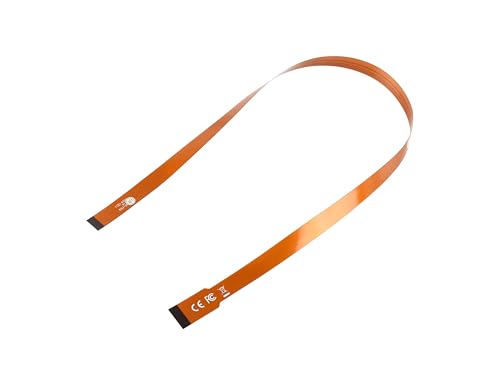
The most frequent complaint with this cable involves the sensitivity of the ribbon connector, which can be brittle if you are not careful during installation. Despite this, it remains a standard choice for those who need to position a CSI camera away from the main board.
I would suggest being very gentle when locking the ribbon into place. It is a simple, effective tool as long as you treat the interface with the care it requires.
Users often remark that the length is ideal for custom camera housing.
The connection pins are noted for being accurately spaced for the Pi 5.
Buyers warn that the cable does not handle sharp bends very well.
Get It From Amazon Now: Check Price on Amazon & FREE Returns
5. 915MHz SPI LoRa IoT Project HAT for RPI Raspberry Pi PICO 2 W PICO2 Starter Kit RP2040 RP2350 Expansion Board Programming Coding Accessories

Compared to the camera cables listed above, this LoRa HAT is a far more specialized piece of equipment designed for long-distance data transmission. It serves those who need to bypass standard Wi-Fi limitations by using radio frequency signals to transmit IoT data.
I think this is a fantastic tool for remote telemetry, provided you have the technical patience to configure the SPI interface. The documentation can be a bit thin, so you should expect a learning curve.
Enthusiasts value the long-range potential for outdoor sensor networks.
It is frequently purchased by those building decentralized IoT monitoring systems.
Buyers note that the board is quite compact for the amount of tech included.
Get It From Amazon Now: Check Price on Amazon & FREE Returns
6. MakerFocus Raspberry Pi Zero Camera Cable 2pcs | Raspberry Pi Zero Ribbon Cable, 15CM, 15 Pin to 22 Pin for Raspberry Pi 5/Zero/Zero W

This cable became a market favorite due to its reputation for being a cost-effective replacement for the official, more expensive ribbon cables. It serves the basic needs of a standard camera setup, though I find that it lacks the heavy-duty shielding of premium options.
It is a solid, functional product for casual projects, but it may show its age if moved frequently. Keep it static, and it will likely serve you just fine.
Many users choose this as a budget-friendly backup for their camera kits.
The 15cm length is commonly described as the perfect size for most enclosures.
Buyers occasionally mention that the locking mechanism feels a bit lighter than expected.
Get It From Amazon Now: Check Price on Amazon & FREE Returns
7. Mastering AWS IoT Core: A Practical Guide to Connecting, Securing, and Managing IoT Devices at Scale

This guide earns the top spot because it addresses the fundamental bottleneck of modern IoT, which is the complexity of cloud-side orchestration. Unlike the physical hardware tools in this list, this resource provides the logical framework needed to actually manage your devices at scale.
In my view, you can have all the hardware in the world, but it remains useless without this level of system understanding. It is the most valuable investment for anyone serious about professional-grade connectivity.
Readers consistently praise the clarity of the explanations regarding security protocols.
It is recommended for those moving from simple scripts to enterprise-level architecture.
The focus on AWS IoT Core is frequently highlighted as a major time-saver.
Get It From Amazon Now: Check Price on Amazon & FREE Returns
Choosing Between Them
For those focused on GPIO expansion, the GeeekPi 40-pin board is a reliable utility, while the LoRa HAT remains the superior choice for long-range data needs. For camera-based projects, I would lean toward the Wonrabai cable for its specific compatibility with newer boards. However, my top recommendation is Mastering AWS IoT Core because it provides the essential knowledge to tie all your hardware together into a cohesive, secure, and functional network.
When building these systems, remember that hardware is only as good as the software strategy you apply to it. Always prioritize learning the cloud architecture before you spend your entire budget on connectors and cables. A well-designed system is built on logic first, and physical components second.
As an Amazon Associate, this site earns from qualifying purchases. Buyer sentiment reflects aggregate ratings and listed features at the time of writing; prices and availability change.

James Morris is a passionate writer and researcher who explores Norse culture, Viking history, mythology, and related products to create helpful guides and reviews for readers.
