
There is something in the bones of Norse mythology that refuses to stay buried. Long before the Marvel Cinematic Universe gave Odin a golden eyepatch and Thor a blockbuster hammer, long before Tolkien borrowed dwarf names from ancient Eddic poetry, and long before video game designers mapped out Yggdrasil on digital canvases, the Norse people of Scandinavia were telling stories so vast, so brutal, and so achingly human that they have never truly stopped being told.
Norse mythology — sometimes called viking mythology or Scandinavian mythology — is not merely a collection of old gods and monsters. It is a complete cosmology, a worldview born from ice and fire, shaped by warriors who sailed into uncertainty and returned singing of fate. At its heart is a philosophy both simple and devastating: the world will end, the gods will fall, and yet the fight is still worth fighting. That defiant courage is why Norse mythology continues to grip the imagination of fantasy writers, game designers, historians, and mythology enthusiasts across the modern world.
Whether you are completely new and want Norse mythology explained from the ground up, a parent looking for norse mythology facts for kids, a gamer hunting for the perfect viking names for your next campaign character, a tattoo enthusiast researching norse mythology tattoo meanings, or a seasoned worldbuilder mining famous norse mythology stories for plot architecture — this guide covers everything. The norse mythology gods and goddesses, the nine worlds, the creatures, the legendary weapons and artifacts, the symbols, the family tree, the timeline, the naming traditions, and the reason these ancient norse legends still matter today. Consider this your complete norse mythology summary, built for beginners and enthusiasts alike.
What Is Norse Mythology? Explained for Beginners
Norse mythology is the collection of myths, gods, legends, and religious beliefs of the ancient Norse people of Scandinavia. As a norse mythology for beginners overview, the most important thing to understand is that this was not mythology in the dusty academic sense — it was a living norse mythology religion, practiced through ritual, sacrifice, poetry, and oral storytelling across what is now Norway, Sweden, Denmark, and Iceland, roughly between the 8th and 11th centuries CE, though the roots stretch far deeper into the pre-Christian Iron Age.
Norse mythology is also called old norse mythology, viking religion, or simply viking mythology. These terms point to something essential: this was the complete spiritual framework of the Norse people, shaping how they understood creation, death, fate, the natural world, and their place within it. Norse mythology beliefs touched every dimension of life — from how warriors understood dying in battle to how farmers interpreted the changing seasons.
The History of Norse Mythology and Its Sources
The history of norse mythology comes to us primarily through two extraordinary texts. The Prose Edda, written by the Icelandic scholar Snorri Sturluson around 1220 CE, is the most comprehensive account of Norse cosmology ever assembled — the single most important norse mythology book for anyone studying the tradition. The Poetic Edda, compiled around the same period from far older oral sources, delivers the myths in raw, powerful verse. Together, these are the foundational norse mythology books, and modern translations of both — alongside Neil Gaiman’s Norse Mythology — are consistently ranked among the best norse mythology books for beginners available today.
Norse Mythology Facts: Core Beliefs
Among the most essential norse mythology facts for understanding the tradition’s beliefs: the Norse did not see death as something to fear but as something to meet with dignity. Norse mythology beliefs held that dying in battle was the highest honor, earning a warrior a place in Valhalla. They believed in fate — in wyrd, the inescapable web woven by the Norns — and that wisdom lay not in escaping destiny but in meeting it with open eyes. They believed the world was alive with supernatural forces, that words held power, that certain objects carried magic, and that the relationship between humans, gods, and giants was one of ongoing, dynamic tension rather than simple hierarchy.
Norse mythology culture expressed these beliefs through poetry, carving, ritual, and above all through storytelling. The skalds — professional Norse poets — were the tradition’s living archive, memorizing and reciting mythological tales at feasts and ceremonies, keeping the stories of the norse mythology gods alive across generations.
Norse Mythology vs Greek Mythology
One of the most illuminating norse mythology facts for beginners is the contrast with Greek tradition. In norse mythology vs greek mythology, the difference is fundamental: Greek gods are largely immortal, comfortable, and positioned above fate. Norse gods know their doom in precise detail — and march toward it regardless. Where Olympus is a palace of divine leisure and political drama, Asgard is a fortress preparing for a war it cannot win. That foreknowledge of failure, and the choice to fight anyway, gives Norse mythology an emotional weight and philosophical honesty that sets it apart from most world mythological traditions.
The Norse Creation Myth: How the World Began
The norse creation myth is one of the most dramatic origin stories in all of world mythology — and understanding it is essential for grasping the logic of everything that follows in the norse mythology timeline.
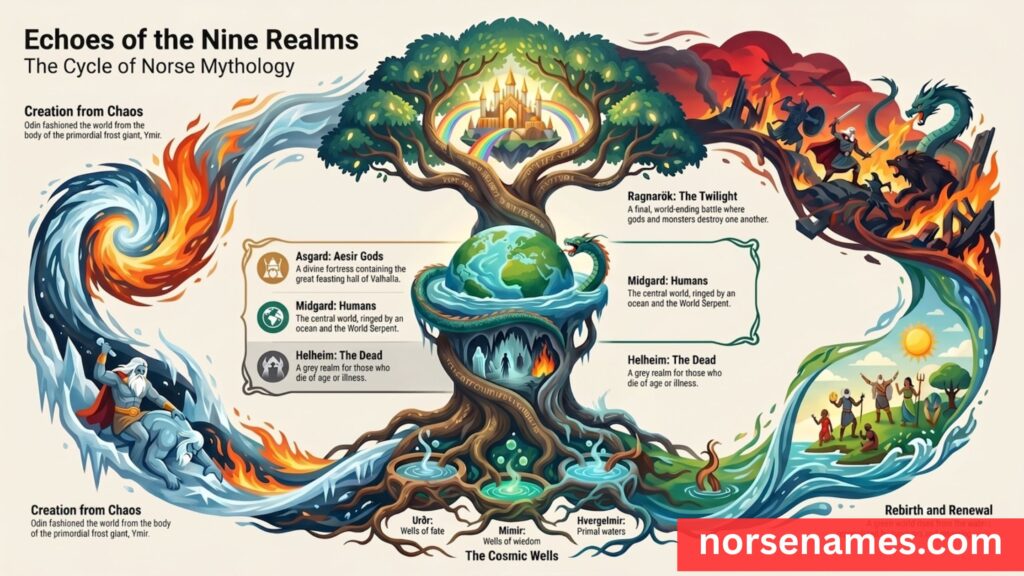
In the beginning, there was only Ginnungagap: a void, formless and silent, stretching between two primal forces. From the north came Niflheim, a realm of ice and creeping mist. From the south blazed Muspelheim, a realm of fire and heat so intense that nothing could survive near its edges. Where these opposites met at the center of the void, ice slowly melted, and from that collision of primal forces rose the first being: Ymir, the first frost giant, enormous and primordial, the raw material from which the world would be made.
From Ymir’s sleeping body came the first giants — a male and female grew from his armpits, and his legs fathered another being between them. From the melting ice also emerged Auðumbla, the great primordial cow, who nourished Ymir with four rivers of milk. Auðumbla herself survived by licking the salty ice blocks of Ginnungagap. As she licked, a new figure slowly emerged from the ice: Búri, the first of the gods. Búri’s grandson was Odin — who, with his brothers Vili and Vé, would reshape the cosmos entirely.
The three brothers killed Ymir. From his body, they fashioned the world: his flesh became the earth, his bones the mountains, his blood the seas and lakes, his skull the dome of the sky, his brain the clouds, and his hair the forests. From the maggots in Ymir’s flesh they made the dwarves, giving them intelligence and craft. They set the sun and moon in the sky and appointed courses for them. They created the first human beings — Ask and Embla, a man and woman found as trees upon the earth — and gave them breath, consciousness, and warmth.
This is the norse creation myth in its fullest form: violent, material, intimate. The universe is not spoken into existence or willed from nothing — it is built from a body. Every mountain is a bone. Every ocean is blood. That is one of the most striking of all norse mythology facts, and it makes the physical world feel sacred and weighted in a way that few other creation traditions achieve.
The Mythological Timeline: From Creation to Rebirth
The norse mythology timeline is one of the tradition’s most powerful structural features — a complete narrative arc running from the void before creation through the age of gods and heroes to the apocalypse of Ragnarök and the renewal that follows. Understanding this chronology is essential to norse mythology explained as a unified system rather than a collection of disconnected tales.
1. Ginnungagap — The Void Before Time Before anything existed, there was only Ginnungagap: the great void between Niflheim (ice) and Muspelheim (fire). This is the starting point of the norse mythology timeline — the silence before the first collision of opposites.
2. The First Beings — Ymir and Auðumbla From the meeting of ice and fire came Ymir, the first frost giant, and Auðumbla, the great cosmic cow. From the ice Auðumbla licked emerged Búri, ancestor of the gods. The norse creation myth begins in earnest here.
3. The Creation of the Worlds Odin and his brothers killed Ymir and used his body to fashion the nine worlds, including Midgard (the human world) and Asgard (home of the gods). They created the first humans, Ask and Embla, from trees found on the earth. The yggdrasil world tree grew to connect and contain all nine realms.
4. The Aesir–Vanir War One of the most important events in the norse mythology timeline, the war between the Aesir gods of Asgard and the Vanir gods of Vanaheim ended in an uneasy peace and the exchange of divine hostages — Freyr and Freya came to Asgard, reshaping the norse mythology gods family tree forever. The aesir vs vanir conflict represents the tension between war and wisdom on one side, and fertility and natural magic on the other.
5. The Building of Asgard’s Walls A mysterious builder offered to construct impenetrable walls around Asgard in exchange for the sun, the moon, and the goddess Freya. Loki, who had agreed to the terms as a joke assuming it was impossible, was forced by the gods to sabotage the work — which he did by transforming into a mare and luring away the builder’s magical horse. The builder was revealed as a giant and killed by Thor. Loki, in mare form, later gave birth to the eight-legged horse Sleipnir.
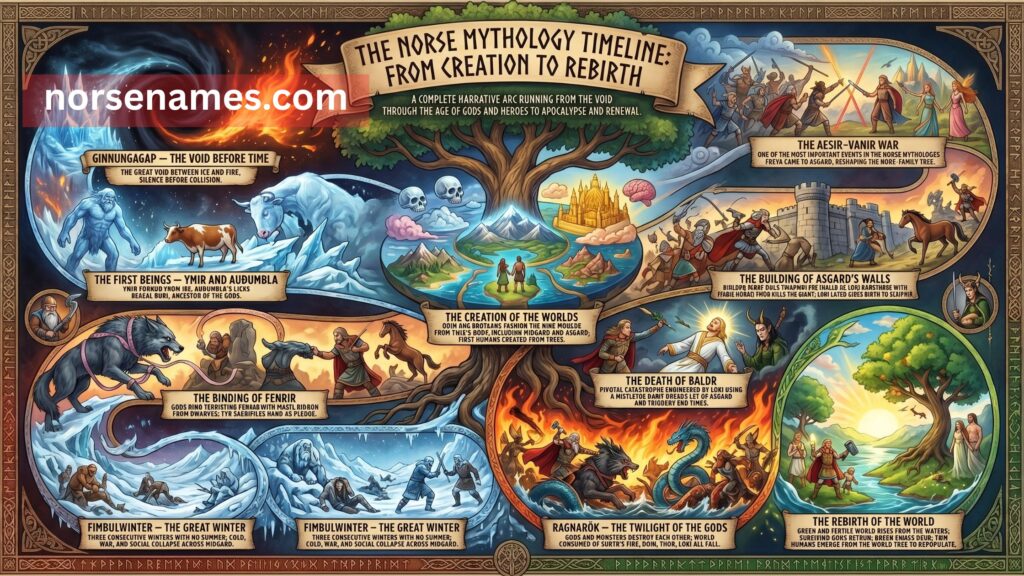
6. The Binding of Fenrir As the fenrir wolf grew to terrifying proportions, the norse mythology gods bound him with Gleipnir — a magical ribbon forged by the dwarves from impossible ingredients. Tyr placed his hand in Fenrir’s mouth as a pledge of good faith, knowing the gods would not release the wolf. Fenrir took the hand. The binding held — for now.
7. The Death of Baldr The death of Baldr — engineered by Loki using a mistletoe dart — is the pivotal catastrophe in the norse mythology timeline. It breaks the joy of Asgard and sets the final sequence of events in motion. Loki’s punishment for this act leads directly to his eternal imprisonment beneath the earth, where his writhing in pain causes earthquakes.
8. Fimbulwinter — The Great Winter Immediately before Ragnarök comes Fimbulwinter: three consecutive winters with no summer between them, a period of cold, war, and social collapse across Midgard. Brothers fight brothers. The bonds of society dissolve. The norse mythology timeline enters its darkest chapter.
9. Ragnarök — The Twilight of the Gods The fenrir wolf breaks free. The jormungandr serpent rises from the sea. Surtr leads the fire giants from Muspelheim. The bifrost bridge shatters under their weight. Gods and monsters destroy each other in one final, world-ending battle. Odin falls to Fenrir. Thor and Jörmungandr kill each other. Heimdall and Loki destroy each other. Surtr’s flames consume what remains.
10. The Rebirth of the World After the destruction, the world rises again from the waters — green, fertile, and new. The surviving gods return. Baldr comes back from Helheim. The children of Thor carry Mjölnir into the new age. Two humans, Líf and Lífþrasir, who hid in the world tree during Ragnarök, emerge to repopulate the world. The norse mythology timeline does not end in darkness. It ends in renewal — a cycle, not a conclusion.
The Nine Worlds of Scandinavian Mythology
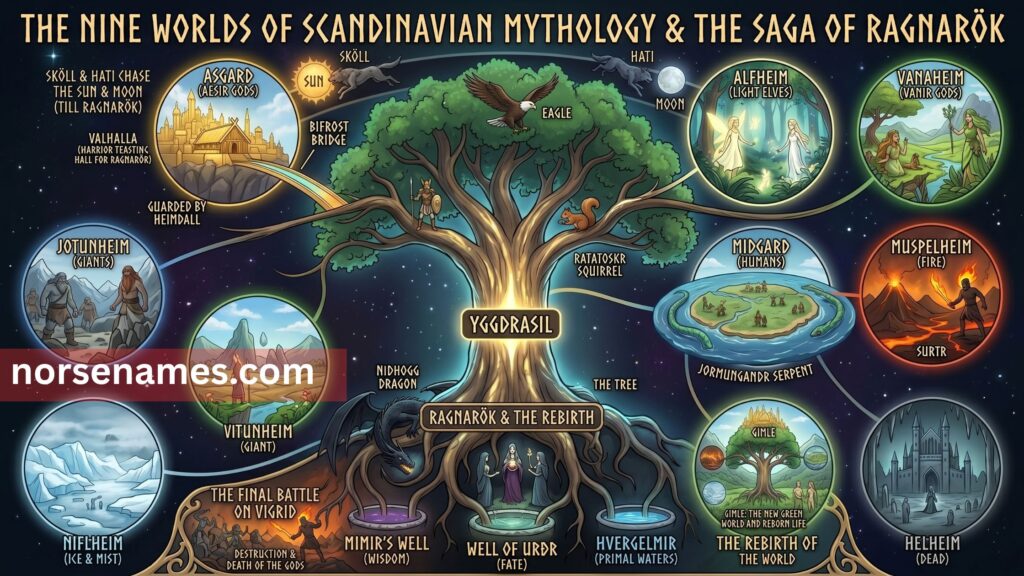
What are the nine worlds in norse mythology? The answer reveals how architecturally complete and philosophically ambitious Norse cosmological thinking truly was. Every norse mythology map of the universe is essentially a diagram of Yggdrasil — the World Tree that holds all nine realms in its branches and roots.
What Is Yggdrasil?
What is Yggdrasil? The yggdrasil world tree is a colossal ash tree at the absolute center of existence, its roots reaching into three cosmic wells — the Well of Urðr (fate), Mimir’s Well (wisdom), and the spring Hvergelmir (primal waters). It is simultaneously a map, a metaphor, and a living entity. The nidhogg dragon gnaws at its roots from below. An eagle looks down from its crown. The squirrel Ratatoskr carries insults between them, stirring conflict for its own amusement. The entire universe is a contested, living organism — and it is always on the edge of collapse.
The Nine Worlds: Complete Viking Mythology Realm Names
Asgard — Home of the Aesir, the primary family of norse mythology gods and goddesses. Reached via the bifrost bridge, guarded by Heimdall. At its heart stands Valhalla — in valhalla norse mythology, this is the great feasting hall where warriors chosen in battle prepare for Ragnarök.
Midgard — The human world, positioned at the center of the norse mythology map. Ringed by the ocean where the jormungandr serpent coils with its tail in its mouth.
Jotunheim — Realm of the giants (jötnar), the primordial beings who predate the Old Norse tradition gods. The aesir vs vanir dynamic is complex, but the aesir vs jotnar dynamic is the defining tension of the entire mythological tradition.
Niflheim — The primordial realm of ice and mist, one of the two forces that existed before the norse creation myth began.
Muspelheim — The blazing realm of fire, ruled by Surtr, whose flaming sword will end the world at Ragnarök.
Alfheim — Realm of the light elves, luminous beings associated with nature and creativity.
Svartalfheim (Nidavellir) — Realm of the dwarves, master craftsmen who forged the most powerful norse mythology weapons and artifacts in existence.
Vanaheim — Realm of the Vanir gods. The aesir vs vanir war between this realm and Asgard is one of the defining events in the Old Norse tradition timeline.
Helheim — Realm of the dead, ruled by Hel, daughter of Loki. The primary destination in the norse mythology afterlife for those who did not die in battle.
The Viking Mythology Afterlife
The Scandinavian mythology afterlife is more complex than a simple heaven-and-hell binary. Warriors who died gloriously in battle went to Valhalla (Odin’s hall) or Fólkvangr (Freya’s hall) — both places of feasting, fighting, and preparation for Ragnarök. Those who drowned at sea went to Rán’s hall beneath the waves. The majority of the dead — those who died of illness, age, or ordinary circumstance — arrived in Helheim, a grey and still place neither punishing nor rewarding, simply final. Old Norse tradition beliefs about the afterlife reflect the tradition’s core values: how you died mattered as much as how you lived.
The Viking Mythology Family Tree: Gods, Giants, and Monsters
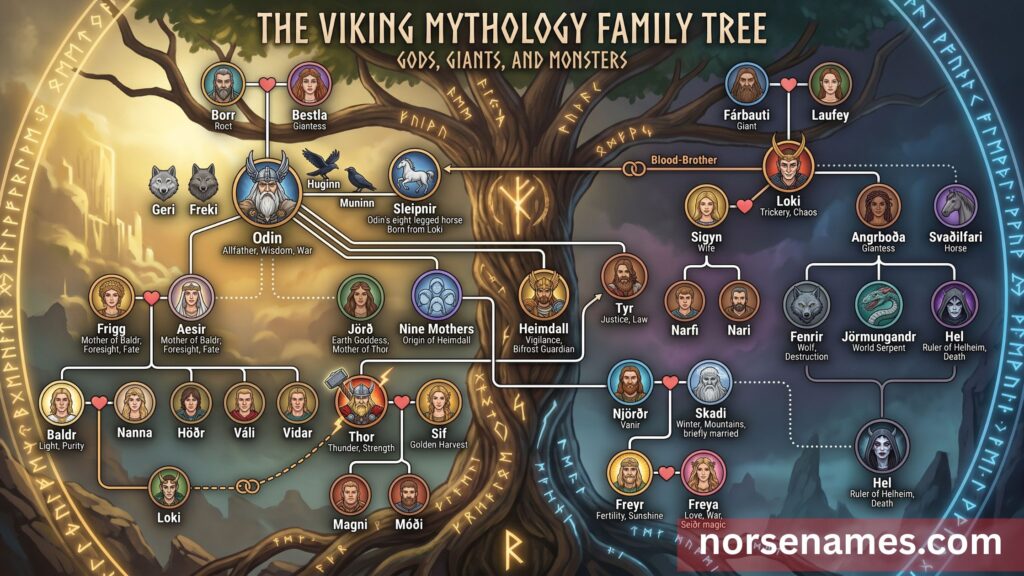
One of the most searched topics in all of Norse mythology is the norse mythology family tree. Understanding who descends from whom — and who is bound to whom by blood, oath, or enmity — is essential to following the greatest norse mythology stories from creation to Ragnarök. The Old Norse tradition gods family tree is also the key to understanding why so many of the tradition’s greatest conflicts are intimate, personal, and impossible to resolve cleanly.
The Two Divine Families: Aesir vs Vanir
The norse mythology deities divide into two primary tribes. The Aesir are the principal family of Norse deities associated with war, wisdom, law, and cosmic order, dwelling in Asgard. The Vanir come from Vanaheim and are associated with fertility, magic, and the natural world. The aesir vs vanir war — one of the defining events in the norse mythology timeline — ended in an uneasy peace and the exchange of divine hostages: Freyr and Freya came to Asgard, and Hœnir and Mimir went to Vanaheim. This union of the two divine families permanently reshaped the norse mythology gods family tree.
Odin and His Lineage
At the root of the Norse deities family tree stands Odin — the Allfather, chief of the Aesir, and the most complex figure in all of norse mythology characters. Who is Odin in norse mythology? Odin is simultaneously the god of wisdom, war, death, poetry, and magic. His parents are Borr and the giantess Bestla — meaning Odin himself carries giant blood.
His wives include Frigg (mother of Baldr) and the earth goddess Jörð (mother of Thor). His children span the norse mythology family tree: Thor, Baldr, Vidar, Váli, Höðr, and others. His ravens Huginn (Thought) and Muninn (Memory) fly across all nine worlds daily. His wolves Geri and Freki flank him in Valhalla. His horse Sleipnir — born from Loki in mare form — is the fastest creature in existence.
Thor: Son of Odin
Who is Thor in norse mythology? Thor norse mythology positions the thunder god as son of Odin and the earth goddess Jörð, and the most beloved of all Scandinavian mythology gods among the common people. His wife is Sif, goddess of the golden harvest. His sons Magni and Móði — strength and courage — survive Ragnarök and carry Mjölnir into the new world. Thor is defined by his mjolnir hammer and by his relationship with Loki — the two are inseparable in Scandinavian mythology stories, the thunder god’s directness and the trickster’s cunning constantly complementing and confounding each other.
Loki: The Trickster and His Monstrous Children
Who is Loki in norse mythology? Loki norse mythology’s great trickster is blood-brother to Odin, frequent companion to Thor, and father of the three most consequential beings in all of Scandinavian mythology creatures. By the giantess Angrboða, Loki fathered Fenrir the wolf, Jörmungandr the world serpent, and Hel, ruler of Helheim. By his wife Sigyn, he fathered Narfi and Nari. In horse form, Loki gave birth to the eight-legged horse Sleipnir. The children of Loki form their own branch of the Scandinavian mythology family tree — and every one of them plays a critical role in the Norse mythology afterlife and Ragnarök.
Norse Mythology Family Tree: Quick Reference
| Figure | Parents / Origin | Key Relationships | Domain |
|---|---|---|---|
| Odin | Borr + giantess Bestla | Father of Thor, Baldr, Vidar, Váli | Wisdom, war, death, fate |
| Frigg | Aesir goddess | Wife of Odin, mother of Baldr | Foresight, fate, family |
| Thor | Odin + earth goddess Jörð | Husband of Sif, father of Magni and Móði | Thunder, strength, protection |
| Loki | Giant Fárbauti + Laufey | Father of Fenrir, Hel, Jörmungandr, Sleipnir | Trickery, chaos, shapeshifting |
| Baldr | Odin + Frigg | Husband of Nanna | Light, purity, beauty |
| Heimdall | Odin + nine mothers | Guardian of the bifrost bridge | Vigilance, light, cosmic hearing |
| Tyr | Odin (or giant Hymir) | Lost hand to Fenrir | Justice, law, sacrifice |
| Freya | Njörðr (Vanir) | Twin of Freyr, sister-hostage to Asgard | Love, war, seiðr magic, death |
| Freyr | Njörðr (Vanir) | Twin of Freya, brother-hostage to Asgard | Fertility, sunshine, prosperity |
| Hel | Loki + giantess Angrboða | Sister of Fenrir and Jörmungandr | Death, Helheim, the afterlife |
| Fenrir | Loki + giantess Angrboða | Brother of Hel and Jörmungandr | Destruction, the great wolf |
| Jörmungandr | Loki + giantess Angrboða | Brother of Hel and Fenrir | The sea, the world-serpent |
| Sleipnir | Loki (as mare) + Svaðilfari | Odin’s eight-legged horse | Speed, travel between worlds |
| Skadi | Giant Þjazi | Briefly married Njörðr | Winter, mountains, hunting |
| Sif | Aesir goddess | Wife of Thor | Earth, golden harvest |
Norse Mythology Gods List and Goddesses List
For quick reference, here is the complete Scandinavian mythology gods list and norse mythology goddesses list covering every major deity in the tradition.
Norse Mythology Gods List
| God | Domain | Key Myth |
|---|---|---|
| Odin | Wisdom, war, death, poetry | Self-sacrifice on Yggdrasil for rune knowledge |
| Thor | Thunder, strength, protection | Constant war against giants; death at Ragnarök |
| Loki | Trickery, chaos, fire | Death of Baldr; architect of Ragnarök |
| Freyr | Fertility, sunshine, prosperity | Gives up his sword for love; dies at Ragnarök |
| Tyr | Justice, law, sacrifice | Loses his hand binding Fenrir |
| Baldr | Light, purity, beauty | Killed by mistletoe dart guided by Loki |
| Heimdall | Vigilance, the bifrost | Sounds Gjallarhorn at Ragnarök; kills Loki |
| Vidar | Silence, vengeance | Kills Fenrir to avenge Odin at Ragnarök |
| Váli | Vengeance | Born solely to avenge Baldr’s death |
| Njörðr | Sea, wind, fishing | Father of Freyr and Freya; Vanir hostage |
| Höðr | Darkness, winter | Unknowingly kills Baldr |
| Ullr | Winter, archery, hunting | God of the bow and skiing |
| Bragi | Poetry, eloquence | Divine skald of Asgard |
Norse Mythology Goddesses List
| Goddess | Domain | Key Myth |
|---|---|---|
| Frigg | Fate, family, foresight | Tries and fails to save Baldr |
| Freya | Love, war, seiðr magic | Teaches Odin seiðr; receives half the battle-slain |
| Skadi | Winter, mountains, hunting | Marries Njörðr seeking vengeance for her father |
| Rán | The sea, storms | Catches drowned sailors in her net |
| Eir | Healing, medicine | Goddess of the best healers |
| Sif | Earth, harvest | Wife of Thor; her golden hair stolen by Loki |
| Iðunn | Youth, renewal | Guards the golden apples of immortality |
| Hel | Death, the underworld | Rules the norse mythology afterlife realm |
| Skaði | Winter, wilderness | Shape of the female hunter archetype |
| The Norns | Fate, time | Weave the destiny of all beings |
Norse Mythology Weapons and Artifacts
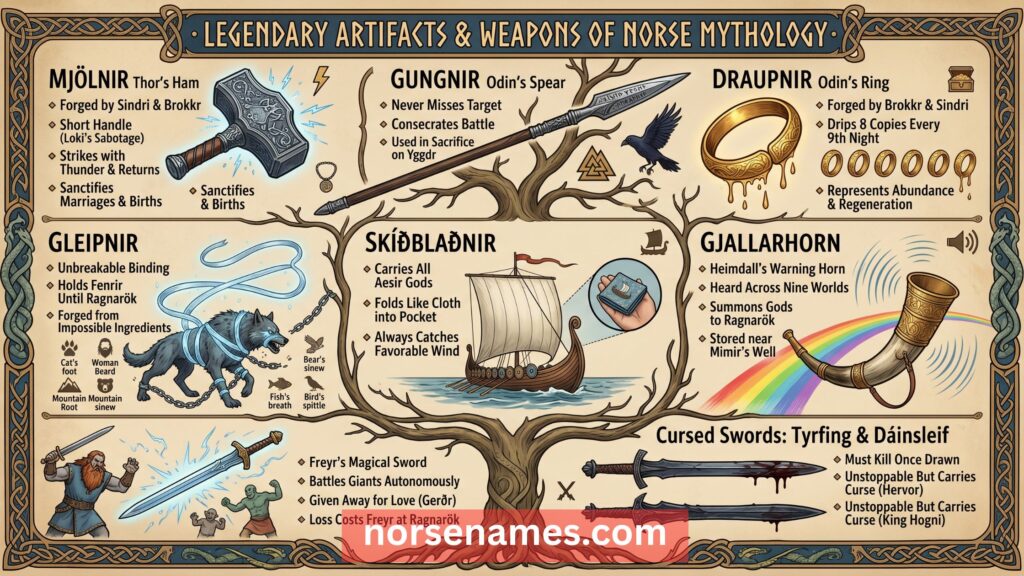
The legendary weapons and artifacts of Norse mythology are among the most imaginatively rich objects in world mythology — and among the most influential on fantasy literature, gaming, and worldbuilding. These are not merely powerful tools; each Scandinavian mythology artifact carries a story, a cost, and a meaning that extends far beyond its function.
Mjölnir — Thor’s Hammer
Mjölnir is the most iconic of all norse mythology weapons and arguably the most recognizable symbol in the entire tradition. Forged by the dwarf brothers Sindri and Brokkr in Svartalfheim, Mjölnir has a short handle — the result of Loki sabotaging the forging by transforming into a fly and biting Brokkr mid-craft. Despite its imperfection, it is the ultimate weapon against giants: it strikes with the force of thunder and returns to Thor’s hand after every throw.
But in thor norse mythology, Mjölnir is not merely a weapon of war. It is a sanctifier — used to consecrate marriages, births, and funerals, bridging the sacred and the martial in a way that perfectly reflects Scandinavian mythology beliefs. Norse people wore miniature Mjölnir amulets as protective talismans, making it both a legendary norse weapon and an everyday symbol of divine protection. In terms of Scandinavian mythology tattoo meanings, Mjölnir remains one of the most popular choices — a symbol of strength, protection, and sacred power.
Gungnir — Odin’s Spear
Gungnir is Odin’s legendary spear, also forged by the dwarves (specifically the Sons of Ivaldi) and considered among the most powerful of all Scandinavian mythologyweapons. Its defining property: it never misses its target. Odin used Gungnir to consecrate battle — throwing it over the enemy at the start of a conflict to dedicate the slain to himself. He also used Gungnir in his self-sacrifice on Yggdrasil, piercing himself with the spear as part of his nine-day ordeal to discover the elder futhark runes. As norse mythology artifacts go, Gungnir represents the union of divine power and self-sacrifice — the idea that the greatest knowledge requires the greatest cost.
Draupnir — Odin’s Ring
Draupnir is a golden arm-ring forged by the dwarves Brokkr and Sindri, gifted to Odin. Its power is both simple and extraordinary: every ninth night, eight identical rings of equal weight and quality drip from it. Draupnir represents abundance, regeneration, and the recursive nature of divine wealth. When Baldr was placed on his funeral pyre, Odin laid Draupnir on his chest — and Baldr later sent it back from Helheim, making it one of the few norse mythology artifacts to travel between the living world and the norse mythology afterlife.
Gleipnir — The Unbreakable Binding
Gleipnir is perhaps the most unusual of all norse mythology artifacts — a binding rather than a weapon, yet more consequential than most swords. Forged by the dwarves of Svartalfheim from six impossible ingredients — the sound of a cat’s footstep, the beard of a woman, the roots of a mountain, the sinews of a bear, the breath of a fish, the spittle of a bird — Gleipnir appears as a silken ribbon but cannot be broken by any force in the nine worlds.
The gods used it to bind the fenrir wolf after two iron chains had failed, with Tyr paying for the binding with his hand. Gleipnir holds until Ragnarök — at which point the fenrir wolf breaks free and swallows Odin. Among Scandinavian mythology weapons and artifacts, Gleipnir is unique: it represents the idea that the most powerful things are often those that cannot be seen.
Skíðblaðnir — Freyr’s Magical Ship
Skíðblaðnir is the greatest of all ships in norse mythology, forged by the Sons of Ivaldi and given to Freyr. It is large enough to carry all the Aesir gods with their armor and weapons when fully deployed — yet when not in use, it can be folded like a cloth and fit in a pocket. It always catches a favorable wind whenever its sail is raised. As norse mythology artifacts go, Skíðblaðnir represents the dwarves’ supreme craftsmanship and the Norse cultural reverence for ships as vessels of both practical and supernatural power.
Gjallarhorn — Heimdall’s Horn
Gjallarhorn is Heimdall’s horn, one of the most symbolically charged of all norse mythology artifacts. Its sound can be heard across all nine worlds. Heimdall norse mythology keeps it at the bifrost bridge, and at Ragnarök he will blow it with enough force to wake every god and being in the cosmos, summoning them to the final battle. The Gjallarhorn also has a secondary role in norse mythology: one of Yggdrasil’s roots reaches to the well where the horn is stored, near Mimir’s well of wisdom, suggesting a deep connection between the power of sound and the power of knowledge in Scandinavian mythology beliefs.
Freyr’s Sword
Freyr possessed a sword of extraordinary power — one that could fight on its own when wielded by someone clever. It is described in Scandinavian mythology as a sword that battles giants of its own accord. Freyr gave this sword away as part of his courtship of the giantess Gerðr, trading his greatest weapon for love. This sacrifice costs him dearly at Ragnarök, where Freyr faces the fire giant Surtr without his magical blade and dies for it. Among norse mythology heroes and their stories, Freyr’s sacrifice of his sword for love is one of the tradition’s most humanizing divine moments — and one of its most costly.
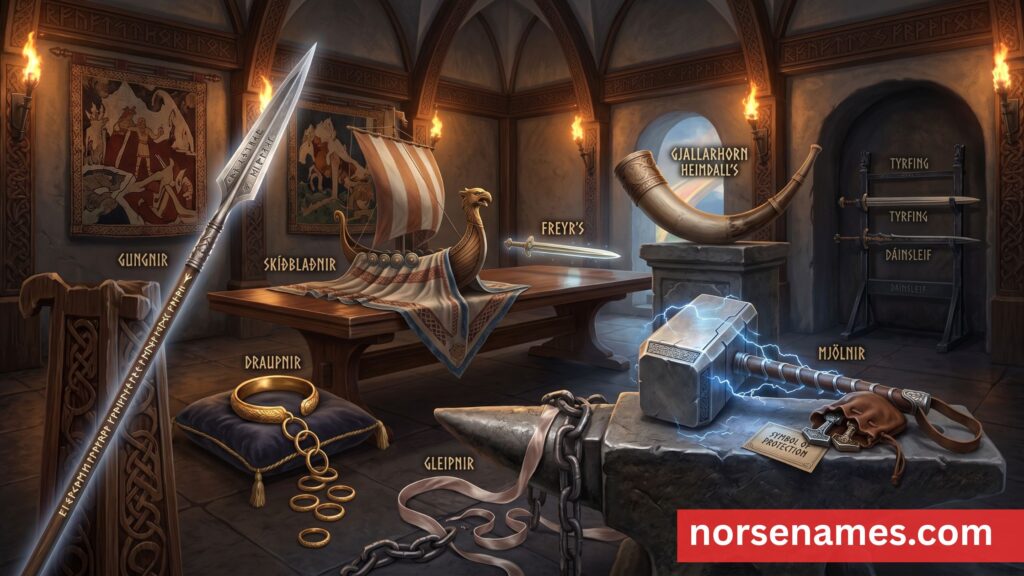
Legendary Norse Weapons and Artifacts: Quick Reference
| Artifact | Owner | Type | Power |
|---|---|---|---|
| Mjölnir | Thor | Hammer / norse mythology weapon | Never misses; returns to hand; sanctifies |
| Gungnir | Odin | Spear / norse mythology weapon | Never misses; consecrates battle and sacrifice |
| Draupnir | Odin | Ring / norse mythology artifact | Produces eight copies every ninth night |
| Gleipnir | The Gods | Binding / norse mythology artifact | Unbreakable; holds Fenrir until Ragnarök |
| Skíðblaðnir | Freyr | Ship / norse mythology artifact | Fits in a pocket; always catches fair wind |
| Gjallarhorn | Heimdall | Horn / norse mythology artifact | Heard across all nine worlds; summons gods to Ragnarök |
| Freyr’s Sword | Freyr | Sword / norse mythology weapon | Fights giants autonomously; given away for love |
| Tyrfing | Hervor / Heidrek | Cursed sword / legendary norse weapon | Unstoppable but must cause death each time drawn |
| Dáinsleif | King Hogni | Sword / legendary norse weapon | Once drawn, must kill before being sheathed |
Legendary Norse Creatures and Monsters
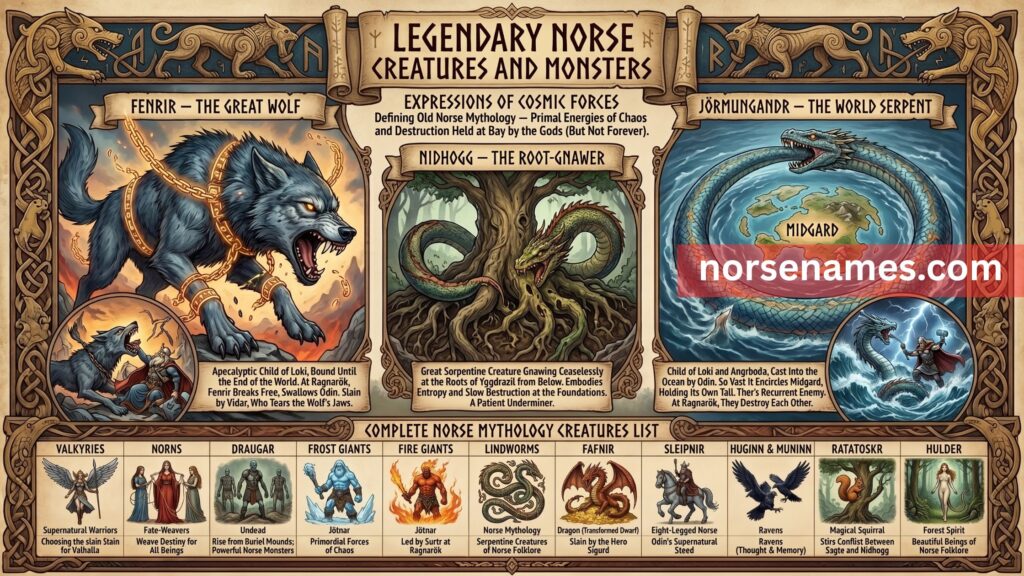
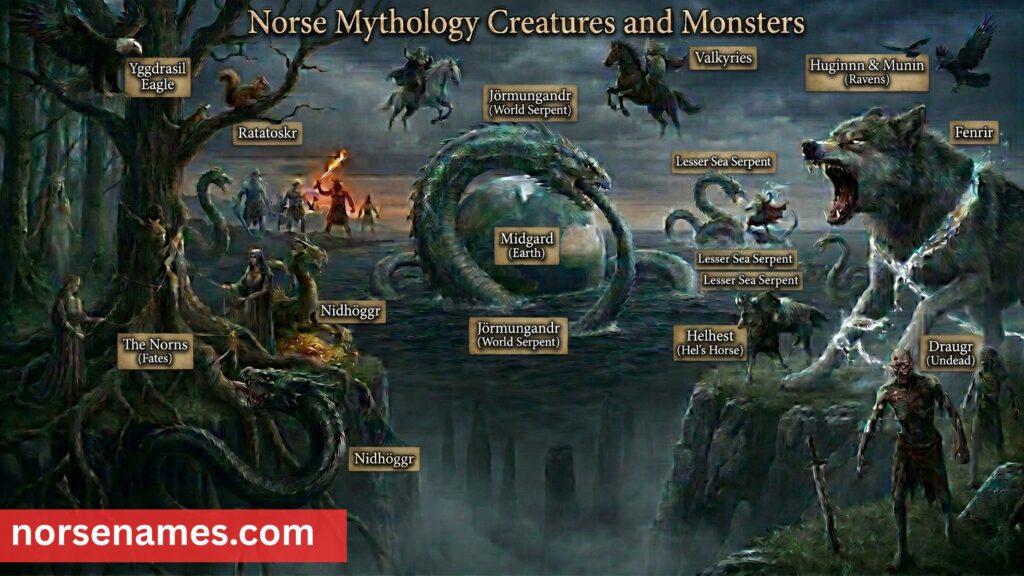
The norse mythology creatures and monsters are expressions of the cosmic forces that define old norse mythology — the primal energies of chaos and destruction that the gods spend all of history trying to hold at bay, and ultimately cannot. Here is the complete Scandinavian mythology creatures list and norse mythology monsters overview.
Jörmungandr — The World Serpent
The jormungandr serpent is the world-encircling sea serpent, child of Loki and Angrboða, cast into the ocean surrounding Midgard by Odin. So vast is the jormungandr serpent that it encircles the entire world, holding its own tail in its mouth. The enmity between Jörmungandr and thor norse mythology’s thunder god is one of the great recurring themes of viking legends. At Ragnarök, they destroy each other.
Fenrir — The Great Wolf
The fenrir wolf is the apocalyptic child of Loki, bound by Gleipnir until the end of the world. At Ragnarök, the fenrir wolf breaks free and swallows Odin whole — only to be killed by Vidar, who tears the wolf’s jaws apart in vengeance for his father.
Nidhogg — The Root-Gnawer
The nidhogg dragon is the great serpentine creature gnawing ceaselessly at the roots of Yggdrasil from below, embodying entropy and the slow work of destruction at the foundations of everything. As norse mythology monsters go, the nidhogg dragon is the most philosophically significant — not a stormer of gates, but a patient underminer of all that exists.
Complete Norse Mythology Creatures List
| Creature | Type | Key Role |
|---|---|---|
| Fenrir | Fenrir wolf | Will swallow Odin at Ragnarök |
| Jörmungandr | Jormungandr serpent | Will kill Thor at Ragnarök |
| Nidhogg | Nidhogg dragon | Gnaws the roots of Yggdrasil |
| Valkyries | Supernatural warriors | Choose the battle-slain for Valhalla |
| Norns | Fate-weavers | Weave destiny for all beings |
| Draugar | Undead | Rise from burial mounds; powerful norse mythology monsters |
| Frost Giants | Jötnar | Primordial forces of chaos |
| Fire Giants | Jötnar | Led by Surtr at Ragnarök |
| Lindworms | Norse mythology dragons | Serpentine creatures of norse folklore |
| Fafnir | Dragon (transformed dwarf) | Slain by the hero Sigurd |
| Sleipnir | Eight-legged horse | Odin’s supernatural steed |
| Huginn & Muninn | Ravens | Thought and Memory; Odin’s scouts |
| Ratatoskr | Magical squirrel | Stirs conflict between eagle and Nidhogg |
| Hulder | Forest spirit | Beautiful beings of norse folklore |
Legendary Norse heroes
Norse mythology is not only the story of gods and monsters. The norse mythology heroes — human and semi-divine figures who carve their names into the mythological tradition through extraordinary deeds — are among the tradition’s most enduring characters.
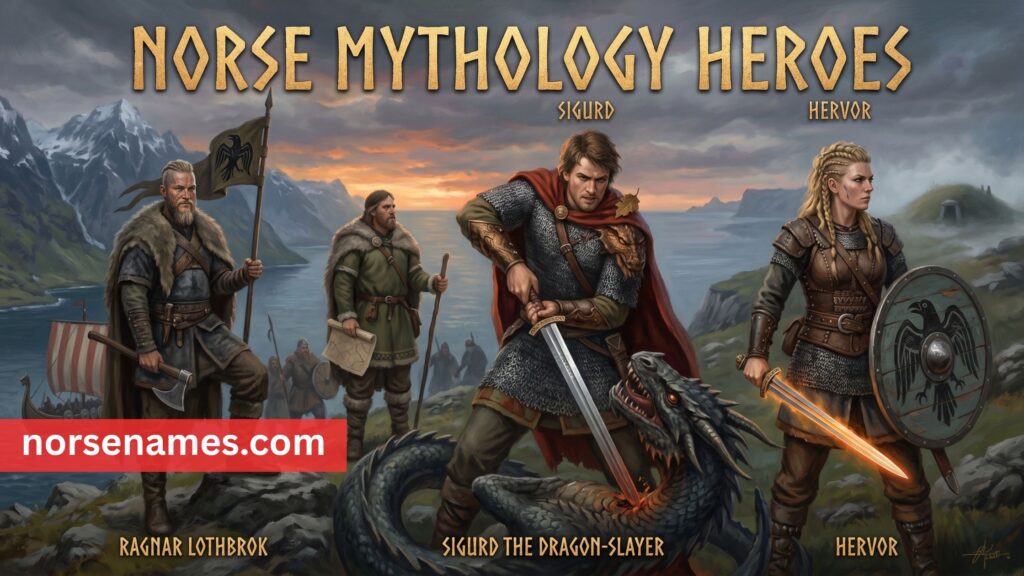
Sigurd the Dragon-Slayer is the supreme Scandinavian mythology hero. His story — slaying the dragon Fafnir, bathing in its blood to gain near-invincibility (with one fatal unprotected spot), winning and losing the valkyrie Brynhildr, and dying betrayed — is the great human epic of norse legends. Tolkien drew directly on Sigurd for his story of Turin Turambar; Wagner built his four-opera Ring Cycle from the same material.
Hervor is one of norse mythology’s greatest female heroes — a shield-maiden who descends into a burial mound to retrieve the cursed sword Tyrfing from her dead father’s grave and takes her place among warriors. Her story is among the most vivid examples of female heroism in all of old Scandinavian mythology.
Ragnar Lothbrok straddles the line between history and norse legend — a Viking king and warrior whose saga is one of the most dramatic in the entire tradition, and whose fame has never diminished from the medieval period to the modern television screen.
Leif Erikson represents the historical dimension of norse mythology heroes — a Norse explorer who became legendary in his own lifetime, sailing west to Vinland (North America) centuries before Columbus.
These norse mythology heroes share a common trait: they do not seek immortality or divine favor. They seek glory, action, and a death worth singing about. That philosophy is one of the deepest expressions of norse mythology beliefs and norse mythology culture — the idea that how you live matters infinitely more than how long.
Norse Mythology Symbols and Their Meanings: A Complete Guide
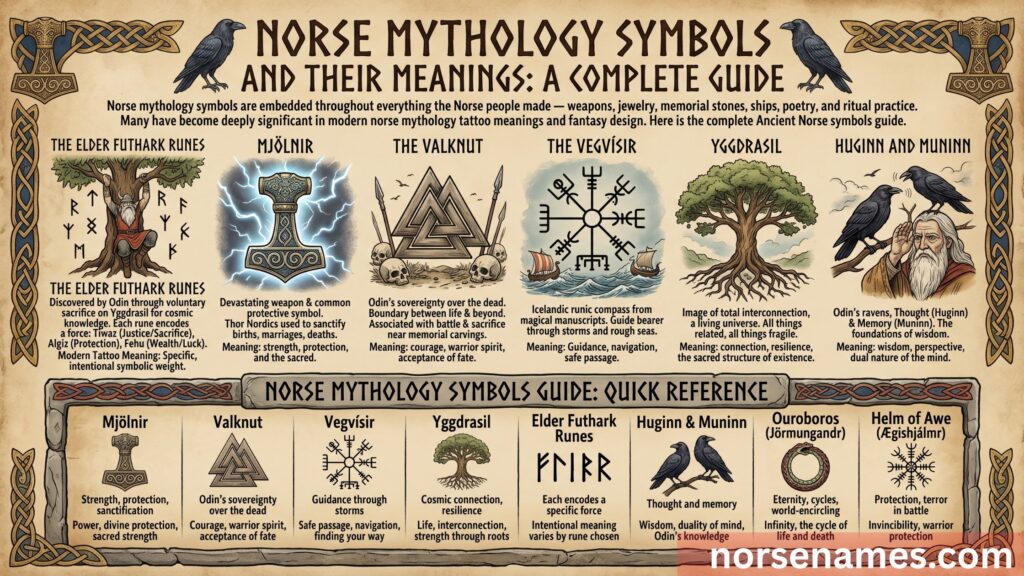
Norse mythology symbols are embedded throughout everything the Norse people made — weapons, jewelry, memorial stones, ships, poetry, and ritual practice. Many have become deeply significant in modern norse mythology tattoo meanings and fantasy design. Here is the complete Ancient Norse symbols guide.
The Elder Futhark Runes
The elder futhark runes are the oldest runic alphabet used in Scandinavia, comprising 24 symbols. In one of the most extraordinary Scandinavian mythology stories, Odin discovered the elder futhark runes by hanging himself on Yggdrasil for nine days and nights — a voluntary death and rebirth in pursuit of cosmic knowledge. Norse runes meaning extends far beyond simple letters: each rune encodes a force of reality. Tiwaz encodes justice and sacrifice. Algiz encodes protection. Fehu encodes wealth and luck. Raidho encodes journey. Thurisaz encodes the power of giants and uncontrolled force. As norse mythology tattoo meanings go, runes are among the most popular choices because each one carries a specific, intentional symbolic weight.
Mjölnir
The mjolnir hammer is both the most devastating weapon in all of norse mythology and its most common protective symbol. In thor Nordic myths, the hammer sanctifies and protects. Norse people wore Mjölnir amulets to consecrate births, marriages, and deaths. For norse mythology tattoo meanings, Mjölnir represents strength, protection, and the sacred — making it one of the most universally meaningful Scandinavian mythology symbols.
The Valknut
The valknut symbol — three interlocked triangles — appears consistently on Scandinavian memorial carvings near scenes of battle and sacrifice, always associated with odin norse mythology. Among Ancient Norse symbols, the valknut is understood to mark the boundary between life and what lies beyond, representing Odin’s sovereignty over the dead. Its precise meaning remains debated among scholars, which gives it an additional layer of mystery as a norse mythology tattoo meaning for modern wearers.
The Vegvísir
The Vegvísir is a runic compass symbol from Icelandic magical manuscripts, said to guide its bearer safely through storms and rough seas. Among Nordic myths tattoo meanings, the Vegvísir is one of the most popular choices — representing guidance, navigation, and safe passage through uncertainty.
Yggdrasil
Beyond its cosmological function, the yggdrasil world tree is itself among the most powerful of all norse mythology symbols — the image of total interconnection, of a living universe where all things are related and all things are fragile. As a norse mythology tattoo meaning, Yggdrasil represents connection, resilience, and the sacred structure of existence.
Huginn and Muninn
Odin’s ravens represent thought and memory — the twin foundations of wisdom in odin norse mythology. As Ancient Norse symbols, they speak to the power of intelligence and the danger of forgetting. As norse mythology tattoo meanings, they represent wisdom, perspective, and the dual nature of the mind.
Norse Mythology Symbols Guide: Quick Reference
| Symbol | Meaning | Common Norse Mythology Tattoo Meaning |
|---|---|---|
| Mjölnir | Strength, protection, sanctification | Power, divine protection, sacred strength |
| Valknut | Odin’s sovereignty over the dead | Courage, warrior spirit, acceptance of fate |
| Vegvísir | Guidance through storms | Safe passage, navigation, finding your way |
| Yggdrasil | Cosmic connection, resilience | Life, interconnection, strength through roots |
| Elder Futhark Runes | Each encodes a specific force | Intentional meaning varies by rune chosen |
| Huginn & Muninn | Thought and memory | Wisdom, duality of mind, Odin’s knowledge |
| Ouroboros (Jörmungandr) | Eternity, cycles, world-encircling | Infinity, the cycle of life and death |
| Helm of Awe (Ægishjálmr) | Protection, terror in battle | Invincibility, warrior protection |
Famous Norse Mythology Stories
No norse mythology summary would be complete without covering the famous Norse legends that defined the tradition. These are the tales that norse legends scholars and storytellers return to again and again.
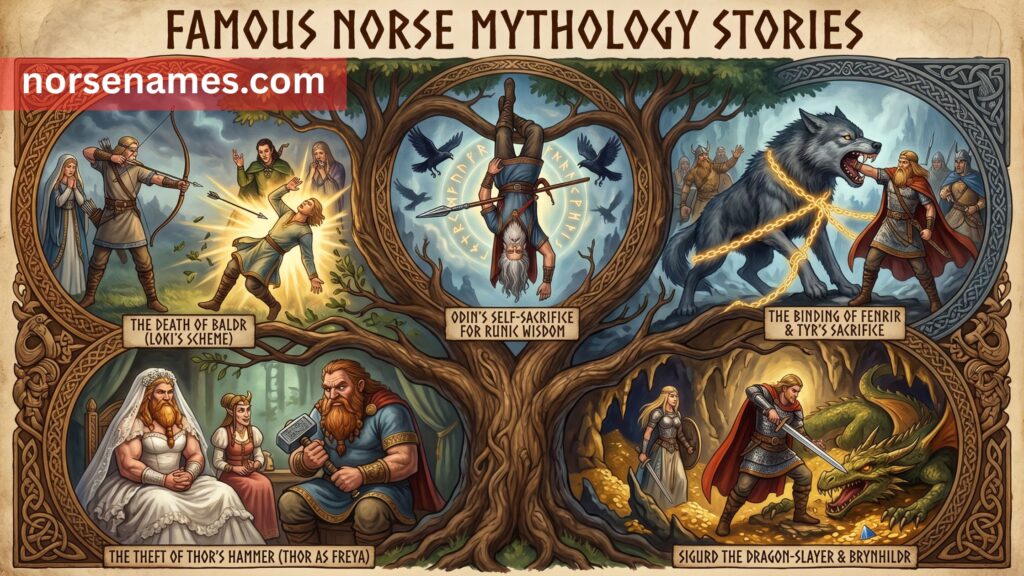
The Death of Baldr is norse mythology’s most devastating tragedy. Baldr’s mother Frigg extracted protective oaths from every thing in existence — except mistletoe, which she considered too young to bother with. Loki discovered this gap, crafted a dart of mistletoe, and placed it in the hands of Baldr’s blind brother Höðr. Baldr fell. All of Asgard wept. The entire Nordic myths afterlife system strained as Hel offered to release him if every being in existence wept — all did, except one giantess (Loki in disguise). Baldr remained in Helheim until after Ragnarök.
The Theft of Thor’s Hammer is one of the funniest famous norse mythology stories: Thor wakes to find Mjölnir stolen by the giant Þrymr, who demands Freya as his bride. The solution — Thor disguising himself as a bride and Loki as his handmaiden — is peak loki norse mythology comedy and one of the most beloved tales in all of viking legends.
Odin’s Self-Sacrifice is among the most profound of all norse mythology stories. Odin hangs himself on Yggdrasil for nine days, pierced by Gungnir, to discover the elder futhark runes. It is one of mythology’s most extraordinary images of voluntary suffering in pursuit of wisdom.
The Binding of Fenrir is one of the most psychologically rich of all Norse legends — the gods’ fear of the fenrir wolf, their deception, Tyr’s sacrifice, and the terrible knowledge that what they bound will one day break free and end everything.
The Völsunga Saga and Sigurd is the supreme norse heroic epic: Sigurd the dragon-slayer, Brynhildr the valkyrie, betrayal, fate, and the most beautiful and terrible love story in all of norse legends.
Aesir vs Vanir: The War Between the Gods
The aesir vs vanir war is one of the most important events in the entire norse mythology timeline — and one of the least discussed in popular norse mythology summaries. Understanding the aesir vs vanir conflict is essential to understanding how the Nordic myths gods family tree reached its current shape.
The Aesir — the gods of Asgard, led by Odin — represent war, wisdom, law, and the ordered cosmos. The Vanir — the gods of Vanaheim — represent fertility, nature, sea-faring, and the seiðr magic that even Odin had to learn from Freya. The two tribes went to war, trading victories and defeats until neither could prevail. Eventually, they negotiated a peace, sealed by exchanging hostages: Freyr and Freya went from Vanaheim to Asgard; Hœnir and Mimir went from Asgard to Vanaheim. The Vanir beheaded Mimir (finding Hœnir useless without him), and Odin preserved Mimir’s head through seiðr magic, continuing to consult it for wisdom.
The aesir vs vanir resolution represents one of norse mythology’s deepest ideas: that the opposing forces of martial order and natural magic are not enemies to be destroyed but complementary powers to be integrated. The Norse deities are stronger together than apart — and the war that almost ended the divine order became the event that completed it.
Norse Influence on Fantasy and Gaming
The debt that modern fantasy owes to norse mythology is enormous and runs in every creative direction — an influence on gaming, literature, and worldbuilding that shows no sign of diminishing.
J.R.R. Tolkien drew directly from norse mythology books and Eddic source material. The dwarves of The Hobbit take their names almost verbatim from the Dvergatal in the Völuspá. The wandering grey wizard in a wide-brimmed hat echoes odin norse mythology’s mortal disguise. The doom-laden atmosphere of Middle-earth draws its DNA from the norse mythology religion’s understanding of fate. Tolkien’s love of norse mythology influence on fantasy was not incidental — it was foundational.
In gaming, viking mythology has become one of the most fertile creative territories in the medium. God of War (2018) and God of War: Ragnarök rendered the nine worlds of norse mythology with extraordinary fidelity. Valheim drops players into a Norse afterlife landscape in service of Odin. The Elder Scrolls V: Skyrim saturates its world with scandinavian mythology from dragon language to mead-hall culture. Assassin’s Creed: Valhalla immerses players in viking religion and norse mythology culture at the height of the Viking Age.
In literature, Neil Gaiman’s Norse Mythology (2017) is among the best norse mythology books for modern readers — warm, precise, and deeply faithful to the famous norse mythology stories. Rick Riordan’s Magnus Chase series brings norse mythology facts for kids to life in an adventurous contemporary setting. American Gods weaves odin norse mythology into a melancholy contemporary American landscape with haunting power.
Norse mythology influence on fantasy is structural as much as cosmetic. The concept of wyrd (inescapable fate) gives fictional worlds moral weight. The looming presence of ragnarok norse mythology teaches that great stories need meaningful endings. The complexity of loki norse mythology characters teaches that the most interesting figures resist simple moral categorization. These lessons explain why old norse mythology remains, century after century, the bedrock that fantasy keeps returning to — and why a working knowledge of norse mythology culture is practically a professional qualification for the modern fantasy writer.
Norse Mythology for Kids: A Fun Introduction to Viking Legends
Many parents and teachers wonder whether Norse mythology for kids is suitable. The answer is yes—provided children are introduced to age-appropriate retellings. While the original Viking myths contain battles, monsters, and tragic endings, modern children’s books simplify these stories and focus on adventure, courage, friendship, and problem-solving instead of violence.
The best place for young readers to begin is with the most recognizable Norse mythology characters. Thor, the mighty god of thunder, teaches bravery and determination. Odin, the wise All-Father, encourages curiosity and the pursuit of knowledge. Loki, the mischievous trickster, reminds children that cleverness should be used responsibly, while Freyja introduces themes of kindness, compassion, and courage. Kids also enjoy discovering magical places like Asgard, the colorful Bifröst bridge, and the enormous Yggdrasil World Tree that connects the Nine Realms.
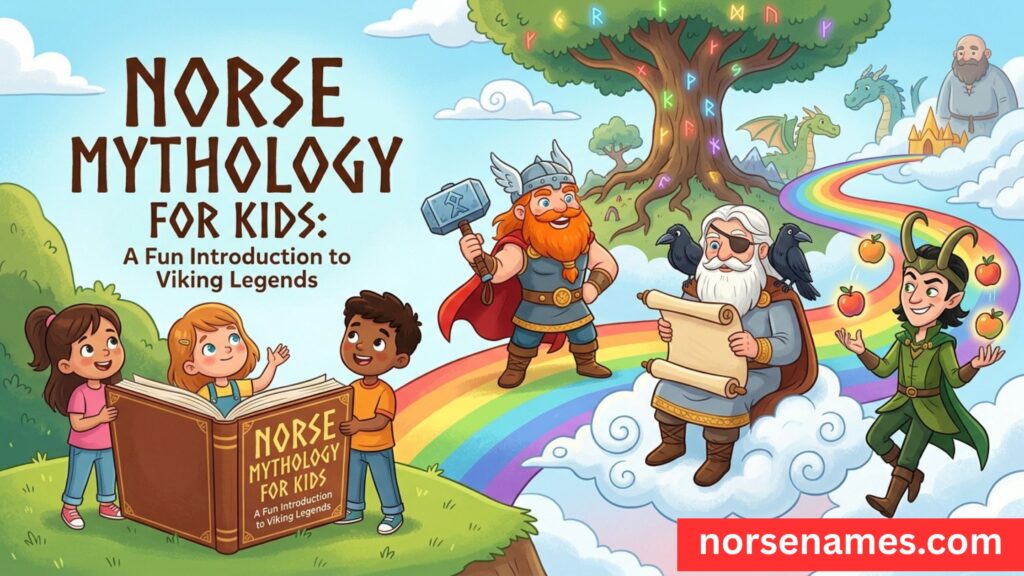
Learning Norse mythology helps children develop an interest in history, storytelling, and ancient Scandinavian culture. Many famous books, movies, games, and fantasy stories draw inspiration from these Viking legends, making them an excellent starting point for young readers who enjoy mythology and adventure. For beginners, illustrated books and simplified retellings provide the perfect way to explore the fascinating world of Norse gods, heroes, giants, dragons, and magical creatures without the complexity of the original medieval texts.
Norse Mythology Names: Viking Names, Norse Names, and Meanings
Names in norse mythology carry enormous weight — encoding identity, lineage, fate, and power. The norse mythology names and meanings tradition is one of the richest available for fantasy writers, gamers, and worldbuilders. Whether you are looking for heroic viking names, authentic norse names for characters, or a norse mythology name generator approach to building entirely original names — this section covers everything.
How Norse Naming Works
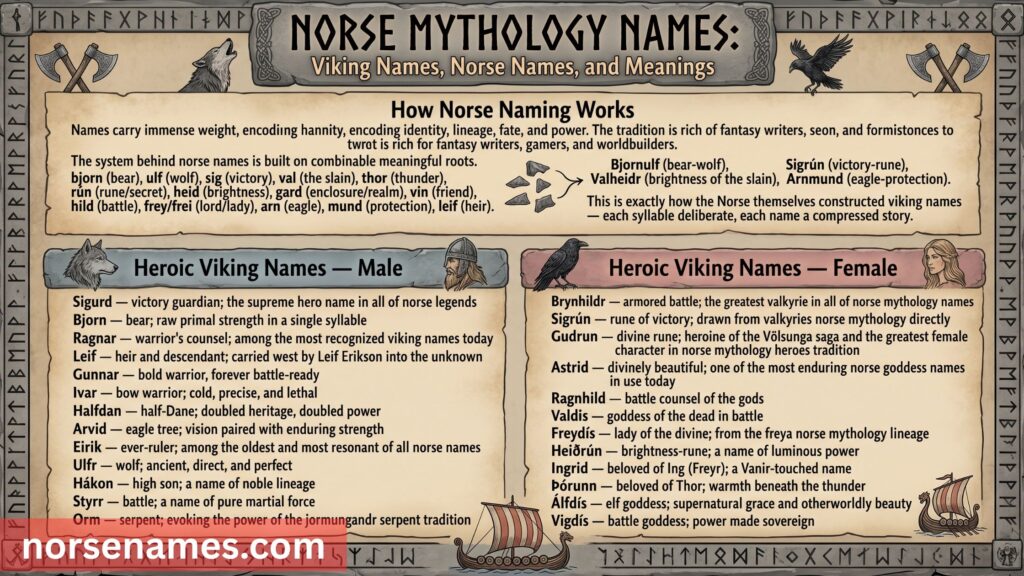
The system behind norse names is built on combinable meaningful roots: bjorn (bear), ulf (wolf), sig (victory), val (the slain), thor (thunder), rún (rune/secret), heid (brightness), gard (enclosure/realm), vin (friend), hild (battle), frey/frei (lord/lady), arn (eagle), mund (protection), leif (heir). Combining these roots produces authentic norse mythology names and meanings: Bjornulf (bear-wolf), Sigrún (victory-rune), Valheidr (brightness of the slain), Arnmund (eagle-protection). This is exactly how the Norse themselves constructed viking names — each syllable deliberate, each name a compressed story.
For those building a norse mythology name generator approach: elemental root + role/quality root = a norse name that feels rooted in the tradition.
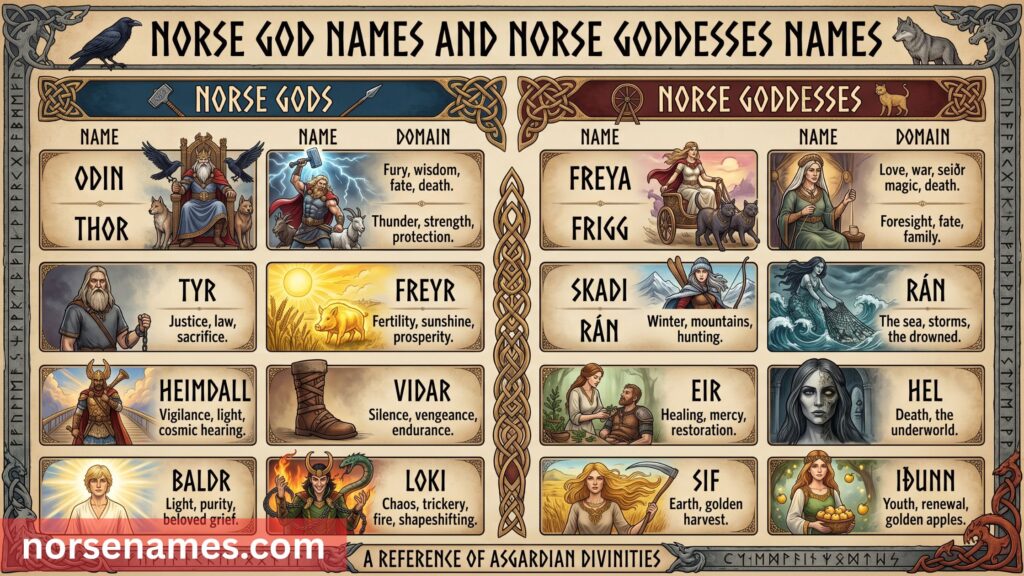
Norse God Names and Norse Goddess Names
| Name | Type | Meaning / Domain |
|---|---|---|
| Odin | Norse god names | Fury, wisdom, fate, death |
| Thor | Norse god names | Thunder, strength, protection |
| Tyr | Norse god names | Justice, law, sacrifice |
| Freyr | Norse god names | Fertility, sunshine, prosperity |
| Heimdall | Norse god names | Vigilance, light, cosmic hearing |
| Vidar | Norse god names | Silence, vengeance, endurance |
| Baldr | Norse god names | Light, purity, beloved grief |
| Loki | Norse god names | Chaos, trickery, fire, shapeshifting |
| Freya | Norse goddess names | Love, war, seiðr magic, death |
| Frigg | Norse goddess names | Foresight, fate, family |
| Skadi | Norse goddess names | Winter, mountains, hunting |
| Rán | Norse goddess names | The sea, storms, the drowned |
| Eir | Norse goddess names | Healing, mercy, restoration |
| Hel | Norse goddess names | Death, the underworld |
| Sif | Norse goddess names | Earth, golden harvest |
| Iðunn | Norse goddess names | Youth, renewal, golden apples |
Heroic Viking Names — Male
- Sigurd — victory guardian; the supreme hero name in all of norse legends
- Bjorn — bear; raw primal strength in a single syllable
- Ragnar — warrior’s counsel; among the most recognized viking names today
- Leif — heir and descendant; carried west by Leif Erikson into the unknown
- Gunnar — bold warrior, forever battle-ready
- Ivar — bow warrior; cold, precise, and lethal
- Halfdan — half-Dane; doubled heritage, doubled power
- Arvid — eagle tree; vision paired with enduring strength
- Eirik — ever-ruler; among the oldest and most resonant of all norse names
- Ulfr — wolf; ancient, direct, and perfect
- Hákon — high son; a name of noble lineage
- Styrr — battle; a name of pure martial force
- Orm — serpent; evoking the power of the jormungandr serpent tradition
Heroic Viking Names — Female
- Brynhildr — armored battle; the greatest valkyrie in all of norse mythology names
- Sigrún — rune of victory; drawn from valkyries norse mythology directly
- Gudrun — divine rune; heroine of the Völsunga saga and the greatest female character in norse mythology heroes tradition
- Astrid — divinely beautiful; one of the most enduring norse goddess names in use today
- Ragnhild — battle counsel of the gods
- Valdis — goddess of the dead in battle
- Freydís — lady of the divine; from the freya norse mythology lineage
- Heiðrún — brightness-rune; a name of luminous power
- Ingrid — beloved of Ing (Freyr); a Vanir-touched name
- Þórunn — beloved of Thor; warmth beneath the thunder
- Álfdís — elf goddess; supernatural grace and otherworldly beauty
- Vigdís — battle goddess; power made sovereign
Fantasy Norse Names Inspired by Creatures, Weapons, and Places
| Fantasy Name | Source | Suggested Character Use |
|---|---|---|
| Fenrik | Fenrir wolf | Wolf-rider, berserker, beast-bond warrior |
| Nidara | Nidhogg dragon | Serpent-cult mage, dragon-blooded villain |
| Valka | Valkyries norse mythology | Shield-maiden, death-touched warrior |
| Bifra | Bifrost bridge | Portal-walker, divine courier, realm-traveler |
| Ymirakh | Ymir (norse creation myth) | Primordial sorcerer, colossal villain |
| Skadir | Skadi | Winter ranger, cold-climate huntress |
| Helvir | Helheim (norse mythology afterlife) | Death-touched rogue, underworld guide |
| Jormund | Jormungandr serpent | Sea-sorcerer, serpent-worshipper |
| Heimvar | Heimdall norse mythology | Divine sentinel, gateway guardian |
| Runavex | Elder futhark runes | Rune-mage, language-sorcerer |
| Glepnira | Gleipnir (norse mythology artifact) | Binder of chaos, impossible-task specialist |
| Gunvir | Gungnir (legendary norse weapon) | Spear-master, consecrator of battle |
Norse Mythology Names and Meanings: Quick Reference
| Name | Origin | Meaning |
|---|---|---|
| Sigurd | Norse mythology hero | Victory guardian |
| Brynhildr | Valkyrie | Armored battle |
| Ragnar | Viking name | Warrior’s counsel |
| Astrid | Norse goddess names | Divinely beautiful |
| Eirik | Viking king | Ever-ruler |
| Gudrun | Norse heroine | Divine rune |
| Leif | Viking explorer | Heir, descendant |
| Valdis | Norse name | Goddess of the battle-dead |
| Gunnar | Viking warrior | Bold warrior |
| Freydís | Norse name | Lady of the divine |
| Styrr | Old Norse | Battle |
| Álfdís | Norse goddess names | Elf goddess |
If you enjoy Norse-inspired naming, you might also explore our guides to Viking Names, Norse Names, Dwarven Names, Barbarian Names, Fantasy Names, Wizard Names, and Creature Names for further naming inspiration rooted in mythology and fantasy worldbuilding tradition.
Frequently Asked Questions
What is Norse mythology? Norse mythology is the collection of myths, gods, legends, and religious beliefs of the ancient Norse people of Scandinavia. It encompasses a complete cosmology — the nine worlds, the yggdrasil world tree, the norse mythology gods and goddesses, the famous norse mythology stories of creation and destruction, and the prophesied ending and renewal at Ragnarök. It is also called viking mythology, old norse mythology, or scandinavian mythology, and forms the basis of the norse mythology religion practiced by the Norse people before the spread of Christianity.
Who are the main gods in Norse mythology? The most famous Norse deities and goddesses include Odin (Allfather, god of wisdom and war), Thor (god of thunder and protection), Loki (the trickster), Freya (goddess of love, war, and magic), Frigg (goddess of fate and family), Tyr (god of justice), Heimdall (guardian of the bifrost bridge), Baldr (god of light), and Freyr (god of fertility and sunshine). The full norse mythology gods list and norse mythology goddesses list covers over two dozen major deities divided between the Aesir and Vanir divine families.
What is Yggdrasil? Yggdrasil is the World Tree connecting the nine worlds and serving as the center of the Norse cosmos. The yggdrasil world tree is a colossal ash tree whose roots reach into three cosmic wells — of fate, wisdom, and primal water. It is simultaneously a norse mythology map, a metaphor for cosmic interconnection, and a living entity constantly under threat from the nidhogg dragon gnawing at its roots.
What is Ragnarök? Ragnarök is the prophesied end of the world in norse mythology, where gods and monsters battle in one final catastrophic confrontation before the world is reborn. What is ragnarok in norse mythology more precisely is a sequence of events in the norse mythology timeline: the fenrir wolf breaks free, the jormungandr serpent rises, Surtr’s fire consumes everything, and the major norse mythology gods fall. Crucially, ragnarok norse mythology ends not in permanent darkness but in renewal — a new world rises from the waters.
What are the nine worlds of Norse mythology? The nine worlds of norse mythology are Asgard (home of the Aesir gods), Midgard (the human world), Jotunheim (realm of the giants), Vanaheim (realm of the Vanir gods), Alfheim (realm of the light elves), Svartalfheim (realm of the dwarves), Niflheim (realm of ice and mist), Muspelheim (realm of fire), and Helheim (realm of the norse mythology afterlife). All nine norse mythology realm names refer to distinct states of existence within the yggdrasil world tree.
Who is Loki in Viking mythology? Loki is the trickster god of norse mythology — a shapeshifter of shifting allegiances who is blood-brother to Odin, frequent companion to Thor, and ultimately the architect of Ragnarök. Loki norse mythology stories span the full spectrum from brilliant comedy to cosmic tragedy. He is father of the fenrir wolf, the jormungandr serpent, and Hel, ruler of the norse mythology afterlife. Loki is simultaneously the most helpful and most destructive figure in all of norse mythology characters.
What are the best Norse mythology books for beginners? The best norse mythology books for beginners include Neil Gaiman’s Norse Mythology (2017); Kevin Crossley-Holland’s The Norse Myths; and Carolyne Larrington’s translation of the Poetic Edda. For norse mythology facts for kids and younger readers, Rick Riordan’s Magnus Chase series brings the nine worlds to life in an adventurous contemporary setting. Any of these norse mythology books is an ideal starting point.
What are the main Norse mythology weapons and artifacts? The most famous norse mythology weapons and artifacts include Mjölnir (Thor’s hammer), Gungnir (Odin’s never-missing spear), Draupnir (Odin’s self-multiplying ring), Gleipnir (the unbreakable binding that holds Fenrir), Skíðblaðnir (Freyr’s foldable magical ship), Gjallarhorn (Heimdall’s world-summoning horn), and Freyr’s autonomous fighting sword. Each of these legendary norse weapons and artifacts carries a story and a symbolic meaning that extends far beyond its practical function.
What are good Norse mythology tattoo meanings? Popular norse mythology tattoo meanings include Mjölnir (strength and divine protection), the Valknut symbol (warrior courage and acceptance of fate), the Vegvísir (guidance and safe passage), Yggdrasil (cosmic connection and resilience), elder futhark runes (specific intentional meanings per rune chosen), and Huginn and Muninn (wisdom and the dual powers of thought and memory). All of these norse mythology symbols carry deep roots in norse mythology beliefs and norse mythology culture.
Conclusion
Norse mythology endures not because it is comfortable, but because it is honest. It tells us the universe was made from violence and shaped by sacrifice. It gives us norse mythology gods and goddesses who fear death and seek wisdom anyway. It gives us legendary norse weapons forged by dwarves in impossible conditions, norse mythology monsters of terrifying beauty, a norse mythology family tree tangled with love and betrayal, a norse mythology afterlife that reflects what people valued in life, and a cosmos held together by a tree whose roots are always being gnawed from below.
That is not a mythology of escape. It is a mythology of full, unflinching engagement — with fate, with courage, with the beautiful and terrible world as it actually is. The history of norse mythology is ultimately the story of a people deciding what to value when nothing lasts forever — and choosing, above all else, to value the fight itself.
For fantasy writers, scandinavian mythology is an inexhaustible source of story architecture, character depth, and world texture. The norse mythology influence on fantasy has shaped the genre’s greatest works, from Tolkien’s Middle-earth to Gaiman’s American Gods to the living, breathing worlds of modern video games. For gamers, viking mythology is the map beneath some of the most emotionally powerful worlds ever built. For anyone approaching norse mythology for beginners, the tradition rewards every level of engagement — from a first read of famous norse mythology stories to a deep dive into the elder futhark runes, the norse mythology family tree, the legendary weapons and artifacts, and the philosophical structure of the nine worlds and their inevitable, glorious end.
The ravens of thought and memory are still flying. The yggdrasil world tree still stands. And the myths that Norse people carved into stone and sang into firelit halls are still shaping every story we tell about what it means to be brave in a world that will not last.