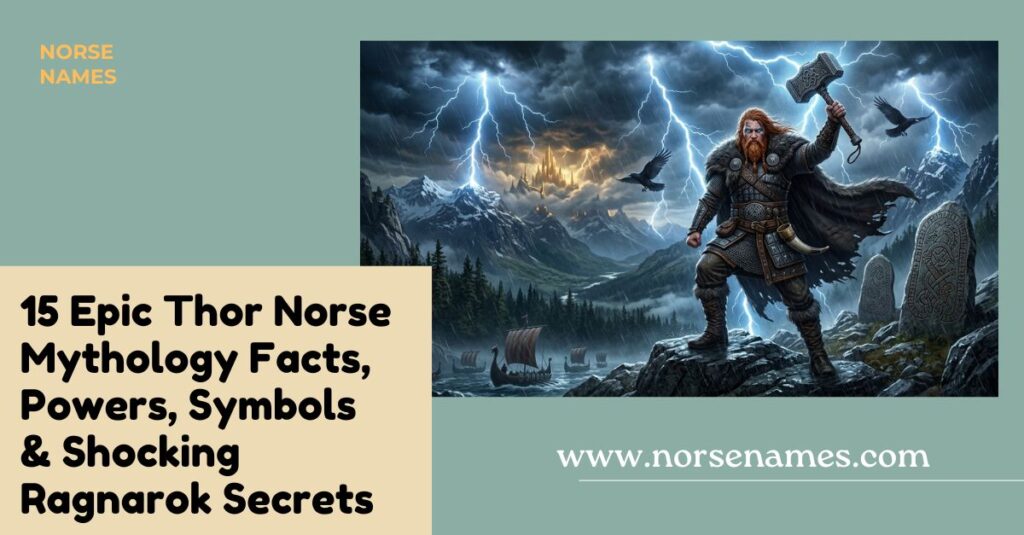

Lightning splits the sky over a storm-tossed sea, and somewhere above the clouds a hammer is spinning back toward the hand that threw it. This is the world that Thor norse mythology has handed down to us for over a thousand years — a world of crashing thunder, giant-slaying battles, and a red-bearded god who would rather solve a problem by smashing it than by talking it out. Few figures from the old Norse sagas have survived as vividly into the modern imagination as Thor, and that staying power isn’t an accident.
Long before he was a comic book hero, Thor mythology described him as the god Viking farmers prayed to before a voyage, the protector invoked to keep crops safe and ships afloat, and the deity whose hammer marks were carved into amulets worn around the neck for luck and protection. He sat at the center of everyday Norse life in a way that even Odin, the wise and distant Allfather, never quite managed. Odin was for kings and poets; the Norse god Thor was for everyone else.
For writers, gamers, and worldbuilders, Thor offers something rare: a character who is simultaneously cosmic and relatable. He battles world-ending giants and serpents large enough to encircle the earth, yet he’s also hot-tempered, a little slow to catch a joke, fiercely loyal, and prone to losing his hammer in genuinely embarrassing ways. That blend of epic stakes and human flaws is exactly why the thunder god mythology surrounding the thunder god remains one of the most borrowed templates in fantasy fiction and tabletop gaming today, and why his story is worth understanding in real depth rather than just skimming the highlights.
Who Is Thor in Norse Mythology?
Thor is the Norse god of thunder, storms, strength, and protection, and one of the most powerful figures in the entire Norse pantheon. Thor meaning traces back to the Old Norse “Þórr,” directly related to the word for thunder, and variations of it survive across Germanic languages — the English weekday “Thursday” literally means “Thor’s Day.” That linguistic fingerprint alone tells you how deeply this god of thunder norse mythology built around him became woven into the daily rhythm of life across Northern Europe.
Unlike Odin, who ruled from a throne of secrets, prophecy, and sacrifice, Thor was a working god. He didn’t deal in riddles. He dealt in giants, storms, and the literal defense of Asgard and Midgard from the chaos pressing in at the edges of the nine realms. Sailors prayed to him before crossing dangerous waters. Farmers thanked him for rain. Warriors carried his symbol into battle. In a mythology full of gods with complicated, often morally gray motivations, the Thor god’s purpose was refreshingly direct: protect the realms, smash the giants, keep the world standing until Ragnarok finally arrives.
This straightforwardness is part of what makes him such rich material for fantasy worldbuilding. A god defined by clear purpose and physical power gives storytellers an anchor point — a character whose motivations never need much explaining, even as the myths around him get stranger and more elaborate.
Thor Is the God of Which Religion?
Thor belongs to the ancient Norse religion, also called Norse paganism or Old Norse religion, practiced across Scandinavia and other Germanic-speaking regions before the spread of Christianity. This belief system was polytheistic, centered on a pantheon of gods and goddesses known as the Aesir and Vanir, with Thor standing as one of its most widely worshipped figures.
Within this religion, Thor specifically governed thunder, storms, strength, and the protection of both gods and ordinary people. Viking-age Scandinavians prayed to him more frequently than almost any other deity, since his domain touched daily survival directly — safe harvests, safe sea crossings, and safety from hostile raiders or supernatural threats. While Norse religion as an organized practice largely faded after Christianization swept through Scandinavia between the 10th and 12th centuries, Thor’s name, symbols, and stories survived in folklore, place names, and the surviving texts of the Poetic Edda and Prose Edda.
Thor Norse Mythology Facts
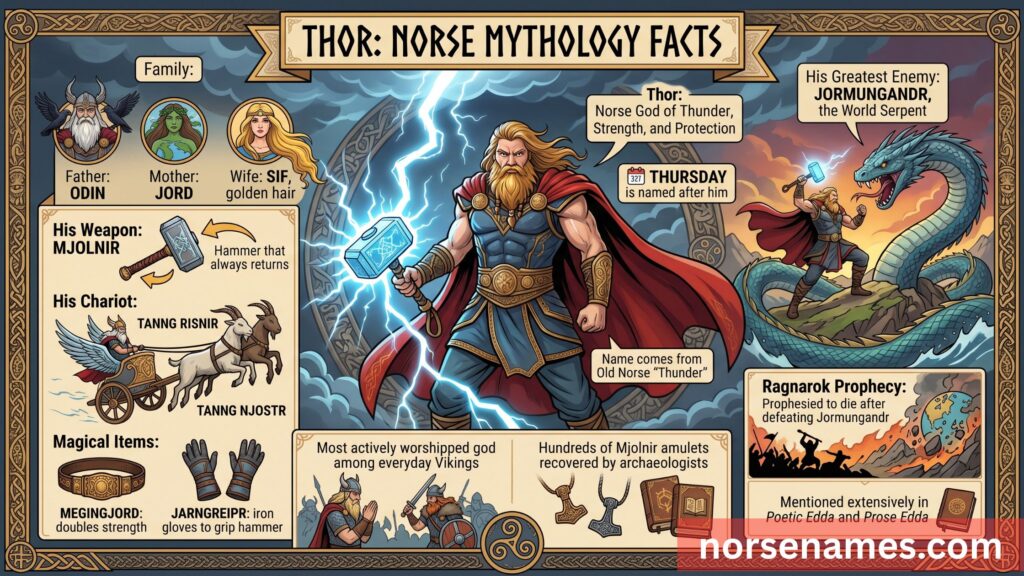
Here are some quick, essential Thor facts that capture his core identity:
- Thor is the Norse god of thunder, storms, strength, and protection
- His name comes from the Old Norse word for “thunder”
- Thursday is named directly after him
- His father is Odin, ruler of the Aesir gods
- His mother is Jord, a personification of the earth
- His wife is Sif, known for her golden hair
- His weapon is Mjolnir, a hammer that always returns to his hand
- He travels in a chariot pulled by two goats, Tanngrisnir and Tanngnjostr
- He wears a belt called Megingjord that doubles his strength
- He wears iron gloves called Jarngreipr to properly grip his hammer
- His greatest enemy is Jormungandr, the World Serpent
- He is prophesied to die at Ragnarok after defeating Jormungandr
- He was the most actively worshipped god among everyday Vikings
- Hundreds of Mjolnir amulets have been recovered by archaeologists
- He is mentioned extensively in both the Poetic Edda and Prose Edda
Thor Family Tree and Relationships
Thor’s family tree includes Odin, Jord, Sif, Thrud, Magni, and Modi, connecting him to many of the most important figures in Norse mythology.
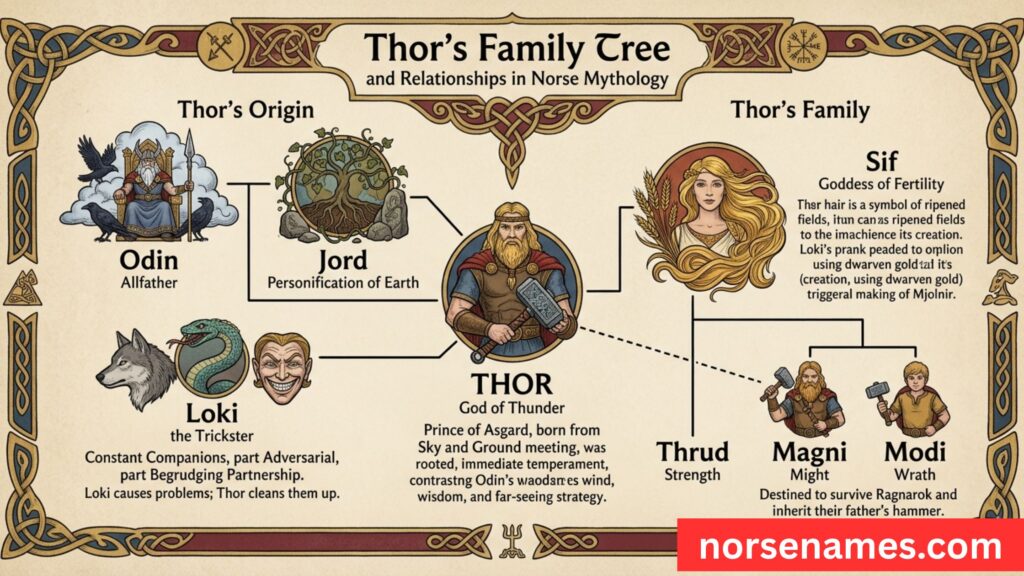
His father is Odin, the Allfather and ruler of Asgard, which makes Thor a prince of the gods by birth. His mother is Jord (sometimes called Fjorgyn), a personification of the earth itself — a detail that feels almost poetic, since the thunder god is literally born from sky and ground meeting. This parentage also explains why Thor, despite being Odin’s son, has a noticeably different temperament than his father; where Odin is associated with wind, wisdom, and far-seeing strategy, Thor is rooted, physical, and immediate.
His relationship with Loki deserves special mention. The two are constant companions throughout the myths, traveling together on multiple adventures, and their dynamic is part adversarial, part begrudging partnership. Loki causes problems; Thor cleans them up, usually by threatening to crush Loki’s skull. It’s a relationship built on mutual exasperation that nonetheless produces some of the most entertaining stories in Viking mythology.
Thor Norse Mythology Wife
Thor’s wife is Sif, a goddess best known in the myths for her long golden hair, often interpreted by scholars as a symbol of ripened wheat or fertile fields. Her hair was famously cut off by Loki in one of the trickster’s more chaotic pranks. To make amends, Loki commissioned the dwarves to forge new hair for Sif out of real gold, an episode that ultimately led to the creation of several legendary treasures, including Thor’s own hammer, Mjolnir.
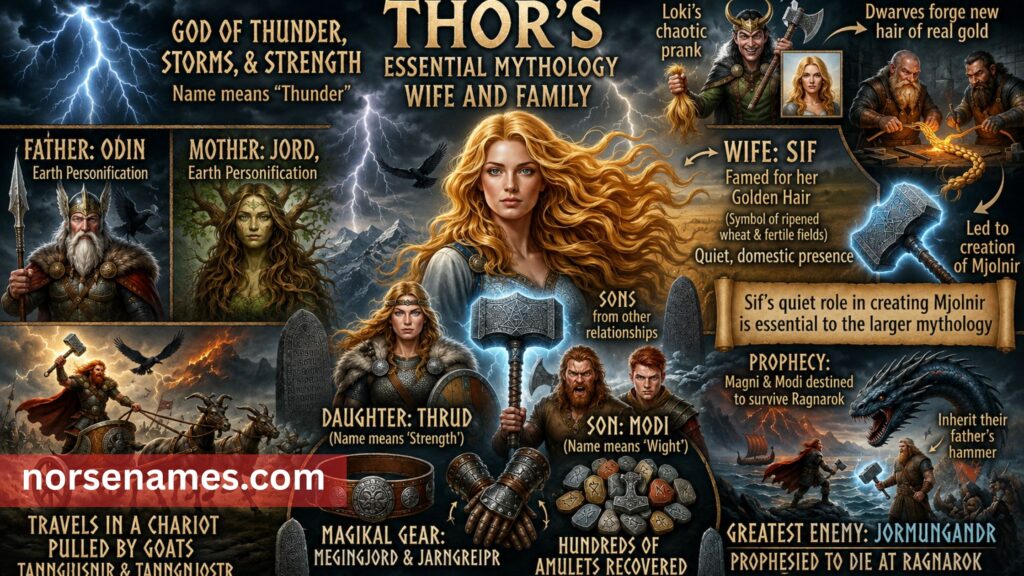
Together Thor and Sif have a daughter, Thrud, whose name means “strength,” fittingly. Sif is portrayed as a quieter, more domestic presence compared to her husband, but her role in triggering the chain of events that produced Mjolnir makes her quietly essential to the larger mythology. Thor’s children also include sons from other relationships, most notably Magni and Modi, whose names mean “might” and “wrath.” According to prophecy, these two are destined to survive Ragnarok and inherit their father’s hammer once the dust of the final battle settles.
Thor Norse Mythology Powers
Thor’s power set is built around raw physical strength, mastery over storms, and an unusually direct connection to thunder and lightning — he doesn’t summon storms so much as embody them.
His central attribute is immense strength, often described as the greatest of any god in Asgard. Norse texts repeatedly emphasize that Thor’s might is unmatched even among the giants of Jotunheim, who are themselves portrayed as towering, overwhelming forces of nature. He’s the one the other gods call on when something needs to be physically defeated rather than outsmarted.
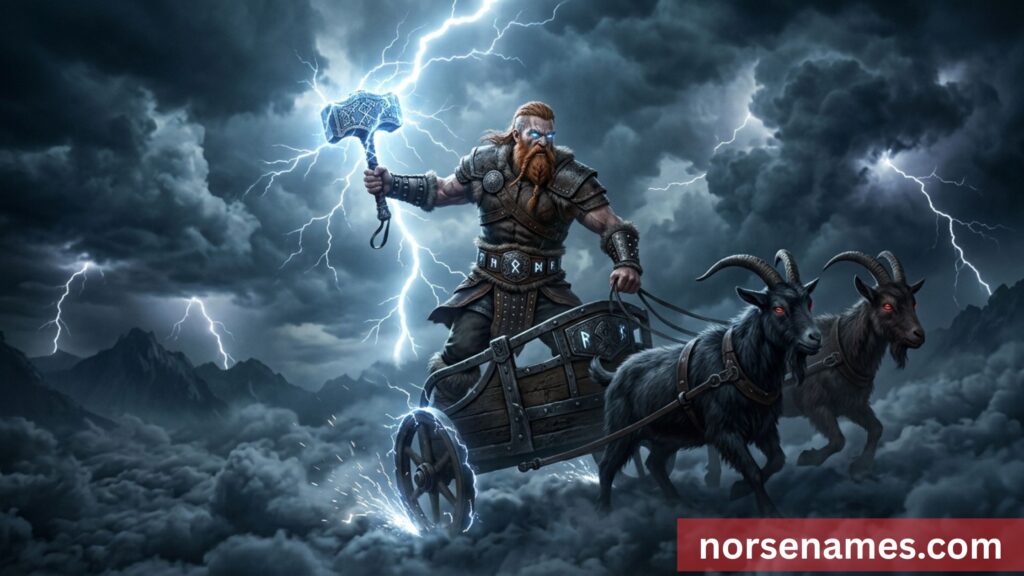
His command over thunder and lightning ties him to weather itself. Storms were understood as the sound of Thor’s chariot rolling across the sky, and thunder was the literal noise of that journey — an image that remains one of the most evocative pieces of imagery in all of Norse religion.
Several tools amplify his natural strength further:
- Mjolnir, his hammer, capable of leveling mountains and returning to his hand after being thrown
- Megingjord, a belt that doubles his already considerable strength when worn
- Jarngreipr, iron gloves required to properly grip Mjolnir’s short handle
- His chariot, pulled by two goats, which generates thunder as it crosses the sky
These items matter for worldbuilding purposes because they show that even Norse mythology’s strongest god isn’t simply invincible by default — his power is partly earned through equipment and ritual, a detail that fantasy systems borrow constantly when building their own magic-item economies.
Mjolnir: Thor’s Hammer and Its Meaning
Thor’s hammer, Mjolnir, is one of the most famous weapons in Norse mythology and symbolizes protection, strength, and divine power. No discussion of Thor’s weapon is complete without Mjolnir, the legendary hammer that has become the single most recognizable symbol tied to him. The Mjolnir meaning is debated among scholars, but it likely derives from a root word connected to “lightning” or “to grind, crush,” fitting for a weapon capable of slaying giants with a single blow.
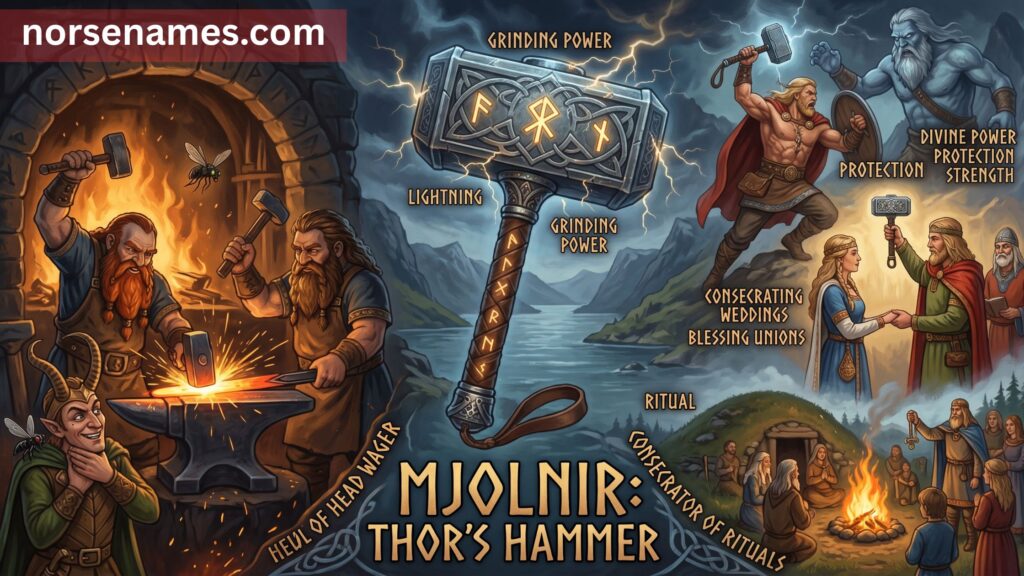
According to the myths, Mjolnir was forged by the dwarf brothers Brokkr and Eitri after Loki, in one of his usual schemes, wagered his own head on a bet about whether the dwarves could outcraft other magical treasures. The hammer came out slightly short-handled due to Loki’s interference mid-forging, but its power was unmatched regardless — capable of returning to Thor’s hand after being thrown, never missing its target, and shrinking small enough to be hidden inside his shirt.
Mjolnir wasn’t only a weapon. It was used in Norse wedding ceremonies to bless unions, and in rituals to consecrate births and even funerals, which says a great deal about how central this single object was to the spiritual life of Viking-Age Scandinavia.
Famous Thor Myths and Stories
The surviving Thor myths preserved in the Poetic Edda and Prose Edda reveal him as the fearless protector of both gods and humans.
One of the most famous Thor mythology stories is the theft of his hammer, recounted in the poem Þrymskviða. The giant Thrym steals Mjolnir and refuses to return it unless he’s given Freya as his bride. Freya refuses outright, so Loki convinces the thunder god to disguise himself as a bride instead, veil and all, and travel to the giants’ hall to retrieve the hammer. The myth is equal parts absurd and tense, ending — predictably — with Thor revealing himself and slaughtering every giant in the hall once Mjolnir is back in his hands.
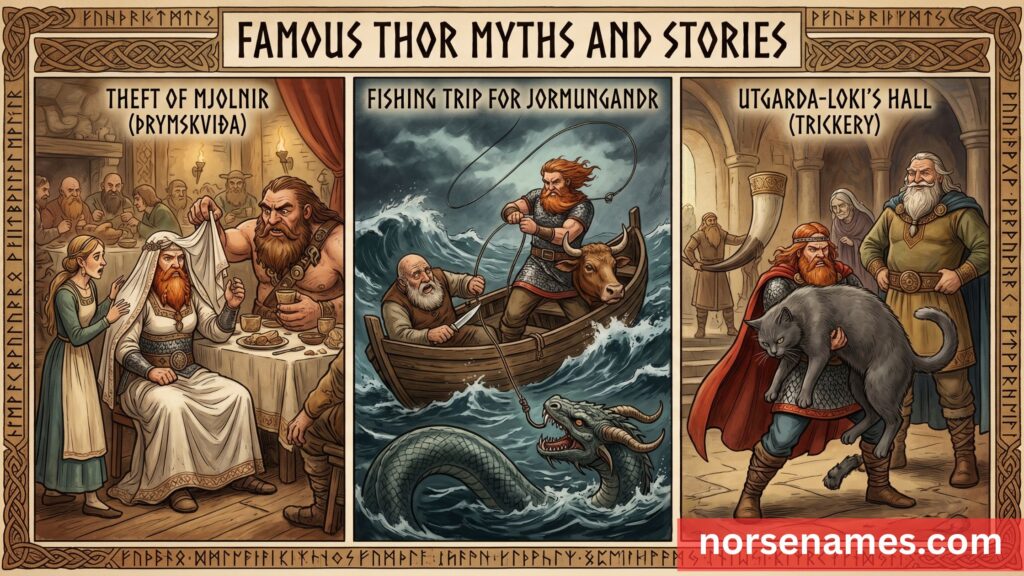
Another major story is Thor’s fishing trip with the giant Hymir, during which Thor uses an ox head as bait and very nearly succeeds in hauling the World Serpent, Jormungandr, up out of the sea. The giant cuts the line at the last second out of sheer terror, denying the thunder god a premature confrontation with his ultimate enemy. This near-meeting is the first chapter in what becomes the defining rivalry of Thor vs Jormungandr, a conflict mythology promises will finally be settled at Ragnarok.
Thor’s journey to the hall of the giant Utgarda-Loki is another standout among Thor legends, full of trickery and humbled pride. Thor and his companions are challenged to a series of contests — a drinking horn that seems impossible to empty, an old woman who proves unbeatable at wrestling, a cat that won’t be lifted off the ground — only for the red-bearded god to learn afterward that he’d actually accomplished feats no mortal should have managed; the “horn” was connected to the ocean, the “woman” was old age itself, and the “cat” was Jormungandr in disguise. It’s one of the cleverest stories in the Prose Edda, blending humility with cosmic scale.
Thor Norse Mythology Creatures
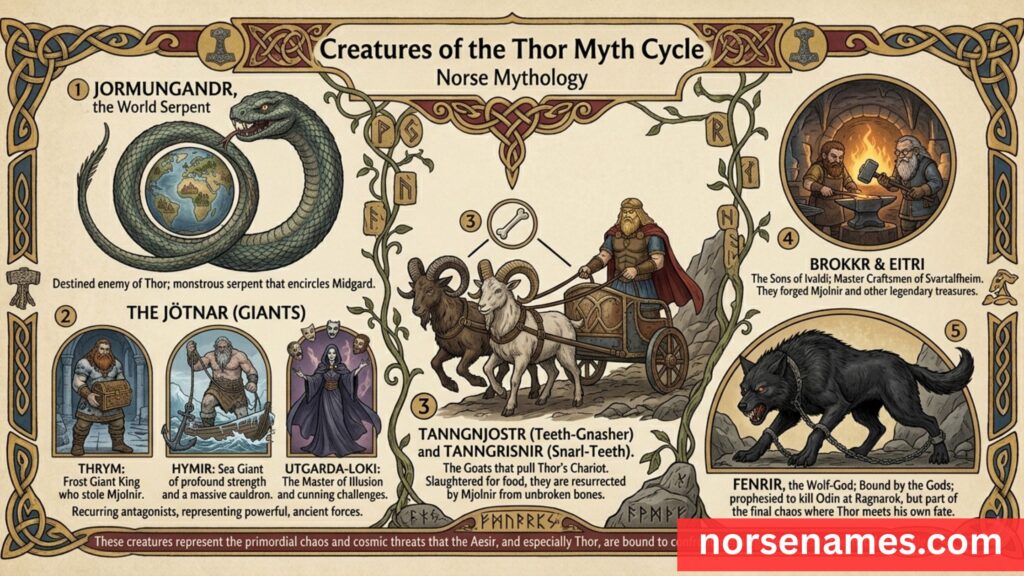
Thor’s stories are populated by an unusually rich cast of mythological beings, many of which have become iconic in their own right.
- Jormungandr, the World Serpent — Thor’s destined enemy, a creature so large it encircles all of Midgard while biting its own tail
- The Jötnar (giants) — recurring antagonists throughout Thor’s adventures, including Thrym, Hymir, and Utgarda-Loki
- Tanngrisnir and Tanngnjostr — the two goats that pull Thor’s chariot, who can be slaughtered for food and resurrected the next morning as long as their bones remain unbroken
- Dwarves — the master craftsmen, particularly Brokkr and Eitri, who forged Mjolnir itself
- Fenrir — while primarily associated with Odin’s fate at Ragnarok, this monstrous wolf belongs to the same prophesied final battle in which Thor meets his own end
These creatures aren’t just obstacles in Thor’s path; they represent the broader forces of chaos that Norse mythology positions this Norse deity against, making him the gods’ primary line of defense against the monstrous and the uncontrolled.
Thor Norse Mythology Symbol
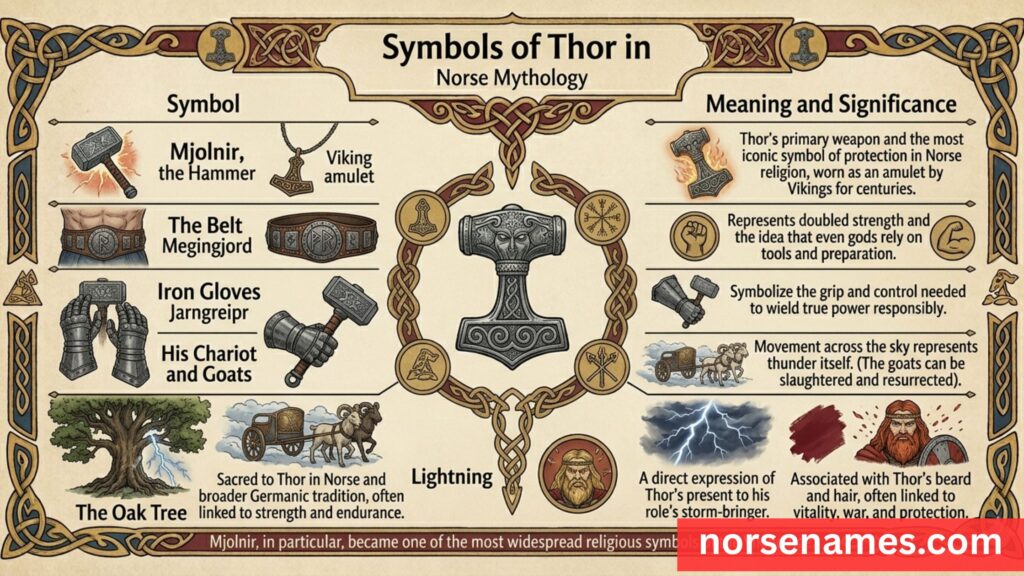
The most recognizable Thor symbol is Mjolnir, although lightning, oak trees, and goats are also closely associated with him.
| Symbol | Meaning and Significance |
|---|---|
| Mjolnir, the hammer | Thor’s primary weapon and the most iconic symbol of protection in Norse religion, worn as an amulet by Vikings for centuries |
| The belt Megingjord | Represents doubled strength and the idea that even gods rely on tools and preparation |
| Iron gloves Jarngreipr | Symbolize the grip and control needed to wield true power responsibly |
| His chariot and goats | Tanngrisnir and Tanngnjostr pull his chariot, and their movement across the sky represents thunder itself |
| The oak tree | Sacred to Thor in Norse and broader Germanic tradition, often linked to strength and endurance |
| Lightning | A direct expression of Thor’s presence and anger, tied to his role as storm-bringer |
| The color red | Associated with Thor’s beard and hair, often linked to vitality, war, and protection |
Mjolnir in particular became one of the most widespread religious symbols of the Viking Age, often worn alongside or even instead of Christian crosses during the transitional period when the two faiths coexisted across Scandinavia. Archaeologists have recovered hundreds of hammer pendants from graves and hoards, a clear sign of how personally Vikings connected with Thor’s protection.
Thor and Viking Culture: Why Thursday Carries His Name
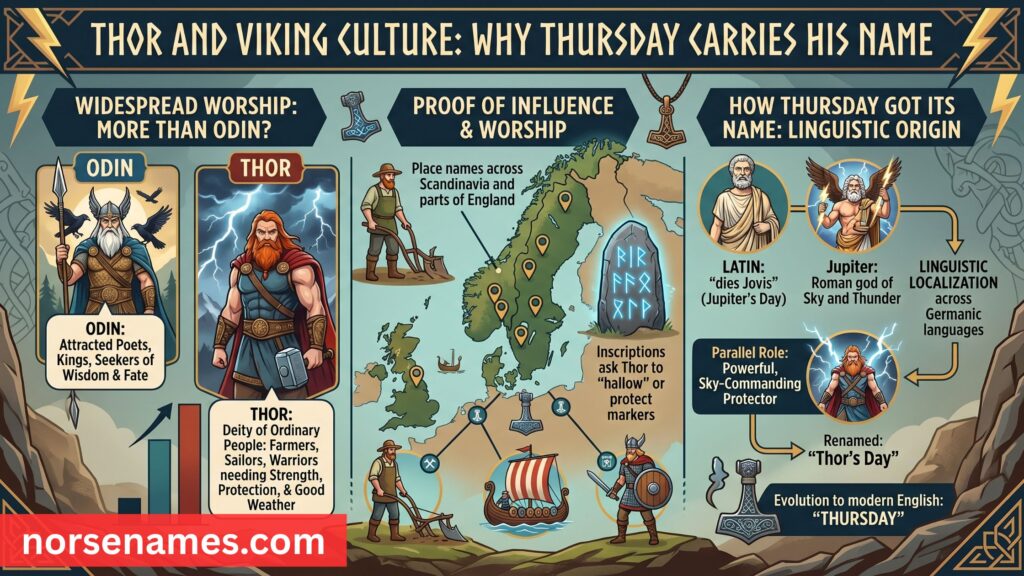
Thor wasn’t a distant, abstract figure in Viking society — he was arguably the most actively worshipped god in everyday life, more so than the famously powerful Odin. While Odin attracted poets, kings, and those seeking wisdom or fate-bending favor, this Viking god was the deity of ordinary people: farmers, sailors, and warriors who needed strength, protection, and good weather more than they needed prophecy.
Place names across Scandinavia and parts of England still carry his name, and runestones frequently include inscriptions asking Thor to “hallow” or protect the markers themselves. This brings us to a question many readers ask: why is Thursday named after Thor? The answer lies in a linguistic pattern across Germanic languages, where Latin “dies Jovis” (Jupiter’s Day) was localized to fit local deities of thunder and sky. Since Thor occupied a role parallel to Jupiter — a powerful, sky-commanding protector — Germanic peoples renamed the day “Thor’s Day,” which evolved into the modern English “Thursday.”
Thor vs Marvel Thor: What’s the Difference?
Anyone researching Thor today inevitably runs into two very different versions of the character: the mythological Thor described in the Eddas, and the modern Marvel Thor familiar from comics and film. While they share a name, a hammer, and a handful of family members, the two versions diverge sharply once you look closely.
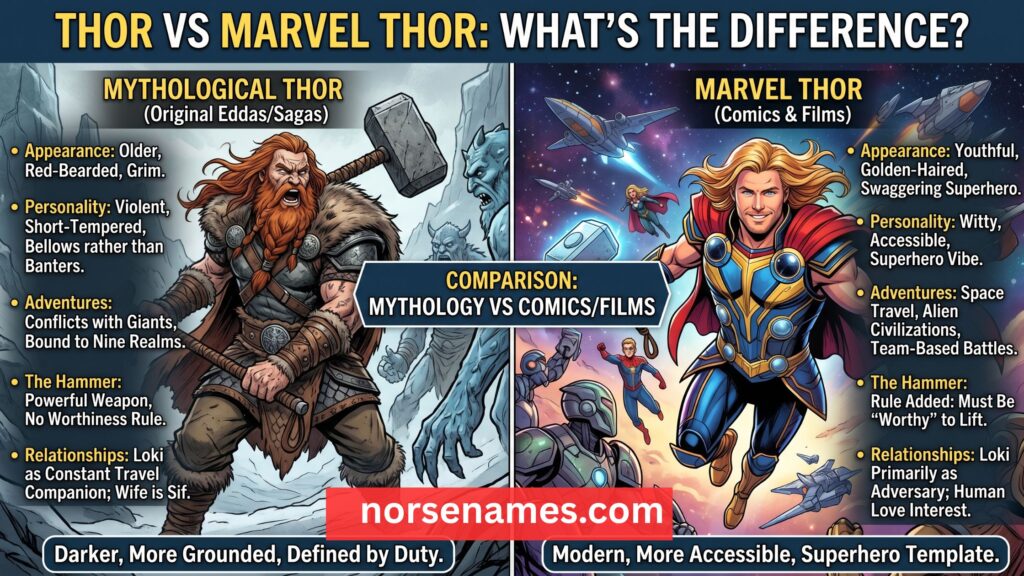
Comic book Thor, as created by Marvel, is typically portrayed as clean-shaven or golden-haired, youthful, witty, and closer to a swaggering superhero than a grim protector god. Marvel Thor’s adventures usually involve space travel, alien civilizations, and team-based battles alongside other superheroes, none of which appear anywhere in the original sagas. His hammer in the comics also carries an added rule not found in mythology — that only those deemed “worthy” can lift it — a dramatic device invented for storytelling purposes rather than drawn from any Old Norse source.
This mythological figure, by contrast, is older, red-bearded, bound entirely to the nine realms, and far more violent and short-tempered in his original stories. He doesn’t banter so much as bellow, and his conflicts are almost always with giants rather than alien armies or cosmic supervillains. His relationships, too, differ substantially: in mythology, Loki is a constant travel companion rather than primarily an adversary, and Thor’s wife is Sif rather than the human love interest featured in Marvel’s films.
For worldbuilders and writers, understanding this gap matters. Drawing inspiration from Thor in Marvel gives you a more modern, accessible superhero template, while drawing from the original myths gives you access to a darker, more grounded, and arguably richer mythological figure — one defined by duty, family, and an unglamorous willingness to do the dirty work of protecting the realms.
Thor Norse Mythology Names
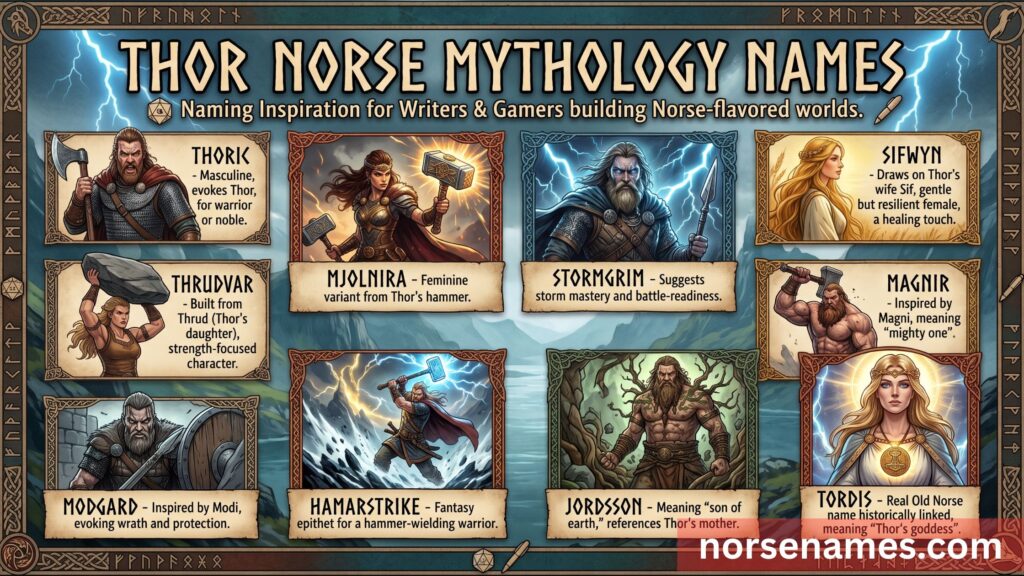
Writers and gamers building Norse-flavored worlds often look to Thor and his mythology for naming inspiration. Below are name ideas connected to his story, useful for characters, clans, or fantasy settings.
- Thoric — a masculine name evoking Thor’s own, suited to warrior or noble characters
- Mjolnira — a feminine variant built from the name of Thor’s hammer
- Stormgrim — a fantasy surname suggesting storm mastery and battle-readiness
- Sifwyn — drawing on Thor’s wife, suited to a gentle but resilient female character
- Thrudvar — built from Thrud, Thor’s daughter, fitting for a strength-focused character
- Magnir — inspired by Magni, meaning “mighty one”
- Modgard — inspired by Modi, evoking wrath and protection
- Hamarstrike — a fantasy epithet for a hammer-wielding warrior
- Jordsson — meaning “son of earth,” referencing Thor’s mother
- Tordis — a real Old Norse name historically linked to Thor’s name, meaning “Thor’s goddess”
These names work especially well in settings involving storm magic, blacksmithing cultures, or warrior clans descended from a thunder deity, and they can be mixed freely with other Norse-inspired naming conventions for a cohesive fantasy world.
FAQs:
Who Killed Thor in Norse Mythology?
Thor was not killed by another god or by any single giant in personal combat. During Ragnarok, Thor faces his lifelong enemy, the World Serpent Jormungandr, and succeeds in killing it. However, immediately afterward, Odin’s son manages only nine steps before collapsing and dying from the serpent’s deadly venom, which has poisoned his blood during the fight. His death is framed as a triumphant final victory rather than a defeat, since he successfully eliminates one of the greatest threats to the nine realms even at the cost of his own life.
Was Thor a Real Norse God?
Yes, Thor was a real deity in ancient Norse religion, although he was not a historical person. He was one of the most widely worshipped gods during the Viking Age and was revered as the god of thunder, storms, strength, and protection. Archaeological discoveries, including Mjolnir hammer amulets, runestones, and historical texts such as the Poetic Edda and Prose Edda, confirm that belief in Thor was an important part of Norse paganism across Scandinavia.
Who Came First, Jesus or Odin?
According to historical records, Jesus lived during the early 1st century CE in the Roman province of Judea, while Odin belongs to the much older traditions of Germanic and Norse mythology that developed over many centuries before being written down in medieval Iceland. As a historical figure, Jesus lived in the 1st century, whereas Odin is a mythological deity whose worship predates the Viking Age but is not tied to a single historical lifetime. Since one is a historical religious figure and the other is a mythological god, they come from different traditions and cannot be directly compared in the same way.
Is Thor Actually Odin’s Son?
Yes, in Norse mythology, Thor is the son of Odin, the Allfather and ruler of the Aesir gods. His mother is Jord (also called Fjorgyn), the personification of the Earth. This parentage makes Thor one of the most powerful gods in the Norse pantheon and explains his role as Asgard’s greatest protector. Although modern adaptations sometimes change family relationships, the original Norse myths consistently describe Thor as Odin’s son.
What Is Thor the God of?
Thor is the Norse god of thunder, lightning, storms, strength, and protection. In ancient Norse religion, he was regarded as the defender of both gods and humans, using his legendary hammer, Mjolnir, to protect Asgard and Midgard from giants and other forces of chaos. During the Viking Age, Odin’s son was one of the most widely worshipped deities because people believed he safeguarded their homes, crops, voyages, and communities.
Conclusion
Thor Norse mythology reveals far more than the story of a powerful thunder god. It introduces a protector whose immense strength is balanced by loyalty, courage, and a deep sense of duty. From his legendary hammer Mjolnir and his wife Sif to his remarkable powers, sacred symbols, and battles against giants and mythological creatures, Thor remains one of the most important figures in Norse religion. His heroic journey reaches its climax at Ragnarok, where he sacrifices his life after defeating the World Serpent, Jormungandr, securing his place as one of mythology’s greatest champions.
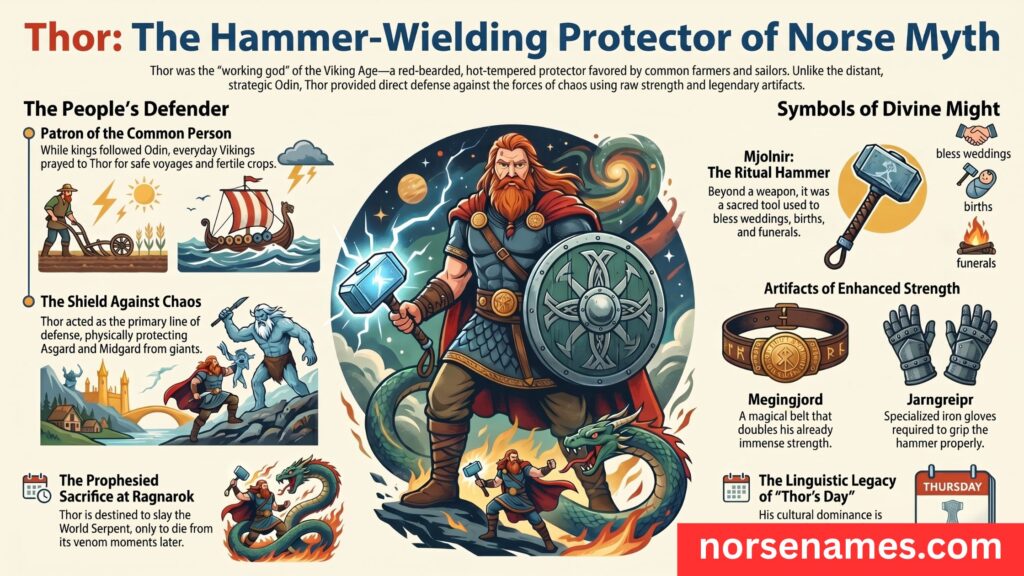
Even today, Thor’s legacy continues to inspire readers, writers, gamers, and worldbuilders around the world. Whether you’re exploring Viking mythology, searching for authentic Norse-inspired names, building a fantasy world, or simply comparing the mythological Thor with his modern Marvel counterpart, his stories offer timeless lessons about bravery, sacrifice, and resilience. As one of the most enduring gods in Norse mythology, Thor remains a fascinating figure whose influence stretches from ancient Scandinavia to modern popular culture.