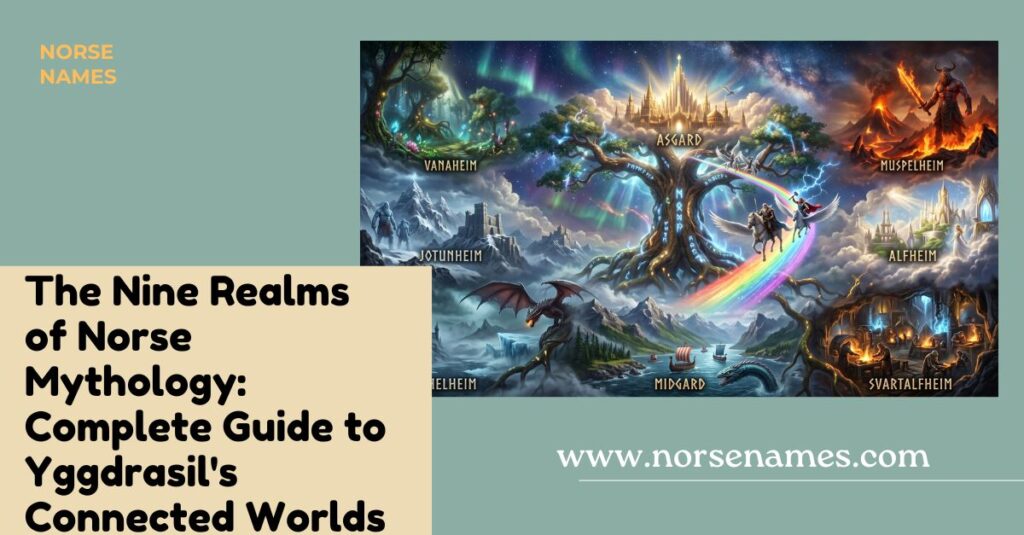

Imagine standing at the base of an impossibly vast tree, its roots stretching into darkness and its branches reaching beyond the stars. This is Yggdrasil, the World Tree of Norse mythology, and it holds something truly extraordinary: the nine realms, each one a completely distinct world inhabited by gods, giants, dwarves, elves, and the souls of legendary warriors. These aren’t merely storytelling devices—they represent an ancient Norse understanding of a layered cosmos where every realm serves a purpose in the greater cosmic order that everything from Odin’s wisdom to Thor’s hammer connects.
The nine realms form the backbone of one of history’s most captivating mythological systems. Vikings didn’t imagine a flat, single world with heaven and hell hanging somewhere above and below. Instead, they envisioned a complex, interconnected universe where Asgard and Midgard touched, where the bridge Bifrost carried travelers between worlds, and where destiny was woven by fate itself. Understanding how these realms connect transforms how we read Norse mythology—it explains why battles matter, where heroes go after they fall in glory, and how the entire Norse cosmology is destined to end in Ragnarok and be reborn.
For modern writers, game designers, and worldbuilding enthusiasts, the nine realms offer an unmatched template for creating immersive, layered universes. The beauty of this ancient Norse cosmology lies in its structural elegance: each realm has distinct geography, inhabitants, and purpose, yet they’re all bound together by Yggdrasil’s cosmic scaffolding. This guide explores every realm in the Norse mythology universe, from the fiery chaos of Muspelheim ruled by Surtr to the peaceful gardens of Vanaheim, giving you the authentic mythology and practical inspiration for your own creative projects.
What Are the Nine Realms? Defining Norse Mythology’s Universe
The nine realms (or “Níu Heimar” in Old Norse) represent the complete Norse cosmology and mythology system—nine separate, interconnected worlds that exist simultaneously within and around the branches and roots of Yggdrasil, the World Tree. Each realm occupies its own space in this cosmic structure yet remains eternally linked to all the others through this magnificent tree and the beings who travel between them.
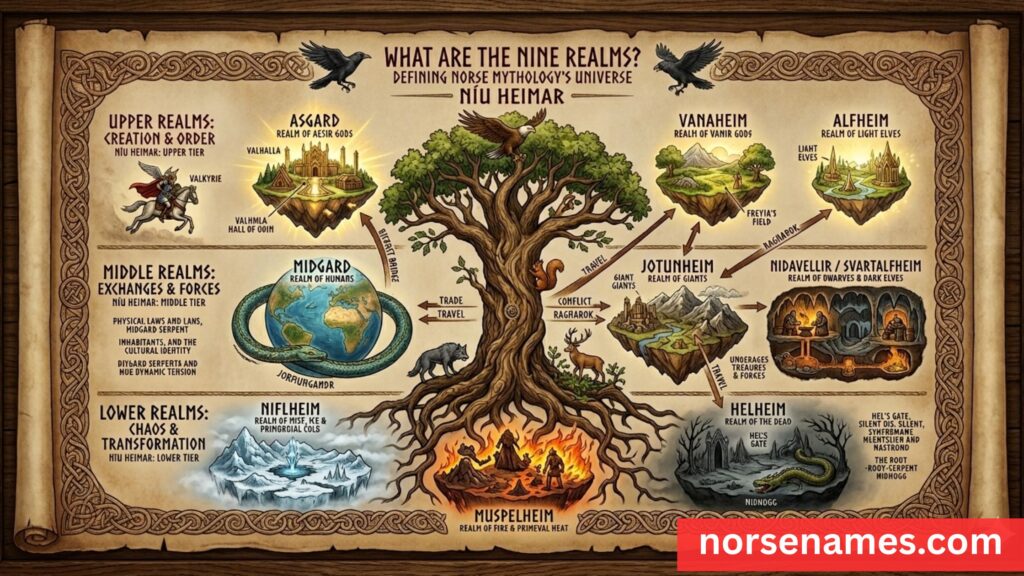
Think of the nine realms less like separate planets and more like distinct dimensions or planes of existence, each with its own physical laws, inhabitants, and cultural identity. A Norse warrior might spend his life in Midgard (the realm of humans), die in glorious battle, be chosen by a Valkyrie, and spend eternity in Valhalla—technically part of Asgard, the realm of the gods. A dwarf born in Svartalfheim might trade goods in Asgard’s markets, encounter a giant in Jotunheim, and eventually face destruction in Ragnarok. The realms exist in a state of dynamic tension and exchange—isolation is impossible, interaction inevitable.
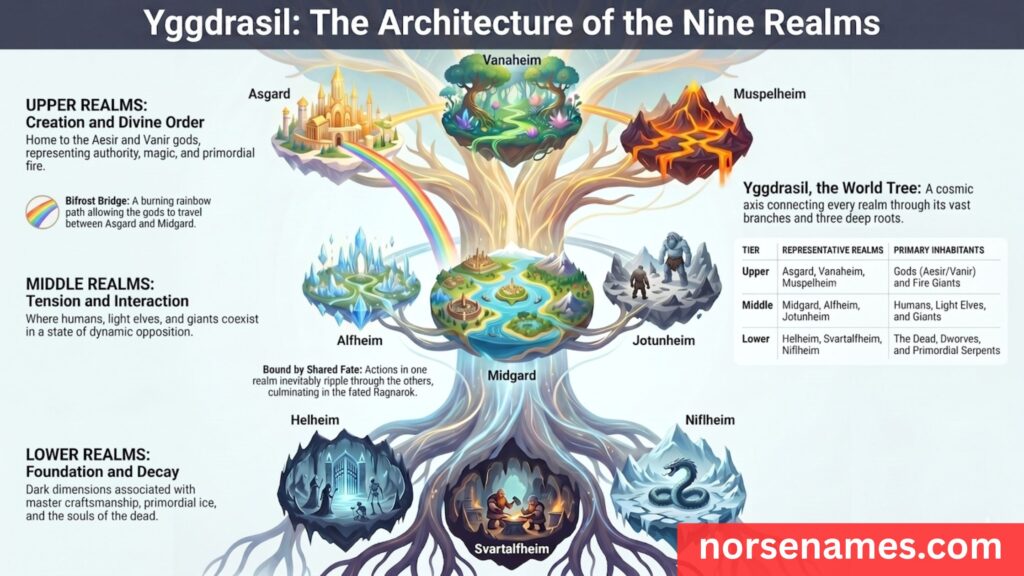
Norse mythology presents these nine worlds in a hierarchical, tripartite structure: three upper realms populated primarily by beings of creation and divine order, three middle realms home to humans and various elemental forces, and three lower realms associated with chaos, darkness, and the necessary forces of transformation. This threefold division reflects the ancient Norse desire to organize cosmic complexity into meaningful patterns.
How Are the Nine Realms Connected? Understanding Yggdrasil, the World Tree
The nine realms couldn’t exist as a unified mythology without Yggdrasil, the World Tree—the cosmic axis that literally connects every world together. This isn’t merely a poetic metaphor but the central mechanism of Norse cosmology. Yggdrasil’s enormous roots reach down into each of the lower realms, its trunk rises through the middle worlds, and its branches extend into the upper realms. Think of it as a cosmic spine connecting every realm into one interconnected universe.
One root of Yggdrasil extends into Asgard, where it’s nourished by the Norns (female beings of fate) and the spring Urd. Another root reaches into Jotunheim, the realm of giants, touching the spring Mimir—whose waters contain all wisdom and memory. The third root extends into Niflheim, the primordial realm of mist and cold, where it’s watered by Hvergelmir, the spring that flows throughout all nine realms. These three roots represent how all creation connects: through the divine order of Asgard, through the primal forces of Jotunheim, and through the ancient wellspring of Niflheim.
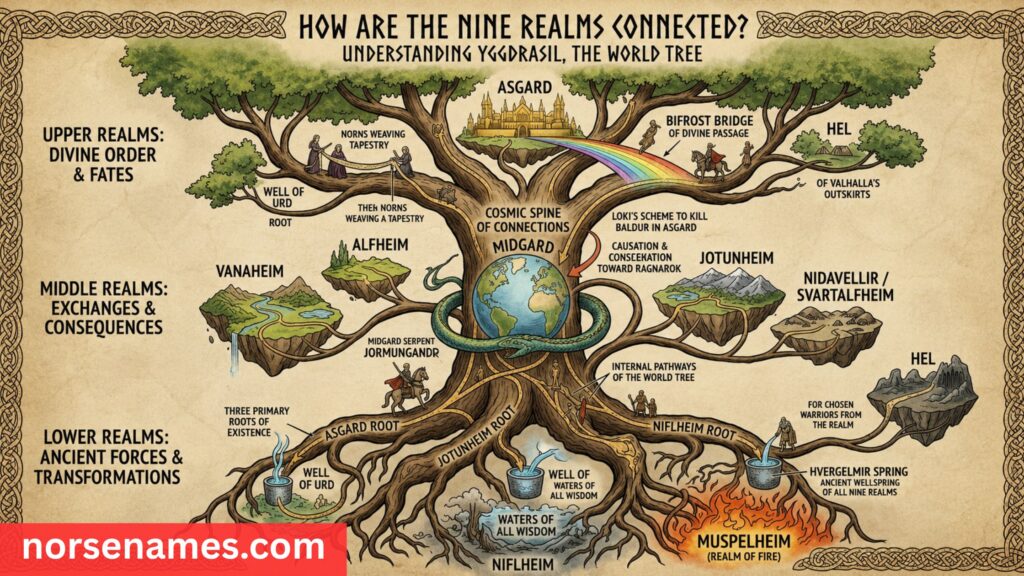
Between these realms travel various pathways and beings. The Bifrost Bridge—a rainbow arc of fire, water, and air—connects Asgard directly to Midgard, allowing the gods to travel between the realm of humans and the realm of divine beings. The Norns walk along Yggdrasil’s trunk, weaving the fates of all beings in all nine realms. Even in death, Norse mythology describes a journey along Yggdrasil’s paths: when a warrior falls in battle and is chosen by the Valkyries, they’re carried not merely to Valhalla but along the World Tree itself.
The connection between realms explains how Norse mythology accounts for causation and consequence across seemingly separate worlds. When Loki, the trickster god of Asgard, schemes to kill Baldur (another god), the ripple effects echo through Midgard and ultimately accelerate the approach of Ragnarok, the fated destruction that will consume all nine realms. Events in one realm inevitably affect the others because they’re all part of a single, interconnected Norse cosmology.
The Nine Realms Explained: Each World of Norse Mythology
Asgard: Realm of the Aesir Gods
Asgard is the golden realm of the Aesir gods—the primary pantheon of Norse mythology. This is where Odin All-Father reigns, where Thor holds court, where Frigg watches over all beings, and where the gods conduct the governance of the entire universe. Asgard contains Valhalla, the great hall where fallen warriors feast and prepare for Ragnarok’s final battle, making it not just a place of peace but a military fortress.
The most famous location in Asgard is Gladsheim, the sacred hall where the Aesir gods meet in council to decide the fates of all nine realms. Asgard also contains Idavoll, the plain where the gods gather, and Idunn’s garden, where the goddess Idunn tends the golden apples of immortality that keep the gods from aging. These aren’t merely decorative details but essential to understanding how Asgard maintains its power and authority throughout the Norse mythology universe.
Vanaheim: Realm of the Vanir Gods and Magic
Vanaheim is the fertile realm of the Vanir gods—a separate pantheon known for their association with magic, prosperity, and natural cycles. While the Aesir gods (led by Odin) represent authority and wisdom, the Vanir gods (including Freya and Freyr) represent the generative forces of nature, sexuality, and abundance. In Norse mythology, the Vanir and Aesir once fought a war, but eventually resolved their conflict through mutual exchange and intermarriage.
Vanaheim exists as an almost paradisiacal realm where crops grow abundantly, where magic flows more openly than in other worlds, and where the cycles of seasons determine much of existence. The goddess Freya rules here alongside Freyr, her brother, embodying the earth’s fertility and the prosperity that makes civilizations possible. For Vikings, Vanaheim represented the rewards of a peaceful world—plenty, pleasure, and the magic that connects humans to nature itself.
Muspelheim: Realm of Fire and Primordial Chaos
Muspelheim is one of the two primordial realms that existed before creation itself—a vast expanse of fire, heat, and chaos ruled absolutely by Surtr, the fire giant. This realm represents the primal force of destruction and passion, the heat from which all creation emerged. In Norse mythology, Muspelheim isn’t evil in a moral sense; rather, it embodies necessary chaos, the cosmic principle that creation requires destruction.
Surtr is described as more ancient than the gods themselves, with flames that burn brighter than the sun. During Ragnarok, Surtr and his fire giants will cross the Bifrost Bridge and set all nine realms ablaze—their flames will consume Asgard itself. Yet this destruction isn’t the end of Norse mythology but a necessary transformation. After Ragnarok’s fires consume the worlds, a new earth will emerge from the sea, and the cycle begins anew. Muspelheim thus represents both the origin of creation and its inevitable ending.
Niflheim: Realm of Mist, Ice, and Primordial Cold
Niflheim is the other primordial realm, existing as a vast expanse of mist, fog, and bitter cold. While Muspelheim represents the heat of creation, Niflheim represents the cold that preceded time itself. In Norse cosmology, before the worlds were formed, only Niflheim and Muspelheim existed—separated by a vast void called Ginnungagap. When these two realms approached each other, their opposing temperatures created the first matter, eventually leading to the creation of all nine realms.
Niflheim contains Hvergelmir, the spring from which all waters flow throughout the Norse mythology universe. Three rivers flow from Hvergelmir: one toward Asgard (called Slid), one toward Jotunheim (called Fimbulthul), and one toward Niflheim itself (called Svol). The primordial serpent Nidhogg gnaws eternally at Yggdrasil’s roots in Niflheim, slowly weakening the World Tree and advancing the approach of Ragnarok. This realm is thus not merely a place of cold but of ancient, inexorable decay.
Midgard: Realm of Humans and the Known World
Midgard is our world—the realm of humans, created by the gods from the corpse of the primordial giant Ymir. The nine realms of Norse mythology place Midgard in the literal center of the cosmos, positioned between the realm of fire (Muspelheim) and the realm of cold (Niflheim). The gods created a protective barrier around Midgard using Ymir’s eyebrows as a wall (called Midgard’s wall), defending it from the forces of chaos that surround it.
In Norse mythology, Midgard is where the greatest stories unfold—where heroes are born, where battles are fought, and where mortal destiny intersects with the fate of the gods themselves. The Bifrost Bridge connects Asgard directly to Midgard, allowing the Aesir gods to travel between their realm and ours. Many of the most famous Norse mythology stories involve gods journeying to Midgard to father heroes, test warriors, or shape the course of human history.
Jotunheim: Realm of Giants and Primal Opposition
Jotunheim is the realm of giants (jotnar)—primordial beings representing the forces that oppose divine order and stability. Where Asgard represents creation and authority, Jotunheim represents the raw, untamed power that existed before the gods imposed their rule. The giants aren’t evil in a moral sense within Norse mythology; rather, they embody the principle of opposition, the force that must continually be resisted to maintain cosmic order.
Giants like Thrym, Hrungnir, and Utgarda-Loki appear throughout Norse mythology engaged in conflicts with the gods and heroes. Thor’s greatest adventures involve journeys to Jotunheim to fight giants and steal their treasures. During Ragnarok, the giants will be the primary force opposing the gods—they’ll break free from their bonds, cross the Bifrost Bridge, and lead the assault that destroys Asgard itself. Yet their destruction is also the catalyst for renewal; without Ragnarok, the nine realms would remain static and unchanging.
Alfheim: Realm of Light Elves and Celestial Grace
Alfheim is the bright realm of the Light Elves, beings more divine and ethereal than their darker cousins. In Norse mythology, Alfheim exists as a realm of beauty, light, and celestial perfection—a place where the elves possess a more refined, god-like nature. The realm is ruled by Freyr, the Vanir god of summer and prosperity, who was given Alfheim as a gift at his birth.
The Light Elves of Alfheim differ from the dwarves of Svartalfheim—where dwarves are associated with earth, stone, and craftsmanship, the Light Elves represent air, light, and ethereal magic. In modern interpretations and fantasy worldbuilding, Alfheim often becomes a sanctuary of natural beauty and ancient wisdom, a realm where magic flows more openly than in Midgard but less chaotically than in Vanaheim.
Svartalfheim: Realm of Dwarves and Master Craftsmen
Svartalfheim (sometimes called Muspelheim in certain sources) is the realm of the dwarves—the Dark Elves or Svartalfar—who are master craftsmen and smiths. This realm is often depicted as existing deep within the earth or within the roots of Yggdrasil itself, a place of stone, fire, and incredible craftsmanship. The dwarves of Svartalfheim created many of the most powerful artifacts in Norse mythology: Thor’s hammer Mjolnir, Odin’s spear Gungnir, Freyr’s ship Skidbladnir, and the magical chain Gleipnir that binds Fenrir.
The most famous dwarves in Norse mythology—Sindri, Brokkr, and Dvalin—are all associated with Svartalfheim. These aren’t merely workers but artists and magicians whose creations shape the course of all nine realms. Many Norse mythology stories involve heroes or gods traveling to Svartalfheim to commission weapons or receive magical items necessary for their survival. The realm represents practical power: the ability to create the tools that allow beings to achieve their goals.
Helheim (Niflheim): Realm of Death and the Dishonored Dead
Helheim—sometimes simply called Hel or the realm of Hel—is the underworld realm ruled by the goddess Hel, a being neither wholly alive nor dead. Unlike Valhalla (which receives warriors who die in glorious combat), Helheim receives those who died of sickness, old age, or dishonor. This isn’t necessarily a place of punishment in the Christian sense, but rather the natural destination for most people who die.
The realm of Hel is described as cold, misty, and gray—a dim reflection of Midgard where the dead exist in a diminished state. Hel herself is described as being half-living and half-dead in appearance, reflecting the liminal nature of her realm. The goddess Hel is Loki’s daughter, making the underworld realm of Norse mythology connected to the trickster god’s lineage. During Ragnarok, Hel will release her dead, and her ship Naglfar (made from the fingernails of the dead) will sail forth to participate in the final destruction.
Muspelheim vs Niflheim: The Twin Primordial Realms
Understanding the distinction between Muspelheim and Niflheim is crucial to grasping Norse cosmology. These two primordial realms represent complementary opposites: fire and ice, heat and cold, creation and dissolution. Before the other seven realms existed, only these two eternal forces occupied the void.
In the Norse cosmology, the interaction between Muspelheim’s heat and Niflheim’s cold created the conditions for existence itself. The primordial giant Ymir emerged from this meeting of opposites, and from Ymir’s body, the gods created all nine realms. This reflects a sophisticated understanding of creation through the interaction of opposing forces—a principle found in many ancient worldviews but rarely expressed with such clarity.
Norse Mythology Beliefs About the Afterlife Across the Nine Realms
One of the most distinctive aspects of Viking beliefs was their understanding of where souls traveled after death—a journey that directly connected to the nine realms themselves. Unlike some religions that placed all souls in a single afterlife location, Norse mythology offered multiple destinations depending on how (and to some extent, who) you were.
Warriors who died in combat could be chosen by the Valkyries—fierce female spirits serving Odin—and taken to Valhalla, part of Asgard. There, they would feast, fight, and train eternally in preparation for Ragnarok. This wasn’t mere reward but military recruitment; the dead warriors assembled in Valhalla would form Odin’s army for the final battle. This belief fundamentally shaped Viking attitudes toward combat and death, making glorious death in battle something to aspire to rather than fear.
Those who died of sickness or old age would travel to Helheim, the realm of the dead, ruled by the goddess Hel. This was understood as the natural passage, not a punishment. The journey involved crossing the Gjallarbrú (the bridge of the dead) and descending into Hel’s gray realm. This afterlife was less glorious than Valhalla but not necessarily terrible—it was simply a diminished existence, a fading into shadow.
Women of exceptional valor might also be chosen by Valkyries and travel to Valhalla, though the sources are less explicit about women’s afterlife journeys. However, female deities like Freya were portrayed as strong, independent, and valued in Norse mythology, suggesting women held significant spiritual standing.
Great chieftains and leaders might be granted special fates, their souls remaining closely bound to the living world or receiving semi-divine status. Some sources suggest that the greatest heroes were believed to gain a kind of immortality through their deeds being remembered and retold.
This Norse mythology system of afterlife beliefs reveals how intimately connected the nine realms were to daily life. Your choices in Midgard—whether to seek glory in battle or to live quietly—directly determined which realm you’d inhabit eternally. This wasn’t abstract theology but practical spiritual guidance with profound implications.
Asgard vs Midgard: Comparing Realms in Norse Mythology
The relationship between Asgard (realm of gods) and Midgard (realm of humans) lies at the heart of Norse mythology. Though distinct realms, they exist in constant interaction, connected by the Bifrost Bridge and bound by shared destiny.
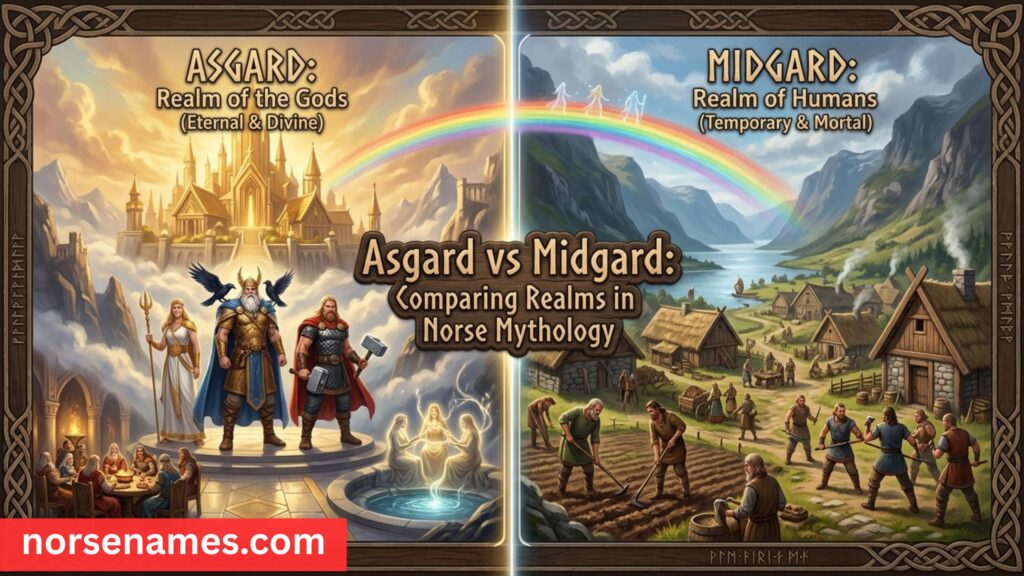
Asgard is portrayed as timeless and golden, a realm where the gods exist in their full divine power, where death and sickness don’t exist (except during Ragnarok), and where time operates differently than in Midgard. The gods in Asgard govern fate itself, weaving the destinies of all beings. Yet paradoxically, even the gods of Asgard cannot escape Ragnarok—they know their doom approaches and face it with courage.
Midgard is temporary and fragile, where humans live brief lifespans, where strength fades with age, where hunger and cold threaten survival. Yet Midgard is also where the greatest stories unfold, where heroic deeds have meaning precisely because they’re difficult, where mortality gives urgency and weight to human action. Many of the most beloved Norse mythology tales involve the gods traveling to Midgard to interact with humans—testing their strength (Thor challenging Utgarda-Loki), fathering heroes (Odin producing Sigurd’s line), or shaping history itself.
The distinction between these realms reveals a sophisticated understanding: divine immortality isn’t necessarily superior to human mortality. The gods live forever, but they face inevitable destruction. Humans live briefly, but they live intensely. The Norse appreciated both perspectives, valuing human achievement precisely because it was temporary and difficult.
Map of the Nine Realms: How They’re Positioned in Norse Cosmology
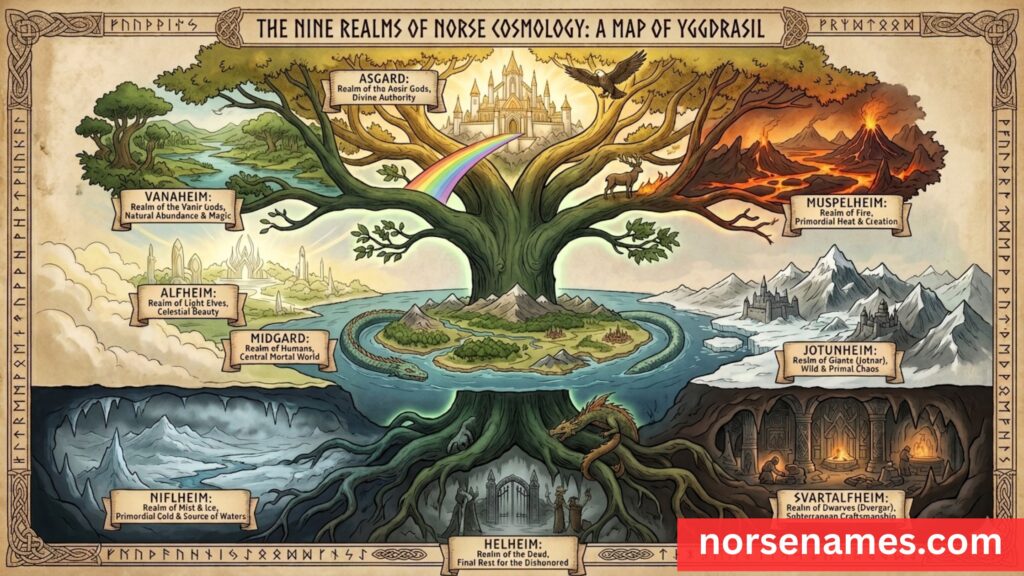
Visualizing the nine realms of Norse mythology requires understanding their position in relation to Yggdrasil, the World Tree. The realms aren’t arranged in simple layers but in a complex spatial relationship around the World Tree’s roots and branches.
The Upper Realms (Associated with Yggdrasil’s Branches):
- Asgard (realm of the Aesir gods) – golden, glorious, divine authority
- Vanaheim (realm of the Vanir gods) – fertile, magical, natural abundance
- Muspelheim (realm of fire) – primordial heat, chaos, and creation
The Middle Realms (Associated with Yggdrasil’s Trunk):
- Alfheim (realm of Light Elves) – bright, ethereal, celestial
- Midgard (realm of humans) – central, fragile, inhabited by mortals
- Jotunheim (realm of giants) – wild, primal, opposition to divine order
The Lower Realms (Associated with Yggdrasil’s Roots):
- Niflheim (realm of mist and cold) – primordial, ancient, source of waters
- Svartalfheim (realm of dwarves) – deep, stone, craftsmanship
- Helheim (realm of the dead) – gray, diminished, final rest for the dishonored
This arrangement reflects Norse philosophical understanding: the higher realms represent divinity and creation, the middle realms represent where the divine meets the mundane, and the lower realms represent age, death, and the primordial foundations beneath existence.
The Nine Realms After Ragnarok: Norse Mythology’s Vision of Renewal
One of the most distinctive features of Norse mythology is its insistence that the nine realms aren’t eternal. Ragnarok—the twilight of the gods, the fated destruction that will consume all creation—approaches inevitably. Yet crucially, Ragnarok isn’t the end of the Norse mythology story but a transformation.
When Ragnarok arrives, the events unfold across the nine realms: Heimdall (the watchman of the gods) blows the Gjallarhorn, signaling the beginning of the end. The great serpent Jormungandr, bound in the depths of Midgard’s ocean, writhes free and causes massive floods that cover all nine realms. Fenrir, the great wolf, breaks his bonds in Jotunheim and charges toward Asgard. Loki breaks free from his imprisonment (where he’d been bound beneath the earth with serpent venom dripping onto his face) and leads the giants of Jotunheim across the Bifrost Bridge.
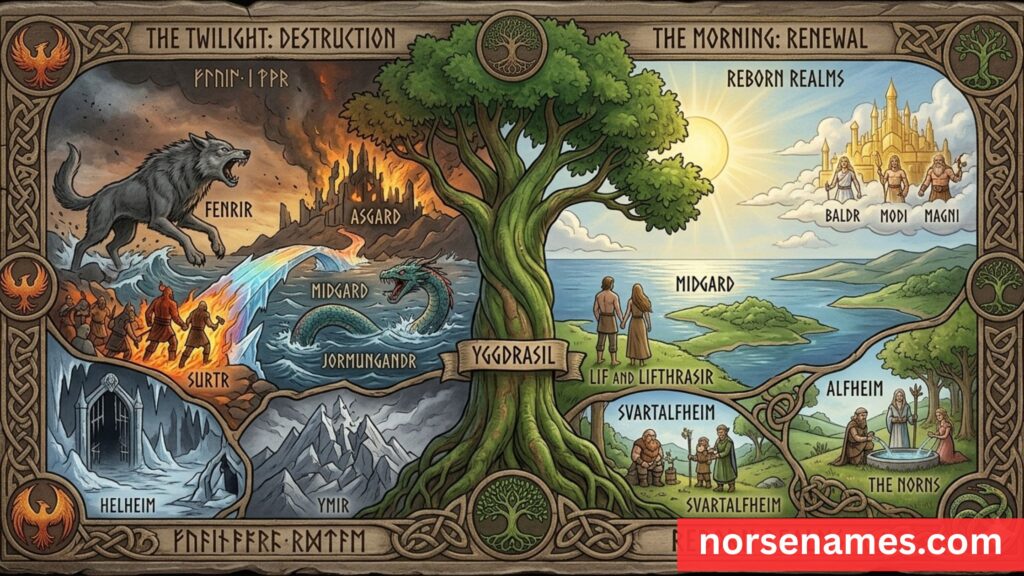
Surtr and the fire giants of Muspelheim set all nine realms ablaze. The stars vanish from the sky. Asgard itself is destroyed. Midgard sinks into the sea. The roots of Yggdrasil itself tremble. Yet after this complete destruction comes renewal: a new earth emerges from the sea, the sun (before devoured by the wolf Skoll) has a daughter who continues the heavens, and a few gods and humans survive to repopulate creation. The nine realms don’t end—they’re reborn.
This vision of Ragnarok followed by renewal is profoundly different from apocalyptic traditions that envision eternal punishment or empty peace. For the Norse, destruction was necessary, even inevitable, but it was also generative. The nine realms would be reborn in a new, perhaps improved form. This cyclical understanding of time—destruction leading to renewal—profoundly shaped Viking attitudes toward life, death, and change itself.
Key Entities of the Nine Realms: Gods, Giants, and Legends
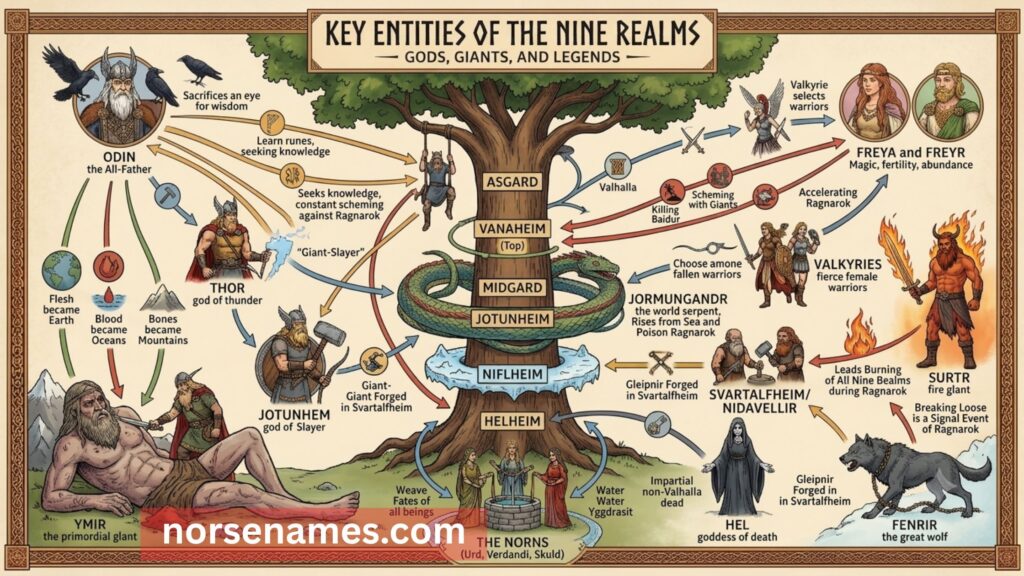
Understanding who inhabits each realm and the entities that traverse all nine realms gives meaning to Norse mythology’s cosmology.
Odin, the All-Father, represents wisdom and kingship. Though based in Asgard, Odin frequently travels throughout all nine realms seeking knowledge—sacrificing his eye for wisdom, hanging from Yggdrasil itself to learn the runes, and constantly scheming to delay Ragnarok’s arrival.
Thor, god of thunder, is the eternal giant-slayer who journeys frequently from Asgard to Jotunheim and Midgard. His hammer Mjolnir was forged in Svartalfheim by the dwarves and is one of the nine realms’ most powerful artifacts.
Loki, the trickster, moves between realms causing chaos. His actions—killing Baldur, scheming with giants—have consequences that ripple across all nine realms and ultimately accelerate Ragnarok’s approach.
Freya and Freyr, the Vanir deities, rule Vanaheim and represent magic, fertility, and natural abundance. Freya is also a Valkyrie who chooses warriors for Valhalla (part of Asgard), showing how the nine realms interconnect even through divine authority.
The Valkyries are choosers of the slain, fierce female warriors who travel between Midgard and Asgard, determining which fallen warriors achieve the honor of Valhalla. They represent the active forces connecting the human realm to the divine.
Ymir, the primordial giant, was killed by Odin to create the nine realms from his body—flesh became earth, blood became oceans, bones became mountains. Though dead, Ymir’s legacy structures all nine realms.
Surtr, the fire giant ruling Muspelheim, represents inevitable destruction. He’s destined to lead the burning of all nine realms during Ragnarok, making him perhaps the most powerful force in Norse mythology’s cosmology.
Hel, goddess of death, rules Helheim with an impartial hand. Neither alive nor dead, she receives those who don’t achieve Valhalla, making her one of the few entities with authority over a realm equal to the gods’.
The Norns (Urd, Verdandi, and Skuld) weave the fates of all beings across all nine realms. They water Yggdrasil with the spring Urd and are said to carve the destinies of gods and mortals alike into the very fabric of the World Tree.
Jormungandr, the world serpent, lies coiled around Midgard in the ocean. During Ragnarok, he’ll rise from the sea and poison the sky with venom, demonstrating how threats exist simultaneously across multiple nine realms.
Fenrir, the great wolf, is bound with the magical chain Gleipnir forged in Svartalfheim. His breaking loose is one of Ragnarok’s signal events, showing how the nine realms’ stability depends on magical bindings created by dwarven craftsmanship.
Nine Realms of Norse Mythology FAQ
Is Valhalla one of the nine realms? Technically, Valhalla is part of Asgard rather than a separate realm, though it functions distinctly within Norse mythology. It’s the great hall where Valkyries bring fallen warriors to feast and train eternally. The distinction matters because souls go to Valhalla only if chosen, whereas Helheim is the default destination for most dead.
What is the meaning of the Nine Realms? The nine realms meaning refers to the nine interconnected worlds in nine realms Norse mythology that exist around Yggdrasil, the World Tree. Each realm represents a unique part of the Norse universe, including the homes of gods, humans, giants, dwarves, elves, and the dead.
What is the strongest realm in Norse mythology? Asgard holds ultimate authority as the realm of the Aesir gods who govern fate itself. However, the primordial realms of Muspelheim and Niflheim—existing before creation—possess primal power that even the gods cannot ultimately resist. During Ragnarok, Surtr’s fire (from Muspelheim) proves stronger than any god.
Where do humans live in Norse mythology? Humans live in Midgard, created from the corpse of the primordial giant Ymir. Midgard is protected by a wall made from Ymir’s eyebrows and surrounded by the ocean. The Bifrost Bridge connects Midgard directly to Asgard, though most humans don’t travel this bridge in their lifetimes.
Why does Norse mythology need nine realms instead of fewer worlds? The nine realms allow Norse mythology to express complex philosophical principles: three upper realms (order, creation), three middle realms (interaction, tension), three lower realms (decay, transformation). The number nine also reflects Indo-European cosmological patterns and allows for the detailed mythology that makes each realm distinct and meaningful.
How are the nine realms governed? Different realms are governed by different entities: the Aesir gods rule Asgard, the Vanir gods rule Vanaheim, Surtr rules Muspelheim, Hel rules Helheim, the dwarves govern Svartalfheim, and so forth. Yet all nine realms are ultimately subject to fate itself, woven by the Norns. Even the gods cannot escape Ragnarok—the appointed destiny that will eventually transform all nine realms.
Are the Nine Realms in Marvel the same as Norse mythology? The nine realms marvel version is inspired by traditional nine realms mythology, but it simplifies and changes several locations, characters, and relationships to fit the Marvel Universe. The original Norse myths describe the realms with much greater detail and different cosmological beliefs.
Norse Cosmology and Modern Understanding
For modern readers approaching the nine realms of Norse mythology, it’s valuable to remember that these weren’t abstract myths to the Vikings but a practical framework for understanding reality. The nine realms explained where different types of beings lived, why fate was inevitable, where souls traveled after death, and why heroic action mattered even in the face of cosmic doom.
The sophistication of this cosmological system rivals any ancient mythological framework. The connection of all nine realms through Yggdrasil the World Tree, the cyclical nature of creation and destruction, the coexistence of multiple divine powers (the Aesir and Vanir gods), and the acceptance that even the greatest gods faced inevitable doom—these represent a worldview of remarkable philosophical depth.
For contemporary audiences, the nine realms offer not merely historical interest but immediate relevance. In an age of climate anxiety and existential uncertainty, the Norse vision of renewal after destruction—Ragnarok followed by rebirth—speaks to something human and profound. In a fragmented world, the image of all nine realms interconnected by a single World Tree offers a different way of imagining wholeness and connection.
Conclusion: The Enduring Power of the Nine Realms
The nine realms of Norse mythology represent far more than a quaint ancient cosmology—they embody a sophisticated worldview that influenced how Vikings understood their universe, their place within it, and the inevitability of cosmic transformation. From Asgard’s golden halls to Helheim’s misty domain, these nine connected worlds create a comprehensive mythology system that accounts for creation, order, chaos, death, and renewal through the structure of Yggdrasil, the World Tree.
The genius of the nine realms lies in their structural elegance and philosophical depth. Each realm operates by its own rules and harbors its own inhabitants, yet all are bound together through shared fate and the physical reality of Yggdrasil. The Bifrost Bridge connects Asgard to Midgard, allowing divine intervention in human affairs. The roots of the World Tree touch Niflheim’s primordial waters, Jotunheim’s primal chaos, and Asgard’s eternal order. Nothing happens in isolation; every action ripples through multiple realms.
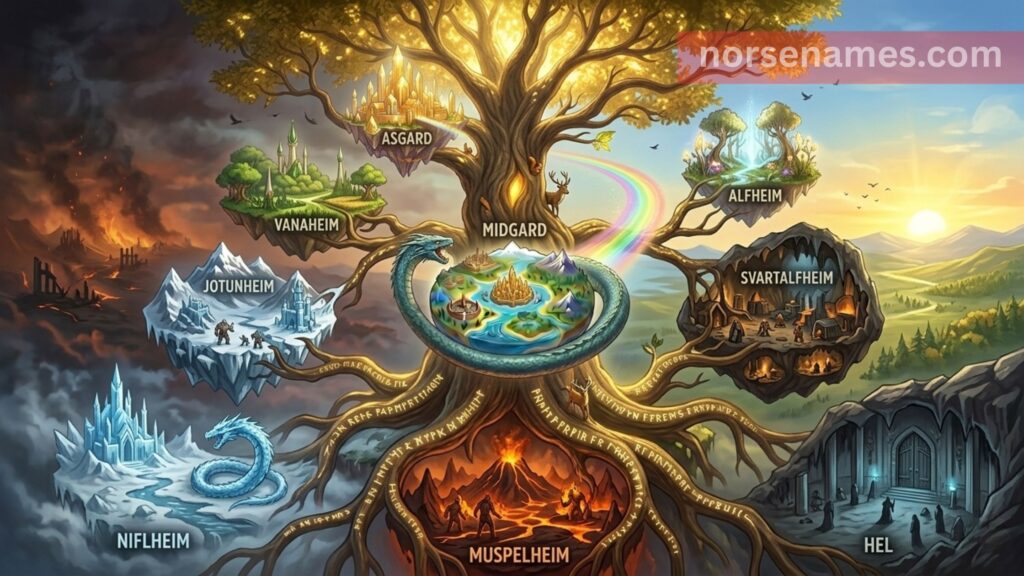
For modern creators—writers, game designers, worldbuilders, and storytellers—the nine realms offer something equally valuable: a proven template for building complex, interconnected fictional worlds that feel lived-in and consequential. The visual and thematic distinctiveness of each realm, the philosophical depth of their coexistence, and the spiritual significance embedded in their structure make them endlessly adaptable inspiration for fantasy projects. Whether you’re crafting a novel, designing a video game, or simply captivated by the grandeur of Viking cosmology, understanding the nine realms transforms your appreciation of Norse mythology.
These realms remind us that the greatest worldbuilding systems combine beauty with complexity, meaning with mystery, order with chaos, and the eternal with the inevitably doomed. In that combination lies the timeless appeal of Norse mythology and the nine realms that form its cosmic heart. As Ragnarok approaches in the ancient tales and the nine realms prepare for transformation, we’re reminded that endings and beginnings aren’t opposites but partners in an eternal dance of creation and renewal.