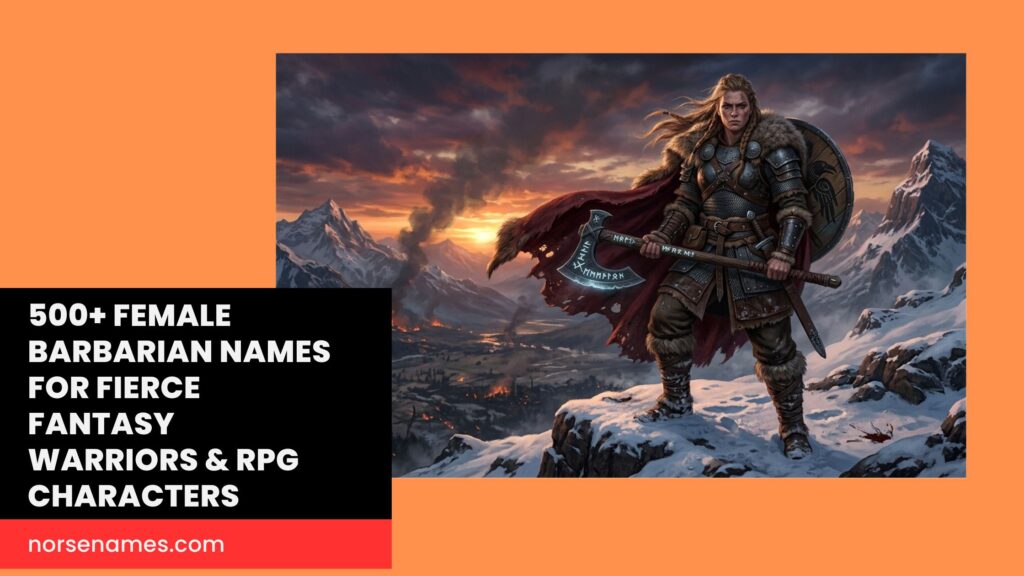

The clash of steel echoes across a frozen ridge. A lone figure stands atop the rocks, braided hair whipping in the wind, war paint smeared across her cheeks like the marks of a storm goddess. She raises her axe, and the warband behind her roars her name — not a name of soft lullabies, but one carved from thunder and bone. This is the world that female barbarian names conjure: untamed, fierce, and steeped in the mythic traditions that have shaped fantasy storytelling for generations.
Norse mythology, in particular, keeps finding new life in fantasy worlds, tabletop campaigns, and video games. Why? Because it never sold survival as pretty. It sold survival as sacred. Fate ruled everyone, even the gods, and warriors carved their identities through deeds, not birthright. That same spirit fuels the modern hunger for barbarian characters — women who don’t ask permission to be powerful, who earn their names in battle rather than inherit them in a nursery. Whether you’re building a D&D character, writing an epic fantasy novel, or naming an NPC clan leader, female barbarian names carry that same electric charge: identity forged through struggle, not given freely.
This guide is your ultimate resource for female barbarian names — from the raw and thunderous to the dark and mystical. Inside you will find famous inspirations, massive categorized name lists, cultural naming traditions, clan surnames, and creative ideas to help you build characters worth remembering for generations.
Origins & Meaning of Female Barbarian Names
The term “barbarian” itself has a tangled history. It comes from the ancient Greek word barbaros, originally used to describe anyone who didn’t speak Greek — their language sounding like unintelligible “bar-bar” babble to Greek ears. Over centuries, the word evolved into a broader (and often unfair) label for any culture considered “outside” civilization: Gauls, Goths, Huns, and later, in fantasy fiction, entire warrior societies defined by strength, freedom, and a rejection of soft city life.
But strip away the ancient prejudice, and what’s left is something fantasy writers fell in love with: the barbarian as archetype. Raw, primal, unshackled by empire or courtly rules. Female barbarian names grew out of this archetype and merged with real historical inspiration — Norse shield-maidens, Germanic warrior tribes, Celtic queens who led armies, and Central Asian steppe riders whose graves have been found buried with swords, arrowheads, and battle scars.
Norse mythology deserves special credit here because it gave fantasy fiction its enduring blueprint. In Viking mythology, fate (wyrd) governed every soul, and glory in battle was the closest thing to immortality. Valkyries chose the worthy dead. Shield-maidens like Lagertha (immortalized in the Gesta Danorum) blurred the line between myth and history. This is why so many female barbarian names still lean on Old Norse phonetics — hard consonants, short vowels, names that sound like they were shouted across a battlefield rather than whispered in a parlor.
The influence remains strong today because barbarian archetypes solve a storytelling problem: audiences crave characters who feel untamed in a world of increasingly polished, sanitized heroes. A good barbarian name signals grit before a single line of dialogue is spoken.
Famous Figures Who Shaped Barbarian Naming Traditions
Understanding where these names come from makes them far more powerful to use. Here are figures — real, legendary, and mythic — whose stories continue to influence how we name barbarian characters today.
Lagertha — A legendary shield-maiden from Saxo Grammaticus’s Gesta Danorum, said to have fought alongside (and later become the wife of) Ragnar Lothbrok. Her name has become nearly synonymous with the “warrior queen” archetype in modern fantasy and pop culture.
Freyja — The Norse goddess of love, war, and death, who led the Valkyries and claimed half of all warriors who died in battle for her hall, Fólkvangr. Freyja represents the duality baked into so many female barbarian names: beauty and brutality coexisting without contradiction.
Skadi — A giantess associated with winter, mountains, and hunting, who married into the Norse pantheon on her own fierce terms. Skadi-inspired names evoke cold resilience — the kind of character who thrives where others freeze.
Boudica — Not from Norse myth, but essential to the barbarian archetype nonetheless. The Celtic queen of the Iceni tribe led a massive uprising against Roman occupation. Her name has become shorthand for righteous fury and rebellion against oppressive power.
The Valkyries — Not one figure, but a whole class of warrior-spirits (Brynhildr, Sigrún, Hildr, and others) who chose which soldiers lived or died in battle. Their individual names now serve as templates for legendary-tier barbarian naming.
Hervor — A legendary shield-maiden from the Hervarar Saga who disguised herself, raided as a pirate, and ultimately claimed a cursed sword from her father’s burial mound. Her story is basically a barbarian origin tale in its purest form.
Each of these figures shows the same pattern: names tied to action, not appearance. That’s the key principle behind every strong female barbarian name — it should sound like something earned.
Unique Female Barbarian Names (With Meanings)
If you want names that feel authentic and battle-worn, this list blends Old Norse roots, Germanic influence, and pure fantasy invention. These work beautifully for D&D characters, novel protagonists, or clan leaders in any barbarian-themed setting.
- Brynhild — “armor” + “battle,” echoing the legendary Valkyrie
- Skarde — inspired by scarred terrain, evokes toughness
- Ragnhild — “advice” + “battle,” a name of counsel and war
- Vigdis — “war goddess,” blunt and powerful
- Thyra — linked to Thor, meaning “thunder”
- Hilda — shortened from Hildr, meaning “battle”
- Sigrun — “victory rune,” a Valkyrie name
- Astrid — “divinely beautiful,” softened by fierce Norse queens who bore it
- Freydis — “lady of the Freyr,” tied to fertility and strength
- Gunnhild — “war” + “battle,” doubly fierce
- Ingrid — “beautiful” + linked to the god Ing, fertility and protection
- Runa — “secret” or “rune,” mysterious and mystical
- Solveig — “sun” + “strength,” radiant power
- Ylva — meaning “she-wolf,” predatory and sharp
- Kára — a Valkyrie name meaning “the wild one”
- Dagny — “new day,” symbolizing rebirth after battle
- Eira — Norse goddess of healing, ironically fierce in contrast
- Frida — “peace,” often given to fierce women as a paradox name
- Halla — “hall,” symbolizing leadership and gathering
- Idun — goddess of youth, used for eternal-warrior archetypes
- Liv — meaning “life,” short and sharp
- Signe — “new victory,” a name of conquest
- Torhild — “Thor” + “battle,” thunderous strength
- Valka — evoking “Valkyrie” phonetically
- Bera — meaning “she-bear,” primal and protective
- Draug — feminine adaptation meaning “spectral warrior”
- Eska — meaning “ash,” tied to fire and rebirth
- Frenja — a variant spelling of Freyja for fantasy use
- Grima — meaning “mask” or “helm,” mysterious warrior energy
- Saga — meaning “seer” or “story,” fitting for a legendary figure
These names balance meaning with sound — every one of them could be shouted across a battlefield without losing its weight.
Female Barbarian Names DnD Players Love
Tabletop players often need names that fit specific tone requirements — gritty, memorable, easy to say aloud during a session. Below is a quick-reference table built specifically with D&D and RPG use in mind.
| Name | Meaning/Vibe | Best Fit |
| Korra | Strong, short, easy to shout in combat | Half-orc or human barbarian |
| Draga | Evokes “dragon,” fierce and primal | Dragonborn barbarian |
| Ushka | Harsh, guttural, tribal feel | Orc or goliath barbarian |
| Wren | Sharp, quick, deceptively small-sounding | Rogue-barbarian hybrid |
| Talvi | Means “winter” in Finnish, icy resilience | Frost giant kin or tundra tribe |
| Zenobia | Historical warrior queen name | Human noble-turned-barbarian |
| Kyra | Clean, commanding, versatile | Any humanoid race |
| Rhona | Scottish-Gaelic roots, rugged charm | Firbolg or human |
| Ottla | Unusual, memorable, tribal | Goliath barbarian |
| Sable | Dark, sleek, predatory | Tiefling barbarian |
| Brannigh | Celtic-inspired, “raven” connotation | Human or half-elf |
| Threska | Invented, harsh consonant cluster | Orc barbarian |
| Naveen | Unisex option, works well for gender-flexible builds | Any race |
| Volka | Wolf-adjacent sound, predatory energy | Shifter or werewolf-touched barbarian |
| Ashka | Fire and ember connotation | Fire genasi barbarian |
| Brigid | Celtic fire goddess name | Human barbarian with divine ties |
| Karga | Harsh and blunt, easy to pronounce | Goliath or half-orc |
| Vasska | Serpent-like sound, cunning warrior | Yuan-ti or lizardfolk |
| Grethel | Old Germanic roots, folk-tale grit | Human barbarian |
| Ondine | Water-spirit inspired, elegant contrast | Genasi or tempest-touched barbarian |
This table works well because these names read easily at a gaming table — no stumbling over syllables mid-initiative.
Famous and Legendary Female Barbarian Names
Some names carry the weight of history and myth behind them, making them instantly recognizable as legendary-tier options for major characters, clan matriarchs, or campaign villains.
- Lagertha — legendary shield-maiden and queen
- Boudica — historical rebel queen of the Iceni
- Freydis Eiríksdóttir — Viking explorer said to have fought off attackers while pregnant
- Hervor — cursed-sword-wielding shield-maiden
- Brynhildr — Valkyrie and tragic heroine of the Volsunga Saga
- Sigrún — Valkyrie lover of hero Helgi in Norse legend
- Þorgerðr Hölgabrúðr — semi-divine figure worshipped in parts of Norway
- Grimhild — powerful sorceress-queen from the Nibelungenlied
- Alfhild — legendary pirate princess of Norse legend
- Awilda — Scandinavian pirate queen, sometimes conflated with Alfhild
- Cynethryth — Anglo-Saxon queen known for political and martial power
- Æthelflæd — “Lady of the Mercians,” a real historical warrior-ruler
- Tomyris — Massagetae queen who defeated Cyrus the Great in battle
- Sarah Bishop — folk legend of a fierce colonial-era survivor (often reworked in fantasy)
- Zenobia — Palmyrene queen who challenged Rome itself
These names carry built-in gravitas. Using one for a major character instantly signals mythic scale.
Cool Female Barbarian Names
Sometimes you just need something that sounds cool without needing a mythology lesson attached. Here’s a table of stylish, punchy options.
| Name | Sound Profile | Great For |
| Kaida | Sharp, modern-fantasy hybrid | Any setting |
| Ravenna | Dark, elegant, memorable | Noble-born barbarian |
| Storm | Direct, elemental power | Nature-tied barbarian |
| Vaeda | Invented, flows smoothly | High fantasy |
| Onyx | Stone-hard, sleek | Tiefling or half-orc |
| Rhaska | Guttural, tribal | Orc or goliath |
| Nyra | Soft sound, sharp meaning potential | Elf-barbarian hybrid |
| Torvin | Unisex, thunder-adjacent | Dwarf or human |
| Kessa | Quick, punchy | Rogue-barbarian |
| Dravka | Harsh consonants, intimidating | Villain or rival |
| Ferra | “Ferrous,” iron-toned | Blacksmith-warrior |
| Wynna | Soft but strong | Half-elf barbarian |
| Braxa | Bold and blunt | Front-line fighter |
| Selka | Fluid, sea-adjacent | Coastal tribe |
| Grivane | Deep, weighty | Clan matriarch |
Warrior and Badass Female Barbarian Names
These names were made for the front line. Harsh consonants, clipped syllables, and a tone that practically growls — these are the badass female barbarian names that belong to the women who lead charges, not follow them.
| Name | Name | Name | Name |
|---|---|---|---|
| Grothka | Valdris | Skuldra | Brakova |
| Jarkvra | Huldrek | Ragnvara | Druskor |
| Krevash | Volgara | Torndra | Grimvex |
| Skulka | Axendra | Brolgash | Ulvrath |
| Darkven | Skarva | Thundra | Mordiska |
| Vraksha | Zuldra | Helgronn | Brukvara |
| Kragveth | Stormka | Irundra | Bolgreth |
Mystical and Shamanic Female Barbarian Names
Not all barbarian women carry axes. Some carry the weight of the spirit world. These unique female barbarian names suit shamans, seers, and ritual leaders — women who speak to the old gods and translate their fury.
| Name | Name | Name | Name |
|---|---|---|---|
| Nhyara | Ossivra | Velundra | Aevokha |
| Umbrysa | Thyskala | Vorvena | Silvokh |
| Drynova | Askvara | Lyrundra | Eshvara |
| Molvekha | Yhsara | Wruvena | Thulivra |
| Soruvax | Kalvorna | Drevitha | Orvalkha |
| Nuvrekha | Essovra | Vydrana | Malorva |
Royal and Noble Female Barbarian Names
Even savage empires have queens. These fantasy female barbarian names carry authority, lineage, and the weight of a crown made from the bones of defeated rivals.
| Name | Name | Name | Name |
|---|---|---|---|
| Valdara | Thyrenna | Borgvara | Sovrekha |
| Yrsvana | Drakenna | Norvolda | Helgavra |
| Runovara | Skandara | Ashvenna | Vorundra |
| Ulmara | Thrakenna | Guldvara | Ivrenka |
| Hrosvara | Skalanda | Mordvenna | Volvara |
Traditional and Classic Female Barbarian Names
Rooted in the deep well of fantasy tradition, these classic female barbarian names have a timeless quality — names that feel like they have existed in oral history for centuries.
| Name | Name | Name | Name |
|---|---|---|---|
| Helga | Brunhild | Signe | Thyra |
| Ragnhild | Ulfhild | Astrid | Gudrun |
| Freydis | Borgny | Vigdis | Alvhild |
| Thordis | Ragnfrid | Solveig | Herdis |
| Gunnhild | Oddrun | Ingebjorg | Hjordis |
| Valdis | Sigrid | Asgerd | Mildrid |
Naming Traditions & Worldbuilding for Barbarian Cultures
Great barbarian names don’t exist in isolation — they’re built from a system, even if that system feels raw and untamed on the surface. Understanding the underlying logic helps writers and game masters create names that feel consistent across an entire culture rather than randomly generated.
Name construction typically follows a two-part structure inspired by Old Norse and Germanic naming conventions: a strength-word (like vig for war, hild for battle, thor referencing storm/thunder) combined with a virtue or nature-word (like dis for goddess, run for secret/rune, gard for protector). This is why names like Brynhild, Gunnhild, and Vigdis feel structurally related — they share a naming DNA even though they represent different characters.
Clan identity often gets baked directly into the name itself. Historical Norse society used patronymics (son-of, daughter-of) rather than fixed surnames — so a character might be “Freydis Ragnarsdóttir,” meaning Freydis, daughter of Ragnar. In fantasy worldbuilding, this system lets you signal lineage and reputation in a single breath. A daughter of a famous warband leader carries expectation the moment her name is spoken.
Symbolic meanings matter enormously in barbarian cultures where names are often earned rather than simply given at birth. A child might receive a birth-name, then earn a war-name after their first kill, raid, or trial. This two-name system (birth-name and battle-name) is a powerful worldbuilding tool — it lets a character’s identity evolve as the story progresses.
Titles and honor names function almost like a second layer of naming. “Skull-Splitter,” “Winter’s Daughter,” “The Unbroken,” or “Storm-Caller” aren’t just cool nicknames — in barbarian cultures, these titles often replace the birth-name entirely once earned. They’re spoken with reverence or fear, depending on who’s saying them.
Female Barbarian Clan Names and Compound Surnames
Every great female barbarian name deserves an equally fierce surname or clan title. These compound names are perfect for worldbuilding, adding texture and lineage to any character. Use them as standalone clan names, family surnames, or deed-earned titles.
| Compound Clan Name | Compound Clan Name | Compound Clan Name |
|---|---|---|
| Ironmaw | Stormcleaver | Bloodridge |
| Frostbone | Ashveil | Skullrender |
| Bonebiter | Darkmantle | Stoneshroud |
| Wolfthorn | Grimscale | Ravenmark |
| Emberclaw | Thornspine | Coldforge |
| Duskstalker | Cindershield | Ironveil |
| Gravewind | Steelhorn | Nightmaw |
| Shadowbane | Bloodthirst | Stormbone |
| Icebreaker | Hollowcrest | Swiftblade |
| Fireridge | Wardsong | Scalecrown |
| Darkember | Stonewail | Wolfhide |
| Ashencloak | Grimfang | Thundermark |
| Ironcrest | Hollowmane | Duskrender |
| Boneshield | Frostveil | Scalebite |
| Shadowhorn | Ravenfang | Emberthorn |
These names can be mixed and matched endlessly. A character named Skuldra Frostbone of the Ravenmark Clan instantly has history, geography, and personality before you write a single word of her story.
Norse Surname Ideas for Barbarian Characters
Surnames (or clan-names) add another rich layer of authenticity to any barbarian character. Below is a collection of Norse-inspired surname ideas, ideal for pairing with any first name from the lists above.
- Ironheart
- Stormrider
- Wolfsbane
- Frostborn
- Battleborn
- Ravensong
- Bearclaw
- Skullcrusher
- Windwalker
- Shieldmaiden
- Ashwalker
- Thornheart
- Grimtide
- Nightfang
- Emberfall
- Stonebreaker
- Wildheart
- Bloodmoon
- Fireforge
- Ironjaw
- Wolfsblood
- Stormbreaker
- Ravenclaw (best avoided due to strong pop culture associations)
- Grimshield
- Frostfang
- Thunderfoot
- Warhammer
- Blackwater
- Sunbringer
- Wintermane
- Steelheart
- Doomrider
- Nightshade
- Highwind
- Ashborn
- Coldforge
- Deathwhisper
- Truesteel
- Ironbrand
- Bonecarver
- Dawnbreaker
- Wolfheart
- Stormcaller
- Direwood
- Skyshard
- Bloodfang
- Emberheart
- Thornwood
- Ragefire
- Stonewarden
Combine any of these with a first name from earlier sections — “Vigdis Ironheart” or “Kaida Stormrider” — and you’ve got a full, campaign-ready identity in seconds.
Funny Female Barbarian Names
Not every table wants gritty realism. If your campaign leans comedic, these names deliver barbarian energy with a wink.
- Bonecrusha
- Smashley
- Grogatha
- Thundra Buns
- Ragebecca
- Smasherina
- Beefadonia
- Ironthighs
- Punchelina
- Rageanne
- Chaosette
- Screamina
- Rowdy Runa
- Brawla
- Fistina
A Note on Barbarian Names for Male Characters
While this article focuses on female barbarian names, the same naming principles apply seamlessly to male counterparts. Barbarian names male fantasy characters often use share the same hard consonants and nature-power fusion: think Bjorn, Ragnar, Ulfric, Skarde, Thorvald, or Grimolf. Pairing a male name from this family with a female name like Vigdis or Brynhild instantly creates a believable warband or family unit without extra worldbuilding effort
Female Barbarian Names Generator
Sometimes none of the names in any list quite fits your vision. That is when you become the naming elder yourself. Here is a simple system for constructing your own fantasy female barbarian names from scratch.
Start with a Hard Consonant Opener — letters like V, K, G, R, Th, Sk, Br, Dr, or Z give names an immediate primal edge. Avoid soft openers like L, M, or W unless you want a more mystical feel.
Choose a Middle Vowel Sound — short vowels like “a,” “o,” and “u” feel raw and ancient. Longer vowel combinations like “aa,” “ei,” or “yv” create a more otherworldly resonance. For shamanic characters, lean into the latter.
Close with a Sharp or Guttural Ending — endings like “-ka,” “-ra,” “-sha,” “-vex,” “-goth,” “-dra,” or “-vorn give your name that finished, fantasy-authentic quality. Avoid endings in “-y,” “-ie,” or “-ee” unless you are specifically going for an ironic contrast between gentle name and savage character (which can itself be a wonderful narrative device).
For example: Sk + a + vorna = Skavorna. Dr + u + vex = Druvex. Kh + o + drath = Khodrath. Every name you build using this system feels original because it is — and it carries the phonetic DNA of the barbarian tradition.
Wrapping Up: Choosing a Name Worthy of Legend
Female barbarian names carry more than sound — they carry story. Every syllable pulled from Norse mythology, Viking mythology, or the broader well of legendary Norse names comes loaded with centuries of warriors, queens, and shield-maidens who refused to be footnotes. When you choose a name like Brynhild, Vigdis, or Freydis for your character, you’re not just picking something that sounds cool — you’re tapping into a tradition of fierce, self-made identity that stretches back through fantasy Norse mythology into real history itself.
Whether you’re rolling up a new D&D barbarian, naming a rival warlord for your novel, or building an entire clan for your fantasy world, let the name do some of the storytelling for you. A well-chosen name hints at backstory before a single scene is written — and in barbarian cultures, that’s exactly how it should work. Names are earned, spoken with weight, and remembered long after the battle ends.
Frequently Asked Questions
What is a female warrior’s name?
A female warrior’s name typically reflects strength, battle, or divine favor — often drawing from Old Norse elements like hild (battle), vig (war), or dis (goddess). Historical and mythological examples include Brynhild, Lagertha, and Boudica, while fantasy settings often invent similar-sounding names to match that same warrior energy.
What do you call a female barbarian?
There’s no single fixed title — female barbarians are called shield-maidens, warrior-queens, berserkers, or simply barbarians, depending on the culture and setting. In Norse-inspired fantasy, “shield-maiden” is the most common historical term, while tabletop games like D&D simply use “barbarian” regardless of gender.
What are good female fantasy names?
Good female fantasy names balance pronounceability with distinctiveness — names like Astrid, Ylva, Kaida, or Sigrun work well because they’re easy to say aloud, carry meaningful roots, and don’t feel overused. The best fantasy names also hint at the character’s culture, personality, or role within the story.
What is a barbarian name?
A barbarian name is typically short, phonetically strong, and rooted in nature, battle, or elemental imagery — designed to sound powerful when shouted across a battlefield. Many barbarian names draw from Norse, Germanic, or Celtic linguistic roots, favoring hard consonants and compound meanings like “battle-strength” or “war-goddess.”