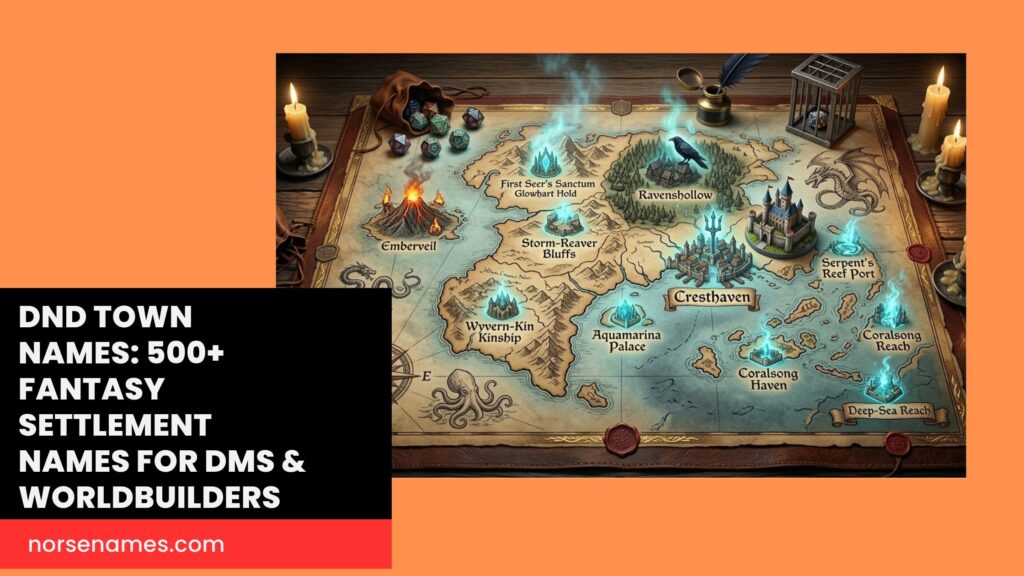

DnD town names are the heartbeat of every living, breathing fantasy world. Before your players ever set foot in a tavern, before the first roll of the dice echoes across the table, the name of a place already begins to weave its spell. A single word — Ravenshollow, Emberveil, Cresthaven — can conjure fog-drenched cobblestones, candlelit market stalls, and centuries of untold history. That is the quiet power of a well-chosen settlement name.
Every Dungeon Master knows the panic of pointing to a blank space on the map and stammering, “You arrive at… uh… a town.” The players blink. The immersion cracks. Great DnD town names don’t just label a location — they breathe personality into the world, hint at the culture within its walls, and spark curiosity before a single NPC utters a word. Whether you’re building a sprawling campaign setting or a single-session adventure, the names of your towns and villages are the first chapter of a story your players will tell for years.
Fantasy worldbuilding lives and dies by specificity. A vague setting feels borrowed. A named, layered one feels real. The finest DnD town names carry history on their tongue — old wounds, founding legends, patron gods, and the whisper of the landscape itself. From the frost-bitten northern hamlets to the sun-scorched desert outposts of the southern badlands, each settlement deserves a name that earns its place on the map.
This guide is your complete companion — a lore-rich, imagination-firing treasury of cool DnD town names, organized by theme, culture, and tone. Whether you’re a first-time DM, a seasoned worldbuilder, or a fantasy writer crafting the next great novel, what follows will fill your maps with places worth remembering.
Origins & Meaning Behind Great Fantasy Town Names
Long before “worldbuilding” was a hobby, real-world cultures named their settlements with intention. A village wasn’t just where people lived — it was a statement of identity, geography, and belief.
In Norse-influenced regions, towns were often named for the land itself (a fjord, a ridge, a stand of birch trees), for a founding clan or hero, or for a god whose favor the settlement sought. A name like “Thorholm” combines the god Thor with holm, an old word for a small island or raised ground — instantly telling you this is a place of strength, protection, and old-world reverence. Celtic and Slavic naming traditions worked similarly, blending nature, ancestry, and myth into compact, memorable words.
This pattern is exactly what makes fantasy town names so satisfying when done well. They’re not random syllable soup — they’re built from meaningful pieces: nature words (-brook, -wood, -fell), structural words (-hold, -gate, -keep), and emotional or mythic words (-doom, -wrath, -hope). The reason these naming conventions remain so influential in D&D, fantasy novels, and video games is that they tap into something primal: the human instinct to mark a place as ours, shaped by what we fear, what we worship, and what we’ve survived.
When you understand this underlying logic, you stop picking random fantasy-sounding words and start building names that mean something — which is exactly what your players will subconsciously feel, even if they never ask “what does that name mean?”
Famous Mythic and Fantasy Settlements That Inspire Great Names
Before diving into name lists, it helps to look at the kinds of legendary places — real, mythological, and fictional — that have shaped how we imagine fantasy towns.
Asgard, the realm of the Norse gods, isn’t a “town” in the traditional sense, but its naming logic (a fortified, godly stronghold) inspires countless capital cities in fantasy settings. Settlements modeled after it tend to use grand, weighty names like Valehold or Gildenreach.
Hel, the shadowy underworld ruled by the goddess of the same name, lends its bleak, final-sounding syllables to dark fantasy locations. Towns near cursed swamps or ancient battlefields often borrow this tone — short, hard consonants that feel like a door closing.
Yggdrasil, the World Tree connecting the Nine Realms, has inspired the popular fantasy trope of “the town built around (or under) an ancient tree” — giving rise to names like Rootspire or Bough Hollow.
Ragnarok, the foretold end of the world, has given fantasy writers a permanent fascination with towns that carry doom in their names — places where the inhabitants know their settlement was built on borrowed time.
Beowulf’s Heorot, the great mead-hall under siege in Old English/Norse-adjacent legend, set the template for the “isolated hall-town” — small, fortified, fiercely loyal communities with names tied to their founding lord, like Hrothgar’s Reach.
The Norns, the three fate-weaving figures of Norse myth, inspire towns named for destiny and prophecy — Fateshollow, Weaver’s End — useful for settlements tied to oracles, seers, or cursed bloodlines.
Each of these examples shows the same lesson: legendary names work because they combine a strong image (a tree, a hall, a fate, a god) with a grounded, place-like ending. That formula is your foundation for everything below.
Legendary Town Name Collections for Your Campaign
Cozy & Pastoral Village Names
Perfect for low-danger starting areas, farming communities, or quiet hubs between adventures.
- Millbrook Hollow
- Hearthfield
- Larkspur Vale
- Thistledown
- Brindlewick
- Oakenmere
- Sunmeadow
- Foxglove Cross
- Wrenhollow
- Cobblestream
- Hollyfern
- Plumtree Hamlet
- Quailridge
- Lambsfold
- Honeywell
- Thornapple
- Maple Hollow
- Riverstead
- Gooseberry Lane
- Fennwick
- Clovermere
- Bramblegate
- Wheatfield Cross
- Dovetail Hollow
- Mossy Bend
- Sweetwater Hollow
- Coppertide
- Wildflower Reach
Warrior & Stronghold Town Names
Ideal for frontier outposts, military towns, and settlements built for defense.
| Town Name | Suggested Meaning / Vibe |
|---|---|
| Ironhold | A fortified town known for unbreakable walls |
| Skarn’s Watch | Named after a legendary lookout or sentinel |
| Bloodgate | A grim border town that has seen many sieges |
| Gravelmarch | A weathered marching town for old soldiers |
| Wolfsbane Keep | Defensive settlement guarding against beasts |
| Stormwall | Built on a cliffside battered by storms |
| Crimson Hollow | A town that survived a brutal massacre |
| Ashenford | Burned once, rebuilt stronger |
| Thornwatch | A vigilant border town near dangerous woods |
| Graymantle | Home to a famous order of defenders |
| Bastion’s End | The last line of defense before the wilds |
| Hammerfall | Founded by dwarven or blacksmith clans |
| Direfen | Marsh-town known for monster hunters |
| Steelmoor | An industrial, war-forged settlement |
| Ravenscar | Named for a battle scar shaped like a raven |
| Duskwarden | A town that guards a cursed border at night |
| Wraithgate | Built near an ancient battlefield, said to be haunted |
| Boldspear | Founded by a legendary warband leader |
| Grimhollow | Dark, defensive, built for survival |
| Ashwarden | Guardians of a burned, sacred ground |
| Stonereach | A mountain-fortress town |
| Vanguard’s Rest | A retired soldiers’ settlement |
| Bramblefort | Hidden defensive town surrounded by thorns |
| Embermarch | Forged near volcanic or fire-touched terrain |
| Direwatch | Watches over a dangerous nearby threat |
Royal & Noble Town Names
Great for capital cities, noble seats, or politically important settlements.
- Goldenreach
- Highspire
- Valecrown
- Sterling Hall
- Aurelia’s Rest
- Kingsmere
- Silverthrone
- Lionsgate
- Marblegate
- Crownhaven
- Velmoor
- Regalis
- Duskthrone
- Amberfall (royal hunting grounds town)
- Coronet Hollow
- Glasshollow (noble glassmaking town)
- Whitehart Crossing
- Ivory Vale
- Sablecourt
- Pearlmere
- Castellan’s Rest
- Velthane
- Eastgate Royal
- Saffron Hall
- Nightingale Court
- Highmarch
- Falconreach
- Brightspire
Dark, Cursed & Mysterious Settlements
Perfect for horror-adjacent campaigns, cursed regions, or villain strongholds.
| Town Name | Dark Fantasy Vibe |
|---|---|
| Hollowmere | A lake town where reflections lie |
| Graveshade | Built atop an ancient burial ground |
| Rotmire Hollow | A swamp town slowly being consumed |
| Witherfen | Crops fail here every season, mysteriously |
| Blacksalt | A coastal town cursed by a forgotten sea god |
| Duskgrave | Permanently shrouded in twilight |
| Bonewick | Named after bones unearthed during founding |
| Greymourn | A grieving town, never fully recovered from tragedy |
| Ashveil | Hidden behind constant volcanic haze |
| Hexford | Known for witches and forbidden rituals |
| Wraithollow | Haunted by restless spirits |
| Nightshade Cross | A crossroads town avoided after dark |
| Cindergrave | Built on the ashes of a burned settlement |
| Thornmarrow | Twisted, overgrown, slowly dying |
| Sorrowfen | A marsh town shaped by an ancient curse |
| Maw’s End | Sits at the edge of a monstrous chasm |
| Diremoor | Surrounded by fog and disappearances |
| Pale Hollow | Residents are eerily quiet, almost lifeless |
| Crowsfeast | Named after an infamous massacre |
| Gloomreach | Sunlight rarely touches its streets |
| Veil’s Rest | A liminal town between life and death |
| Charnel Hollow | Built near an old plague pit |
| Shroudgate | The entrance to a forbidden, cursed region |
| Mournwick | A town in perpetual ritual mourning |
Classic & Traditional DnD Town Names
These are the bread and butter of any fantasy map — names that feel timeless, grounded, and immediately at home in a medieval fantasy world. They blend Old English roots, nature imagery, and geographic descriptors to create instant familiarity.
| Name | Name | Name | Name |
| Ashford | Millhaven | Stonegate | Blackwater |
| Cresthaven | Ironvale | Dunmore | Greyveil |
| Thornwall | Aldermere | Westbridge | Copperfield |
| Harrowmere | Elmhurst | Northwick | Silverbrook |
| Dunwick | Oakenshield | Ravensford | Coldspring |
| Hartwell | Willowmere | Ambervale | Greystone |
| Ferndale | Hollowbrook | Marshend | Duskwall |
| Bridgehaven | Saltwick | Eastmere | Irongate |
These classic DnD town names are perfect for starter towns, peaceful farming villages, merchant hubs, or any settlement the players might visit on a typical adventuring road.
Cool & Unique DnD Town Names
Sometimes your map demands something with more edge — a name that makes players lean forward and ask, “What happened there?” These unique DnD town names carry an air of mystery, danger, or grandeur.
| Name | Name | Name | Name |
| Emberveil | Shadowfen | Grimhallow | Vanthorpe |
| Duskmantle | Ashenveil | Wraithport | Stormkelp |
| Voidhaven | Bleakmarrow | Scornhaven | Nightholm |
| Thornveil | Ashcroft | Cinderholm | Mourdain |
| Cursewood | Frostmantle | Gravenmoor | Hollowgate |
| Dreadspire | Soulwatch | Murkmere | Ashenvale |
| Brimhaven | Gloomreach | Blackthorn | Vexmere |
| Wraithmoor | Dreadfen | Skullgate | Darkholm |
Cool DnD town names like these are ideal for haunted ruins, corrupt city-states, frontier outposts, or any location meant to set players on edge the moment they hear the name read aloud.
Naming Traditions & Worldbuilding: How to Build Your Own System
Random name generators are useful, but the names that really stick with players come from a system — a logic your world follows consistently. Here’s how to build one.
Start with construction, not invention. Most great fantasy town names are compound words: a root (nature, action, or emotion) plus a suffix (place-type). Roots like thorn-, gray-, iron-, ash-, raven-, storm- combine naturally with suffixes like -hold, -mere, -wick, -gate, -fen, -reach, -ford, -watch. Mix and match deliberately based on the town’s personality rather than randomly — a peaceful farming town shouldn’t be called Bloodgate, and a warzone outpost shouldn’t be called Honeywell.
Tie names to clan or founder identity. In many real and mythological naming traditions, towns were named after the person or family who founded them — think Hrothgar’s Heorot. In your world, a settlement called Varn’s Hollow immediately implies a founder named Varn, giving you an easy hook for local legends, statues, festivals, or rivalries.
Use symbolism intentionally. Colors, animals, and natural elements carry emotional weight. Black and gray suggest danger or mourning; gold and silver suggest wealth or nobility; green and amber suggest growth and abundance. A raven suggests omens and death; a lark or dove suggests peace; a wolf suggests danger or fierce loyalty. Choosing these elements consciously makes your town names feel cohesive across a whole region.
Layer in titles and honor names. Many real-world and mythic places carry an honorific layered onto a base name — “Saint,” “Old,” “Fort,” “New,” or a possessive like “King’s” or “Widow’s.” These add instant texture: Old Thornmere feels different from New Thornmere; Widow’s Crossing tells an entire story in two words.
Keep regional consistency. If your campaign has multiple cultures, give each one a distinct naming palette — harsh consonant clusters for a frontier warrior culture, soft vowels and nature imagery for a forest-dwelling elven culture, formal Latinate-sounding names for an old empire. Players will subconsciously recognize “this name belongs to that region” even without being told.
Bonus Section: Medieval-Style Surname & Clan Patterns for Town Founders
Since so many great fantasy town names are built from founder or clan identities, here’s a bonus list of surname-style patterns you can use to generate founder names — which then become town names (e.g., “Hollowmere” founded by “the Hollow clan”).
Occupation-based: Smith, Mason, Fletcher, Cooper, Wainwright, Tanner, Brewer, Miller, Shepherd, Falconer
Nature-based: Thorne, Ashby, Briarwood, Oakheart, Stonefield, Rivers, Moorland, Hollowell, Frost, Bramblewood
Trait or deed-based: Strongarm, Trueblade, Fairwind, Stormrider, Ironwill, Brightshield, Swiftfoot, Darkmoor, Boldheart, Grimstead
Geographic origin-based: Northgate, Westmoor, Highvale, Deepwood, Eastmere, Southwick, Hollowfen, Ridgemont, Glenmoor, Vale
Mythic or honor-based: Wyrmsbane, Starwarden, Fatehollow, Sunblessed, Doomward, Lightbringer, Hallowmoor, Spiritguard, Oathkeeper, Ravensworn
Combine any of these with “the [Name] clan founded [Town],” or simply drop the surname directly into a settlement name: Stonefield becomes Stonefield Hollow; Ravensworn becomes Ravensworn’s Rest. This single technique can generate dozens of unique, cohesive town names for an entire campaign region in minutes.
DnD Town Surnames & District Names
Beyond the settlement itself, great worldbuilding extends into the neighborhoods, districts, and family names within. These compound names add another layer of texture to your DnD town names and the world surrounding them.
| Name | Name | Name | Name |
| Stonebreaker | Ironfist | Ashveil Quarter | Goldgate District |
| Blackthorn Ward | Silvershard | Embercroft | Ironmantle |
| Dawnwatch Tower | Coldwater Row | Duncastle | Shadowfen Ward |
| Greymantle Hall | Thorngate District | Coalwick | Brimstone Row |
| Saltwatch Lane | Dreadford | Grimspire Heights | Cindergate Ward |
| Bloodmere Square | Dawnhollow | Frostwatch Keep | Ashmantle Road |
| Hollowgate Market | Stonecroft Hall | Ironwick Quarter | Wraithfen District |
| Coalhaven Docks | Ashveld | Duskgate Row | Embercroft Lane |
These compound names work equally well as neighborhood names within a large city, noble house titles, or tavern and guild names that give your settlements internal texture and life.
Mountain & Highland Town Names
High passes, dwarven holds, mountain kingdoms carved from living rock — highland settlements demand names as rugged and unforgiving as the terrain that surrounds them.
| Name | Name | Name | Name |
| Stonepeak | Ironpass | Greymantle | Cliffwatch |
| Frostholm | Highcrag | Stormridge | Bouldergate |
| Granitemore | Snowveil | Ironcliff | Ashpeak |
| Dwarfgate | Frostcrag | Stonehollow | Coldpass |
| Hammervale | Ironmere | Greypass | Highwatch |
| Snowmere | Cliffport | Stormcrest | Ironholm |
| Peakwatch | Frostwall | Stonecroft | Deepcrag |
| Graniteveil | Ridgeholm | Coldwatch | Highstone |
These mountain DnD town names are perfect for mining villages, fortified military outposts, hermit communities, or the starting point of a high-altitude dungeon crawl.
Forest & Woodland Town Names
Tucked beneath ancient canopies, between roots older than memory — woodland settlements carry an earthy, slightly feral magic. These DnD town names should feel like they grew there naturally.
| Name | Name | Name | Name |
| Greenhollow | Mosswick | Thornfield | Elmveil |
| Deepwood | Briargate | Oakenmere | Leafwatch |
| Fernhollow | Rootwater | Willowgate | Woodmere |
| Ashgrove | Mosshaven | Briarhollow | Treewatch |
| Greenwatch | Rootholm | Barkhollow | Thornmere |
| Ferngate | Oakenvale | Leafmere | Canopywick |
| Deepbark | Mossmore | Willowvale | Briarwatch |
| Greenveil | Rootfield | Oakhaven | Ashwick |
Woodland DnD town names feel at home in elven territories, druidic circles, ranger outposts, and any campaign that leans into the wild, untamed heart of the natural world.
Desert & Arid Settlement Names
The southern reaches of most fantasy maps are sun-bleached, wind-scoured, and ancient in ways the northern kingdoms can barely imagine. Desert DnD town names should carry heat, dryness, and the particular pride of people who survive where others cannot.
| Name | Name | Name | Name |
| Sandhaven | Dustmere | Ashvast | Cinderport |
| Scorchholm | Miragewatch | Ironheat | Duskmark |
| Emberwatch | Dryhaven | Sandgate | Scorchwick |
| Ashmore | Dunemark | Heatwatch | Cinderholm |
| Dustfield | Blastmere | Sandholm | Drywatch |
| Emberhaven | Scorchmere | Ironash | Dunehaven |
| Sandveil | Ashgate | Cinderwatch | Dryfield |
| Blazewatch | Dustholm | Sandmark | Scorchfield |
These arid DnD town names are ideal for campaigns rooted in desert fantasy — ancient ruins half-buried in sand, nomadic trade towns, scorpion-cult temples, or the legendary lost cities your players will spend entire arcs searching for.
How to Choose the Right Town Name for Your Campaign
If you’re staring at a blank map and need something fast, here’s the practical version of everything above. First, decide the town’s function — farming village, trade hub, military outpost, cursed ruin — because tone should always come before sound. Second, pick one root word tied to geography or history (a river, a battle, a founder) and one suffix tied to the town’s structure or mood. Third, say it out loud. If it rolls easily off the tongue and your players could remember it after one mention at the table, it works.
This is also where tools genuinely help. A solid DnD town names generator can spit out dozens of options in seconds when you’re prepping five settlements for tomorrow’s session and don’t have time to hand-craft each one. Many DMs lean on a fantasy town name generator specifically because it saves prep time while still producing usable, evocative results — especially useful for improvising when players go somewhere you didn’t plan for.
If you want more grounded, real-world-feeling options (great for low-magic or historical-fantasy campaigns), an american town name generator can be a surprisingly useful cross-reference — many real frontier and colonial town names (Millbrook, Hartwell, Ashford) translate beautifully into fantasy settings with almost no changes needed. Similarly, browsing a medieval town names generator can help you nail that authentic, lived-in feel for capital cities and old trade towns.
For community-tested ideas, dnd town names reddit threads (particularly in r/DnD, r/worldbuilding, and r/DMAcademy) are goldmines — DMs regularly share lists of names they’ve actually used at the table, along with feedback on what worked and what felt awkward in play. It’s worth a browse before your next session if you want battle-tested options rather than purely theoretical ones.
And if you’re after that creeping, unsettling atmosphere, lean into dark fantasy town names built from decay, mourning, and omen imagery (see the table above) — they’re some of the most memorable names you can drop into a campaign, because dread sticks in players’ memories even longer than wonder does.
Frequently Asked Questions
What is a good name for a fantasy town?
A good fantasy town name combines a meaningful root word (often tied to nature, history, or a founder) with a place-type suffix like -hold, -mere, -wick, or -reach. Names like Thornmere, Ashenford, or Goldenreach work well because they’re easy to pronounce, memorable, and instantly suggest something about the town’s mood or history.
What are some cool village names?
Cool village names fantasy settings often use include Larkspur Vale, Hollyfern, Wrenhollow, Brindlewick, and Foxglove Cross. The best village names tend to feel small and intimate — favoring soft, nature-based imagery over the harsher, more imposing names better suited to fortified towns or cities.
How do you name a town in D&D?
Start by deciding the town’s role in your campaign (peaceful village, military outpost, cursed ruin, trade hub), then choose a root word reflecting its geography, founder, or history, and pair it with a fitting suffix. Keep the tone consistent — a farming village shouldn’t sound as grim as a cursed ruin — and say the name aloud to make sure it’s easy for your players to remember and repeat at the table.
What’s a good name for a town?
A good town name should be short enough to remember after one mention, evocative enough to hint at the town’s character, and consistent with the naming style of the surrounding region. Whether you’re after unique village names ideas for a quiet hamlet or something grander for a capital city, the strongest names always balance sound, meaning, and memorability.
Final Thoughts: Naming Worlds That Feel Alive
Great DnD town names do more heavy lifting than most DMs realize. They set tone before a single line of dialogue is spoken, they give players an anchor to remember and return to, and — when built with real naming logic instead of random word combinations — they make your entire world feel like it existed long before the campaign began.
Whether you’re drawing inspiration from Norse mythology’s gods and fated heroes, browsing community lists on Reddit for battle-tested ideas, or building your own systematic approach to clan names and regional dialects, the goal is always the same: a name that makes your players lean in and ask, “Wait, what’s the story behind that?” Keep a running list as you create — between the bullet points, tables, and bonus patterns above, you now have more than enough legendary, cozy, royal, and cursed town names to populate an entire campaign world that feels truly your own.