
Baldur Norse Mythology tells the tragic story of the god of light whose death changed the fate of the gods forever. Few names in Norse mythology carry as much weight as Baldur. Ask any fan of Viking lore who is Baldur in Norse mythology, and the conversation almost always turns to the same place: how did Baldur die, and why does his death matter so much? He was the radiant son of Odin, a god so beloved that nothing in the nine realms was supposed to harm him — and yet his story ends not in victory, but in betrayal, grief, and a chain of events that helps trigger Ragnarok itself.
That contrast is exactly why the Baldur Norse mythology story has survived for over a thousand years. He isn’t a warrior god like Thor or a schemer like Loki. He’s something rarer in mythology: a figure defined almost entirely by what is lost when he dies. You’ll also see him written as Balder Norse mythology or in the older Old Norse Baldr, but all three spellings point to the same tragic god — and the same unforgettable myth.
For fantasy writers, game designers, and worldbuilders, the Baldur myth is a masterclass in stakes. It shows how the death of one beloved figure can ripple outward and reshape an entire cosmology. Whether you came here to understand the lore or to mine it for names and inspiration, this guide covers the full baldur story — who he was, why Loki killed him, what mistletoe had to do with any of it, and what happens to him after Ragnarok.
Who Is Baldur in Norse Mythology?
Baldur is the Norse god of light, beauty, purity, and joy, and one of the most cherished members of the Aesir, the ruling family of Norse gods. Old sources describe him as so fair that light seemed to radiate from his skin, and so universally loved that nothing on earth wished him harm. As god baldur, he represented something the rest of the pantheon lacked — goodness without complication.
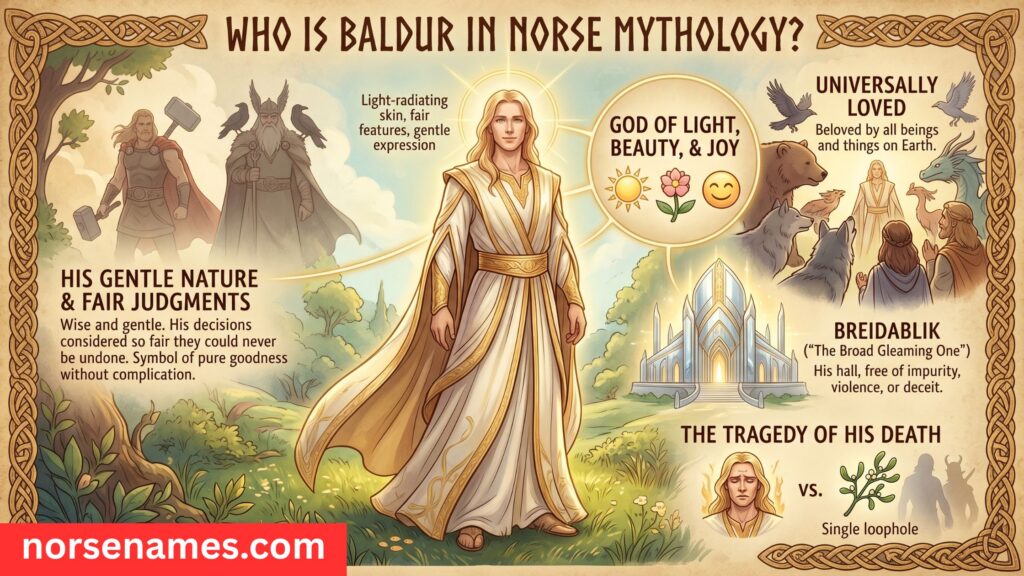
He lived in Breidablik, a hall whose name roughly translates to “the broad gleaming one.” Breidablik’s meaning fits him perfectly: a place said to be free of anything impure, untouched by violence or deceit. Unlike Thor’s hammer-swinging confrontations or Odin’s restless hunger for knowledge, Baldur’s defining trait was simply being good. He was wise and gentle, and his judgments were considered so fair that nothing he decided could ever be undone.
This gentleness is part of what makes the baldr mythology so devastating. He isn’t punished for arrogance or outwitted in a contest. He is killed almost by accident, through a single loophole in his own mother’s protective magic — a detail that turns his death from a heroic sacrifice into something closer to inevitable tragedy.
How Did Baldur Die? The Full Story of Baldur’s Death
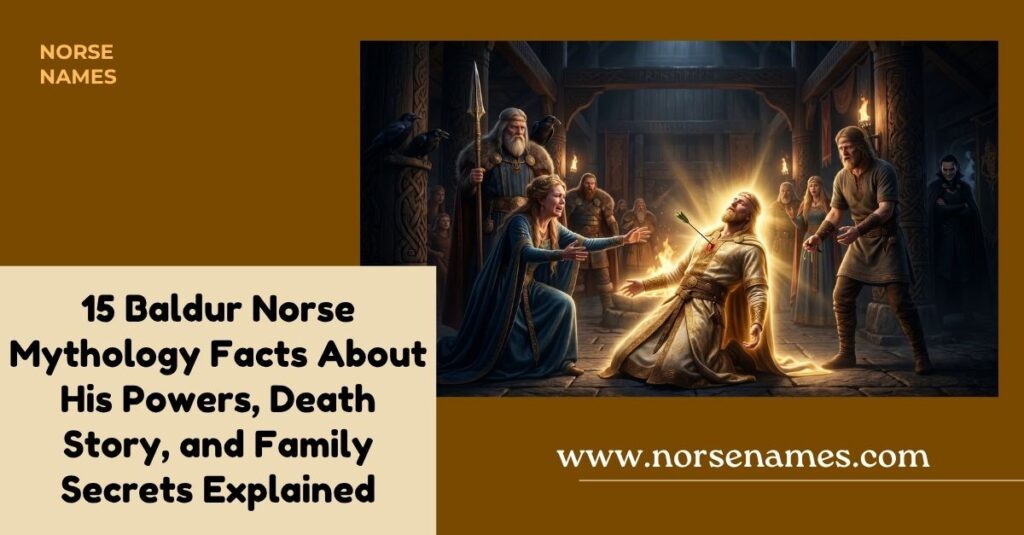
Baldur’s death explained simply: he was killed by a dart made of mistletoe, thrown by his own blind brother, while Loki secretly orchestrated the entire act. But the path to that moment is where the real story lives.
The warning dreams. The myth opens with foreboding. Baldur begins having troubling dreams hinting at his own death. Odin and Frigg take the warning seriously enough that Odin rides to Hel to question a dead seeress about what’s coming, while Frigg sets out to protect her son herself.
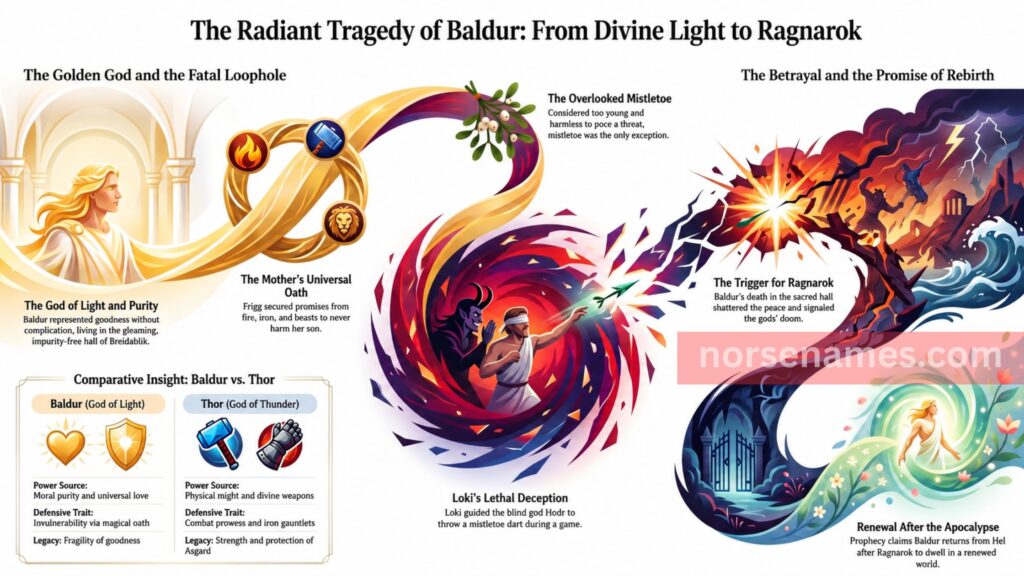
How Frigg tried to protect Baldur. Frigg travels across all nine realms, extracting oaths from every object, animal, and force of nature, asking each one to promise it will never harm her son. Fire, water, iron, stone, trees, diseases, birds, beasts, and poison all agree. One thing is overlooked: mistletoe. It seemed too young and harmless to bother asking.
The fatal game. Once Frigg’s oaths are secured, the gods turn Baldur’s new invulnerability into sport, hurling weapons and stones at him for entertainment and watching them bounce off harmlessly. It’s a strangely playful scene in the middle of one of mythology’s darkest stories.
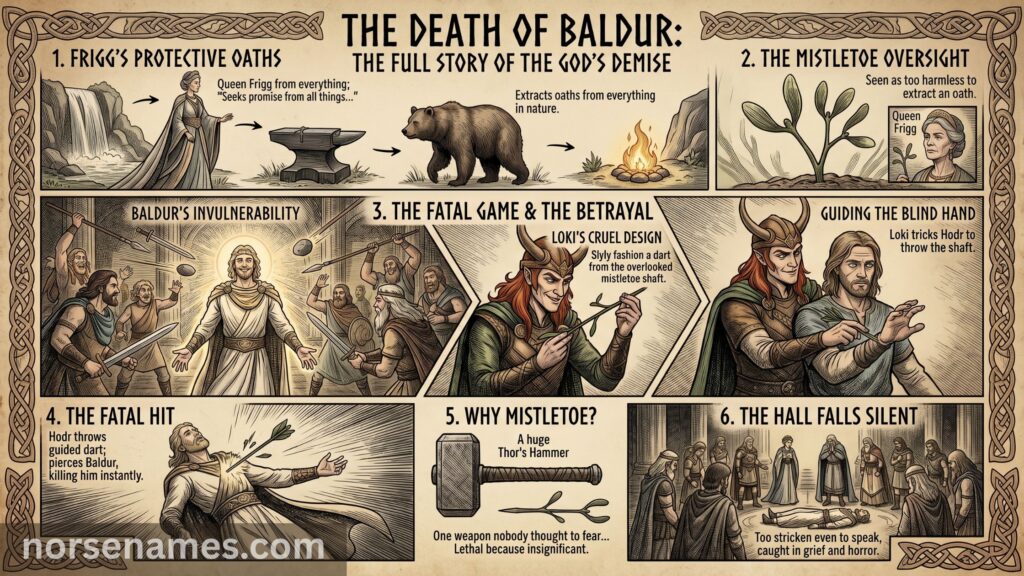
Why did Loki kill Baldur? Loki learns of Frigg’s one oversight and fashions a dart from the overlooked mistletoe. Motives vary by interpretation — some read it as pure jealousy of Baldur’s universal love, others as Loki’s role as an agent of fate, the figure who must set Ragnarok’s chain of events in motion. Whatever the reason, Loki and Baldur’s relationship in this moment becomes the myth’s central betrayal.
How Loki tricked Hodr. At the gathering, Loki notices that Hodr, Baldur’s blind brother, has been left out of the game since he can’t see to aim. Loki offers to guide his hand and presses the mistletoe shaft into his grip. Hodr throws it, guided by Loki, and it pierces Baldur, killing him instantly. Baldur and Hodr’s bond, until that moment loving and uncomplicated, becomes forever defined by this single unwitting act.
Why mistletoe killed Baldur. Mistletoe in Norse mythology occupies an unusual place precisely because of this story — it’s the one thing in all creation considered too insignificant to threaten a god, which is exactly what made it lethal. Unlike Thor, who fights with a legendary hammer, Baldur Norse mythology weapon traditions are minimal — he wasn’t a warrior, and the one weapon ever associated with him was the very thing that killed him. That irony is the engine of the entire myth: the deadliest weapon was the one nobody thought to fear.
The hall falls silent. Sources describe the gods as too stricken even to speak, caught between grief for Baldur and horror that the act happened in their own sacred space.
Baldur’s Funeral and the Journey to Hel
Baldur’s body is carried to his ship, Hringhorni, said to be the largest ship ever built. The gods can’t launch it alone, so they summon the giantess Hyrrokkin, whose enormous push sends it into the sea with such force that the rollers beneath it spark fire. For readers searching Baldur Norse mythology wife, Nanna is the goddess most closely tied to his tragic story — she dies of grief here and is placed on the pyre beside her husband, one of the myth’s quietest, saddest details. Odin lays his ring Draupnir on the flames, and even Thor takes part in the rites.
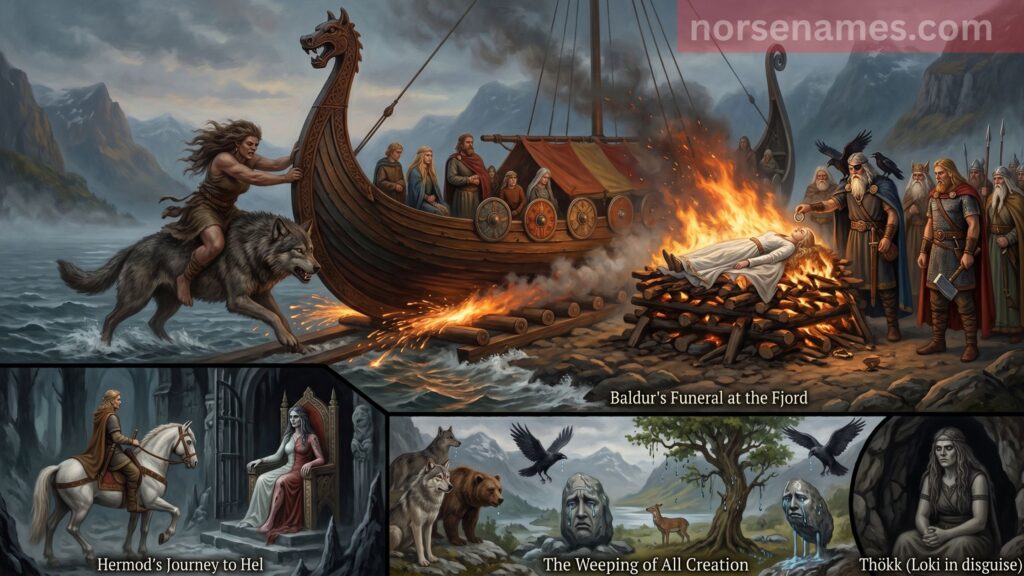
Desperate to undo what’s been done, the gods send the messenger Hermod to plead with Hel, ruler of the dead. Hel agrees to release Baldur on one condition: every single thing in existence must weep for him. Messengers travel through all nine realms, and remarkably, almost everything does — stones, metals, trees, every creature — until they reach one giantess, Thökk, who refuses, claiming she felt nothing for Baldur. Many versions of the myth strongly suggest Thökk is Loki in disguise, sealing Baldur’s fate for good.
Baldur Norse Mythology Family Tree and Relationships
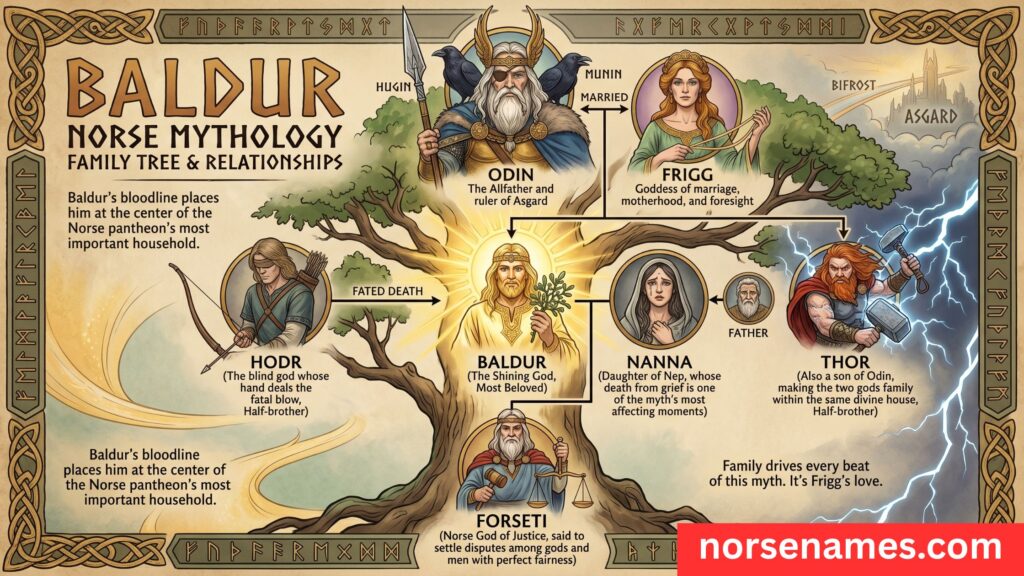
Baldur’s bloodline places him at the center of the Norse pantheon’s most important household, and any baldur family tree starts here:
- Father: Odin, the Allfather and ruler of Asgard
- Mother: Frigg, goddess of marriage, motherhood, and foresight
- Wife: Nanna, daughter of Nep, whose death from grief is one of the myth’s most affecting moments
- Son: Forseti, the Norse god of justice, said to settle disputes among gods and men with perfect fairness
- Half-brother: Hodr, the blind god whose hand deals the fatal blow
- Half-brother: Thor, also a son of Odin, making the two gods family within the same divine house
Family drives every beat of this myth. It’s Frigg’s love that sets the tragedy in motion. It’s Hodr, his own brother, who unknowingly kills him. And it’s Nanna’s death beside him on the pyre that turns this from a story about a god into a story about love and loss that any reader recognizes instantly.
Baldur Norse Mythology Powers: Was Baldur Stronger Than Thor?
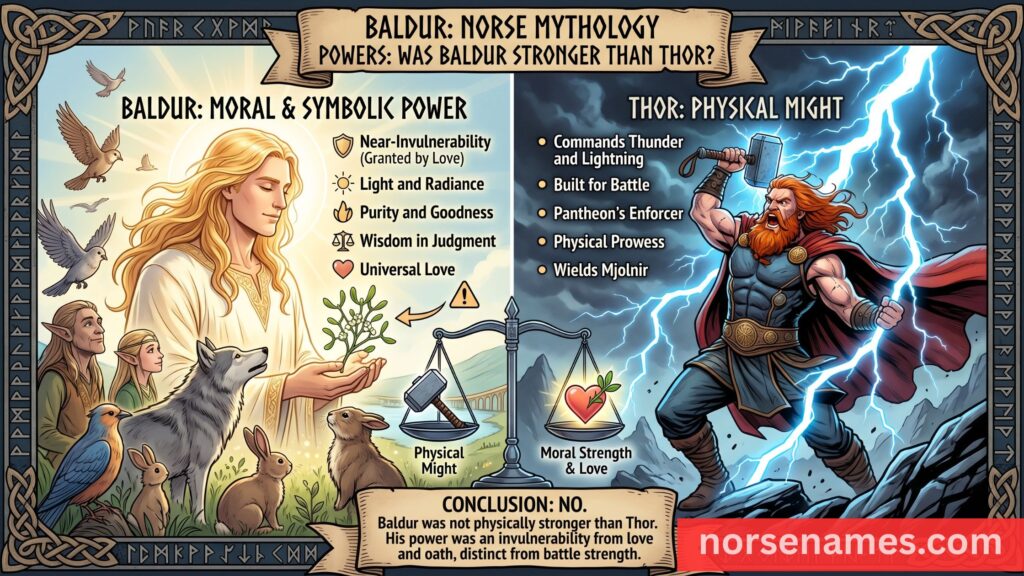
Baldur isn’t typically written with combat powers the way Thor commands thunder or Odin commands prophecy. As the god of light Norse mythology remembers most fondly, his strength is moral and symbolic rather than physical.
| Attribute | Description |
|---|---|
| Light and radiance | Often read as a solar or luminous figure, with light said to follow him |
| Purity and goodness | The only Aesir described as having no flaws or dark impulses |
| Wisdom in judgment | His rulings were considered final and beyond appeal |
| Near-invulnerability | Briefly, nothing in the nine realms could physically harm him |
| Universal love | Uniquely among the gods, every being in creation is said to have loved him |
So, was Baldur stronger than Thor? Not in physical might — Thor remains the pantheon’s enforcer, built for battle. Baldur’s power was different: an invulnerability granted by love and oath rather than muscle, which is precisely why a single overlooked weakness was enough to end him. What does Baldur represent in the end isn’t strength, but the fragility of even the most protected goodness.
Baldur Norse Mythology Symbols
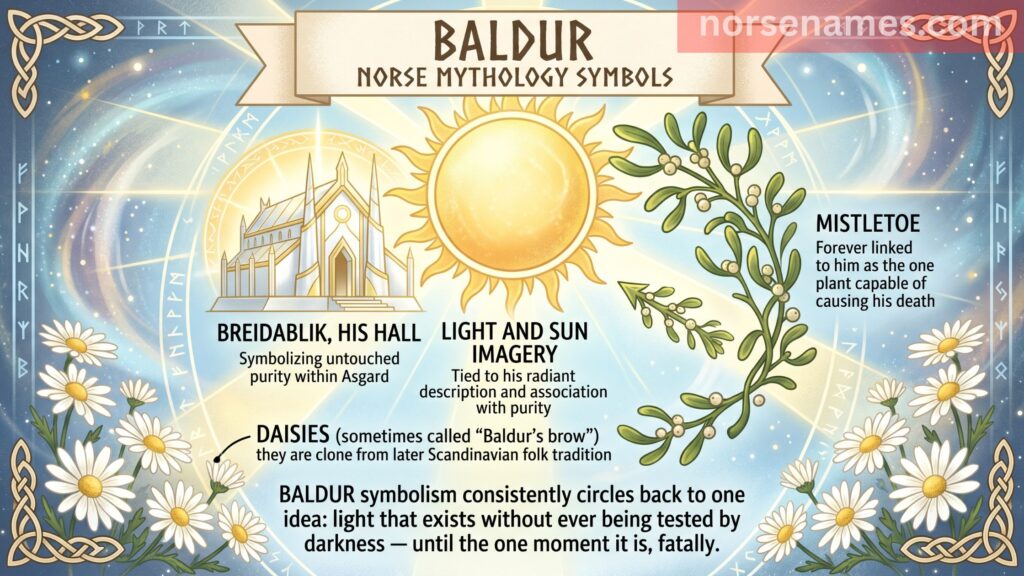
- Light and sun imagery, tied to his radiant description and association with purity
- Mistletoe, forever linked to him as the one plant capable of causing his death
- Breidablik, his hall, symbolizing untouched purity within Asgard
- White and gold, colors commonly associated with his depiction
- Daisies, sometimes called “Baldur’s brow” in later Scandinavian folk tradition
Baldur symbolism consistently circles back to one idea: light that exists without ever being tested by darkness — until the one moment it is, fatally.
Baldur and Ragnarok: Does He Return?
Baldur’s prophecy doesn’t end with his death in Hel. The Völuspá, a central poem of the Poetic Edda, describes a renewed world after Ragnarok’s destruction in which Baldur and Hodr return from the dead, reconciled, to dwell together in the fields of Idavoll.
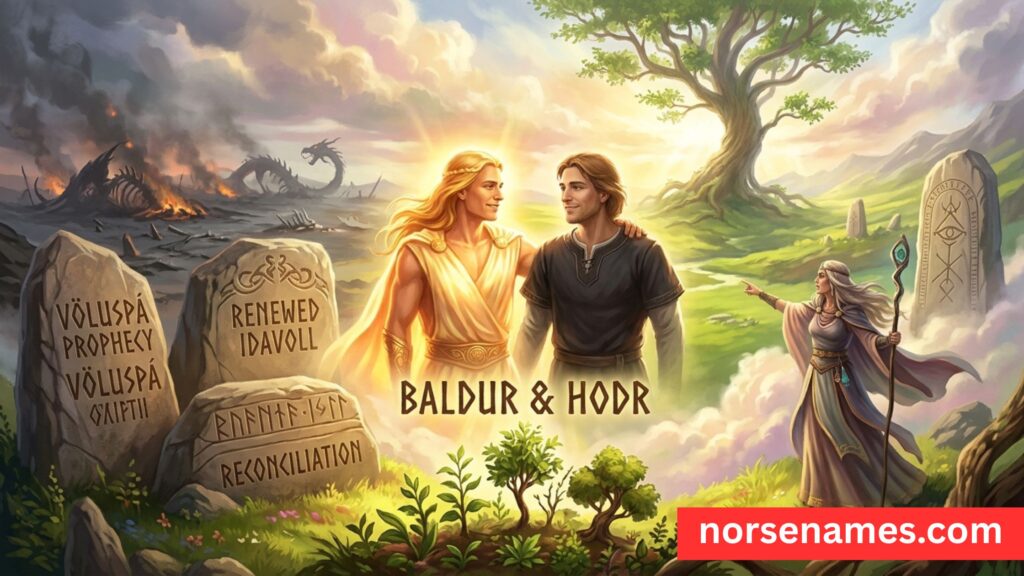
Baldur and Ragnarok are connected in a deeper way than most readers realize — his death is often read as one of the events that sets the doom of the gods in motion, a sign that even the safest, most beloved figure in creation isn’t safe from fate. But what happened after Baldur died isn’t only destruction. His return after Ragnarok is one of the few genuinely hopeful notes in the entire narrative, suggesting that goodness and reconciliation outlast even the gods’ twilight.
Why Baldur Matters in Viking Mythology
Within viking mythology, Baldur’s story functioned as more than entertainment — it was a meditation on fate, or wyrd, a concept deeply embedded in the Norse worldview. The idea that even the most beloved, most protected figure couldn’t escape his fated death resonated with a culture that placed enormous value on facing fate with courage rather than denial.
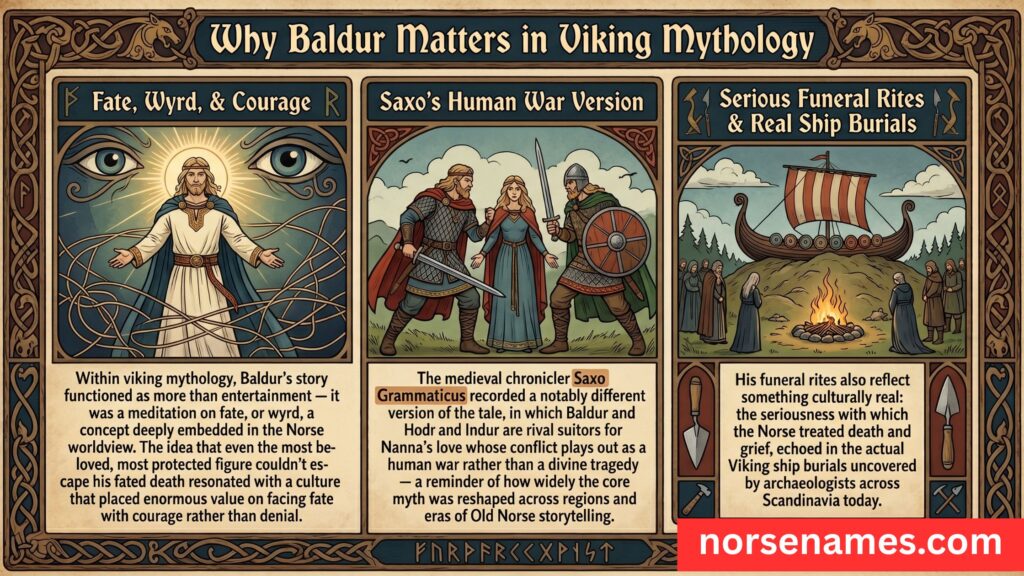
The medieval chronicler Saxo Grammaticus recorded a notably different version of the tale, in which Baldur and Hodr are rival suitors for Nanna’s love whose conflict plays out as a human war rather than a divine tragedy — a reminder of how widely the core myth was reshaped across regions and eras of Old Norse storytelling.
His funeral rites also reflect something culturally real: the seriousness with which the Norse treated death and grief, echoed in the actual Viking ship burials uncovered by archaeologists across Scandinavia today.
Baldur Norse Mythology vs God of War
Many modern readers first encounter Baldur through Baldur God of War (2018), and the contrast with the original myth is striking. The game reimagines him as a tattooed, near-unkillable warrior whose invulnerability is a curse he resents rather than a gift granted out of love. He’s aggressive, bitter, and combat-driven — closer in spirit to a berserker than to the gentle, beloved figure of the source material.
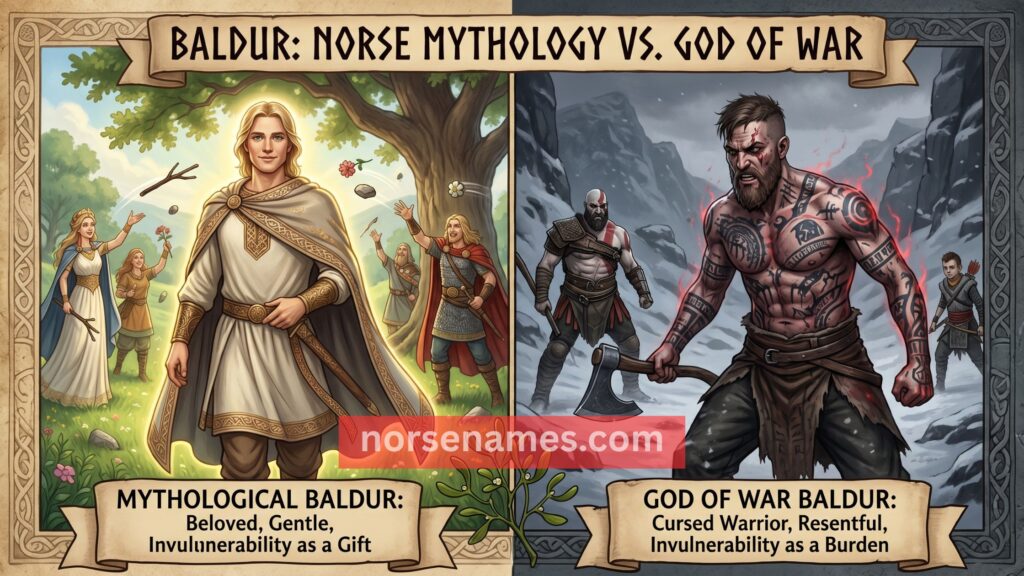
Baldur Norse mythology vs God of War really comes down to motive and tone. The mythological Baldur is killed because everyone loves him too much to imagine he needs protecting from anything but mistletoe; the God of War version is consumed by hating his own invulnerability and the mother who gave it to him. Both versions hinge on the same core irony — a god who cannot be harmed, undone by the people closest to him — but the game inverts the emotional core entirely, swapping tragedy-through-love for tragedy-through-resentment.
Baldur Norse Mythology Names
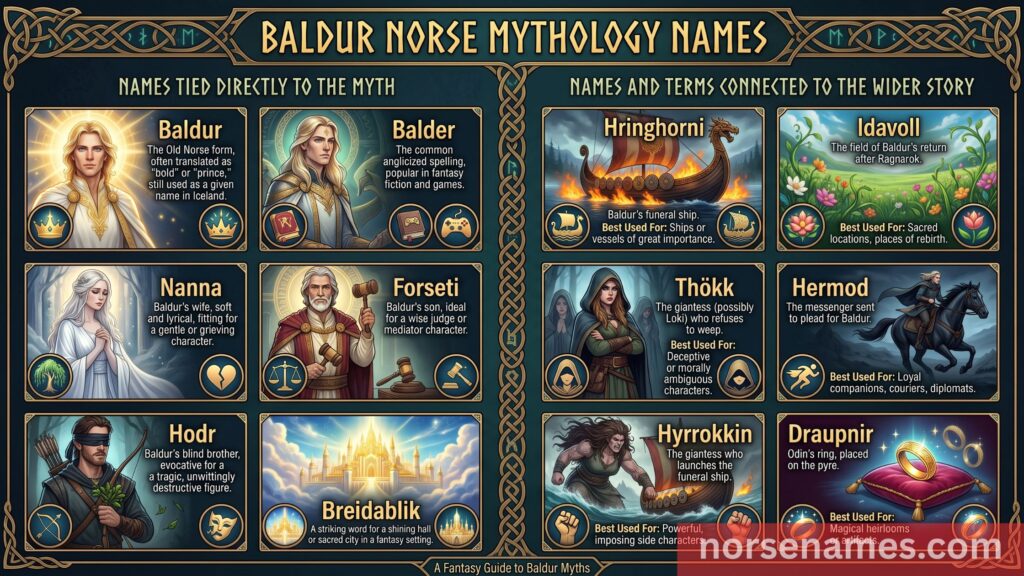
Names tied directly to the myth:
- Baldur — the Old Norse form, often translated as “bold” or “prince,” still used as a given name in Iceland
- Balder — the common anglicized spelling, popular in fantasy fiction and games
- Nanna — Baldur’s wife, soft and lyrical, fitting for a gentle or grieving character
- Forseti — Baldur’s son, ideal for a wise judge or mediator character
- Hodr — Baldur’s blind brother, evocative for a tragic, unwittingly destructive figure
- Breidablik — a striking word for a shining hall or sacred city in a fantasy setting
Names and terms connected to the wider story:
| Name/Term | Connection | Best Used For |
|---|---|---|
| Hringhorni | Baldur’s funeral ship | Ships or vessels of great importance |
| Idavoll | The field of Baldur’s return after Ragnarok | Sacred locations, places of rebirth |
| Thökk | The giantess (possibly Loki) who refuses to weep | Deceptive or morally ambiguous characters |
| Hermod | The messenger sent to plead for Baldur | Loyal companions, couriers, diplomats |
| Hyrrokkin | The giantess who launches the funeral ship | Powerful, imposing side characters |
| Draupnir | Odin’s ring, placed on the pyre | Magical heirlooms or artifacts |
FAQs. About Baldur Norse mythology
Who killed Baldur in Norse mythology?
Hodr, Baldur’s blind brother, threw the fatal weapon — but Loki engineered the entire act, guiding Hodr’s hand and supplying the one weapon capable of harming Baldur.
Who is Hodr?
Hodr is Baldur’s blind half-brother, a son of Odin. He throws the mistletoe dart that kills Baldur, unknowingly guided by Loki, and later returns alongside Baldur after Ragnarok, reconciled.
Who is Odin’s favourite son?
Norse mythology never directly names a favorite son, but Baldur is often viewed as Odin’s most beloved child. The myths describe him as the most loved among the gods, and Odin’s grief after Baldur’s death suggests a uniquely deep bond between father and son. However, Odin also values Thor for strength and sacrifice and respects other sons for different reasons.
What weapon killed Baldur?
A dart or arrow made from mistletoe — the one plant Frigg forgot to bind with a protective oath.
Does Baldur return after Ragnarok?
Yes. The Völuspá describes Baldur returning from the dead alongside Hodr to live in the renewed world at Idavoll, reconciled after Ragnarok’s destruction.
Conclusion
The story of Baldur Norse mythology remains one of the most emotional and unforgettable legends in the Norse world. Unlike many gods who earned fame through battle or conquest, Baldur became a symbol of innocence, hope, and the painful reality that even the most beloved figures cannot escape fate. His death changed the destiny of the gods, set the events of Ragnarök into motion, and ensured that Baldur Norse mythology would be remembered as one of the greatest tragedies in Viking legend.
Whether you’re studying ancient Scandinavian myths, creating fantasy worlds, or simply curious about the gods of Asgard, Baldur Norse mythology offers far more than a story about loss. It explores destiny, family, sacrifice, betrayal, and the enduring hope of renewal after destruction. From Frigg’s desperate protection and Loki’s deception to Baldur’s promised return after Ragnarök, every chapter adds depth to this timeless legend.
More than a thousand years later, Baldur Norse mythology continues to inspire books, games, films, and modern storytelling because its themes remain universal. The tale reminds us that love cannot always prevent tragedy, but goodness can outlive even the darkest moments. That lasting message is exactly why Baldur Norse mythology still stands as one of the most powerful and meaningful stories in all of Norse legend.