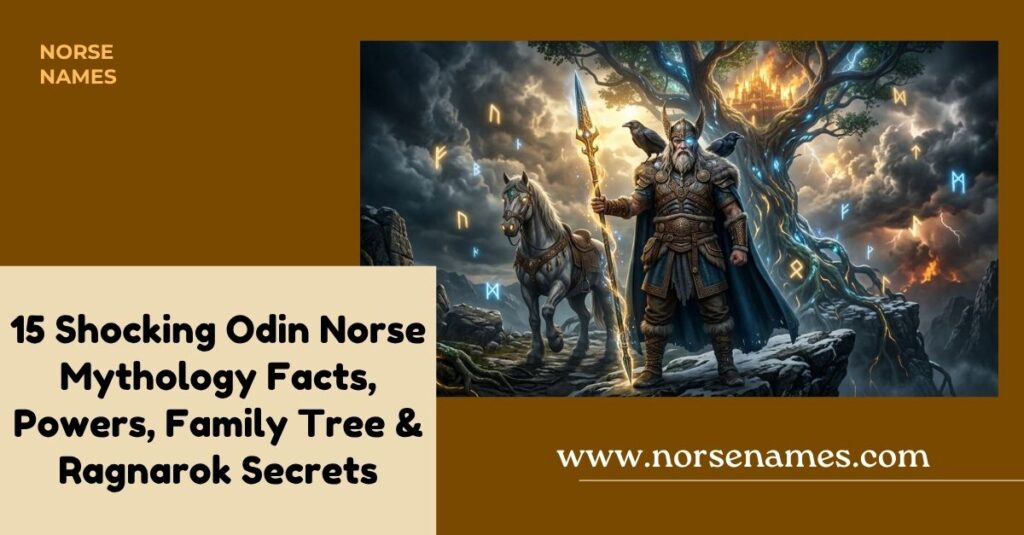

There is something about Odin Norse mythology that refuses to stay in the past. Long after the Viking longships were beached for the last time and the mead halls fell silent, the Allfather continues to captivate historians, fantasy writers, gamers, and anyone fascinated by ancient legend. Few figures in Odin Norse mythology have shaped storytelling as profoundly as Odin, the one-eyed ruler of Asgard whose relentless pursuit of wisdom changed the fate of gods and men alike.
In Odin Norse mythology, Odin is far more than the king of the Norse gods. He is the god of wisdom, war, poetry, magic, and prophecy—a mysterious wanderer who sacrificed his eye at Mimir’s Well and hung for nine nights upon Yggdrasil to uncover the secrets of the runes. Accompanied by his ravens Huginn and Muninn, riding the eight-legged Sleipnir, and preparing endlessly for Ragnarök, Odin represents knowledge earned through sacrifice rather than inherited power.
The Vikings understood that Odin was never meant to be a comforting deity. He is cunning, unpredictable, and willing to sacrifice anything—including himself—in pursuit of greater understanding. Unlike Thor’s straightforward heroism or Freya’s warmth and beauty, Odin moves through shadows, wearing disguises, shaping destinies, and guiding kings while accepting that even the Allfather cannot escape fate.
Whether you’re exploring Viking history for the first time, researching Norse religion, creating a fantasy world, or simply curious about Odin Norse mythology, this guide covers everything you need to know. You’ll discover Odin’s origins, family tree, powers, symbols, greatest myths, role in Ragnarök, influence on Viking culture, modern portrayals in Marvel, and why Odin Norse mythology continues to inspire readers, filmmakers, and game developers more than a thousand years after the Viking Age.
Who Is Odin — and What Is He the God Of?
Odin (Old Norse: Óðinn) is the supreme deity of the Norse pantheon, chief of the Aesir gods, and ruler of Asgard. He is known by an extraordinary number of names — over two hundred by some scholarly counts — each reflecting a different face of his complex nature. Grimnir (the Masked One), Gangleri (the Wanderer), Hárr (the High One), Ygg (the Terrible) — these are just a few of the names used in the Eddic poems to describe him.
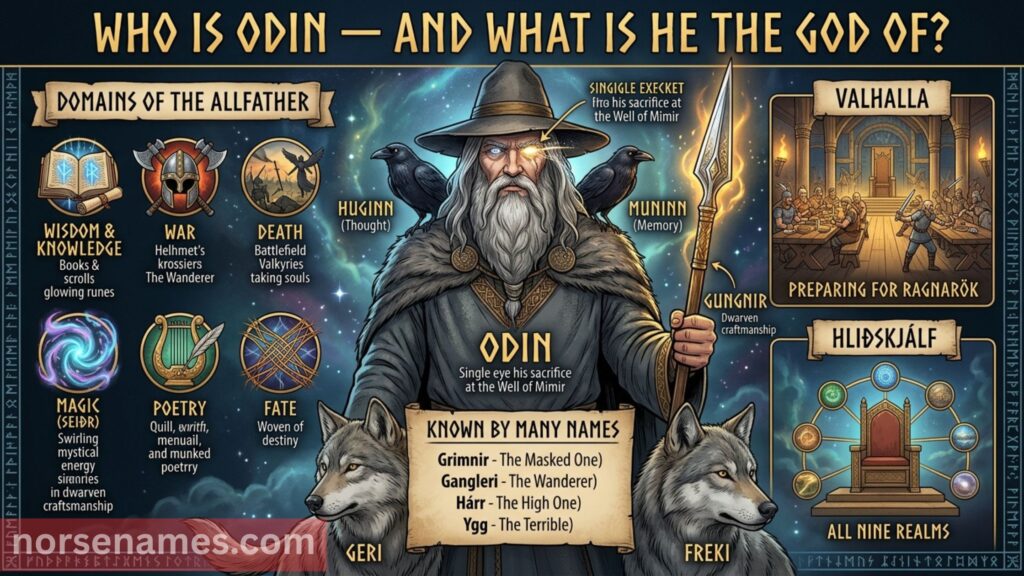
At his core, the Allfather governs an unusually broad domain. He is the god of wisdom, knowledge, war, death, magic (specifically seiðr), poetry, and fate — a combination that makes him unlike almost any other deity in world mythology. He presides over Valhalla, the magnificent hall where the souls of warriors slain in battle — the Einherjar — are gathered to feast and fight in preparation for the final cataclysm, Ragnarök. His throne, Hliðskjálf, is a seat of cosmic vision from which he can observe all nine realms simultaneously.
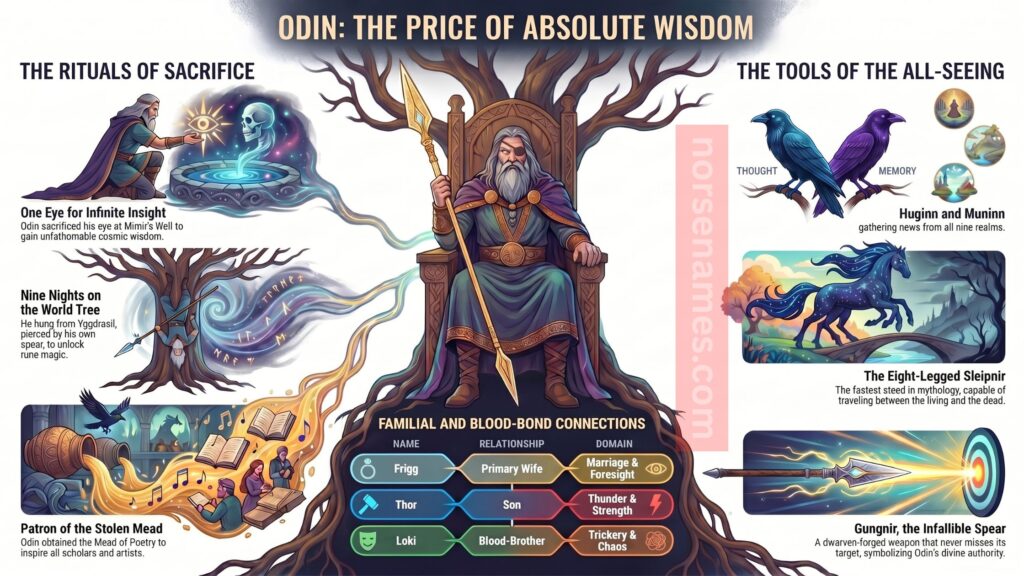
Odin is always depicted as an elderly man — long grey beard, wide-brimmed hat pulled low, a travelling cloak, and a single glittering eye. The other eye socket is empty, the price he paid for a single drink from the Well of Mimir, which granted him unfathomable wisdom. Two ravens, Huginn (Thought) and Muninn (Memory), sit on his shoulders and fly out each day to bring him news from every corner of the world. At his feet crouch two wolves, Geri and Freki, and in his hand he carries the legendary spear Gungnir, forged by the dwarven craftsmen known as the Sons of Ivaldi.
Odin Norse Mythology Powers and Abilities
The abilities described in Odin Norse mythology are very different from those of other Norse gods. Rather than relying on physical strength like Thor, Odin’s true power comes from wisdom, magic, sacrifice, and prophecy. Throughout Odin Norse mythology, the Allfather constantly seeks knowledge, even when it demands great personal sacrifice.
Master of Seiðr and Rune Magic
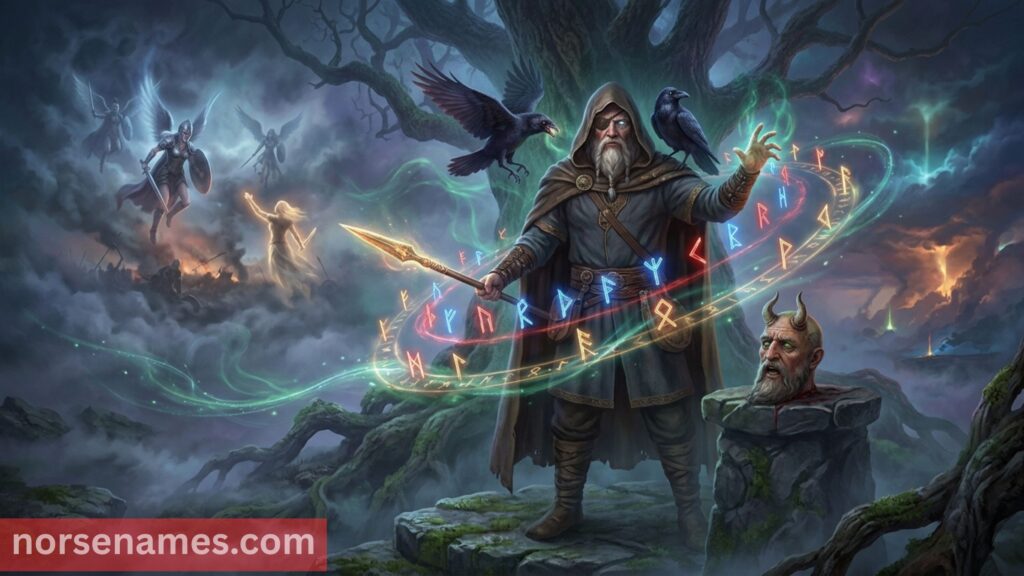
Odin was the greatest practitioner of seiðr, the powerful Norse magic that could influence fate and reveal the future. He also mastered rune magic after hanging from Yggdrasil for nine days and nine nights, sacrificing himself to unlock the hidden knowledge of the runes. These magical symbols were believed to possess the power to heal, protect, curse, and guide destiny.
Wisdom and Prophecy
Wisdom is Odin’s defining trait. He sacrificed one of his eyes at Mimir’s Well to gain unparalleled knowledge and spent his life preparing for Ragnarök. From his throne, Hliðskjálf, and with the help of his ravens Huginn and Muninn, Odin could observe the Nine Realms and gather information from every corner of creation.
Shapeshifting and Leadership
One of the lesser-known powers in Odin Norse mythology is Odin’s ability to change his appearance. He often traveled the world disguised as an old wanderer, testing heroes and seeking hidden wisdom. As ruler of Asgard and leader of the Aesir, he also commanded the Valkyries and welcomed fallen warriors into Valhalla to prepare for the final battle.
God of War, Poetry, and Inspiration
Unlike Thor, Odin represents strategy rather than brute force. He chooses the warriors who will die in battle and rewards courage with a place in Valhalla. Odin is also the god of poetry, gaining the legendary Mead of Poetry to inspire scholars, poets, and storytellers with creativity and wisdom.
Together, these extraordinary abilities explain why Odin Norse mythology presents the Allfather as far more than a warrior king. His mastery of magic, wisdom, prophecy, and leadership made him one of the most influential and fascinating figures in Viking legend, and his legacy continues to shape modern fantasy, literature, and popular culture.
Is Odin the God of War?
This is one of the most common questions people ask — and the honest answer is: partly, but not primarily. In Norse mythology, Odin’s relationship with war is more complex than a simple label suggests.
He does preside over battle in a meaningful sense. The Valkyries who haunt battlefields and choose the slain are his servants. Warriors dedicated their victories to him. Kings sacrificed to him before campaigns. The act of throwing a spear over an enemy host — consecrating the battle to Odin — was a genuine Viking ritual recorded in the sagas.
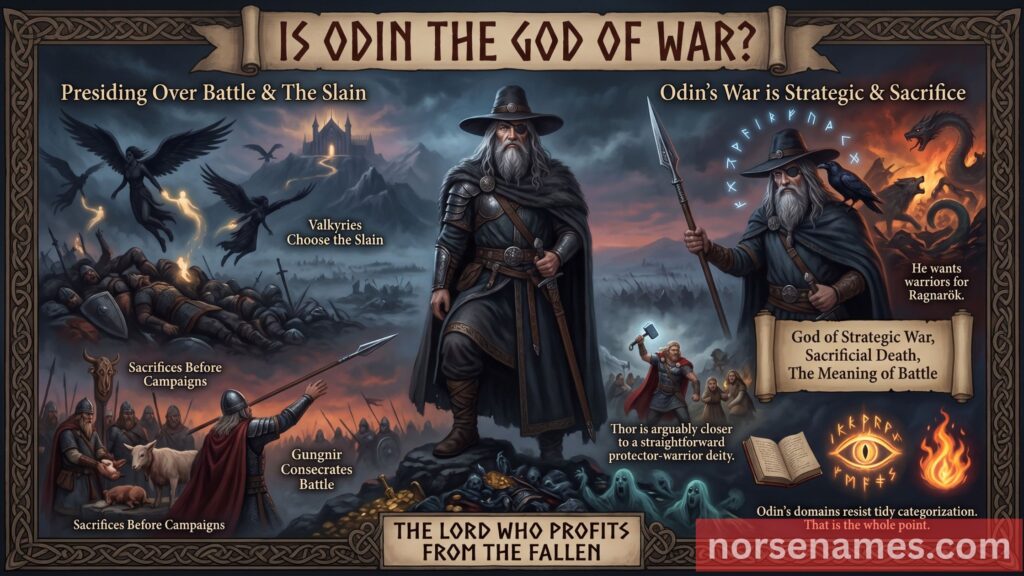
But Odin is not a war god in the way that Ares or Mars are war gods — divine patrons of combat itself. He is the god of strategic war, of sacrificial death, of the meaning that battle produces rather than the act itself. He wants the warriors who die gloriously so they can serve him at Ragnarök. War, for Odin, is a harvest. Thor is arguably closer to a straightforward protector-warrior deity in the Viking worldview. Odin is something darker: the lord who profits from the fallen.
The domains he rules simultaneously — wisdom, poetry, death, magic, and war — resist tidy categorisation. That is, in many ways, the whole point.
Odin Norse Mythology Family Tree
Odin’s family is vast and tangled in the way that only mythological genealogies can be, but a few relationships define him most clearly.
Wives and Consorts
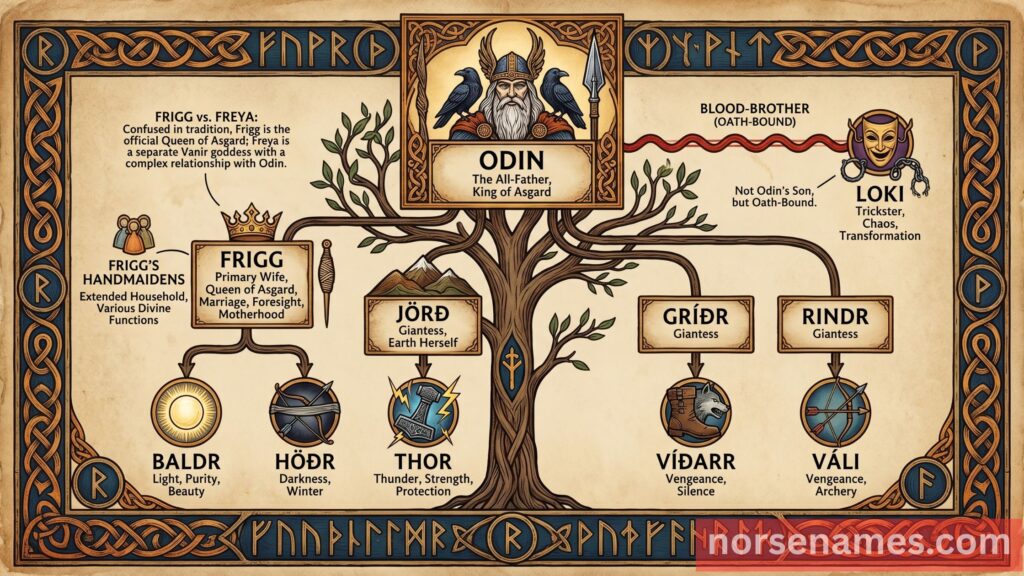
His primary wife is Frigg, goddess of marriage, motherhood, and foresight. Frigg and Odin share the throne of Asgard as near-equals — she too can see the fates of all beings, though unlike her husband she keeps her visions to herself. Together they are parents to Baldr, the beloved god of light and purity, whose death becomes one of the most devastating events in Norse legend.
Odin also fathered children with giantesses and other divine beings. With the giantess Jörð (Earth herself), he sired Thor, the hammer-wielding god of thunder. With the giantess Gríðr, he fathered Víðarr, the silent god destined to avenge Odin’s death at Ragnarök. With the giantess Rindr, he fathered Váli, born specifically for the purpose of avenging Baldr.
The Question of Odin’s Wife
Scholars and readers often wonder whether Frigg or Freya is Odin’s true consort, since some sources blur the two goddesses together. In the most widely accepted reading of the Eddas, Frigg is Odin’s official wife — the queen of Asgard — while Freya is a separate deity of the Vanir with whom Odin had a complex relationship of magical exchange rather than marriage. The confusion arises because both goddesses share qualities of love, magic, and foresight, and some scholars believe they may have begun as two names for the same deity before diverging in later tradition.
Sons, Brothers, and Blood-Bonds
| Family Member | Relationship | Domain |
|---|---|---|
| Frigg | Primary wife, Queen of Asgard | Marriage, foresight, motherhood |
| Thor | Son (with Jörð) | Thunder, strength, protection |
| Baldr | Son (with Frigg) | Light, purity, beauty |
| Víðarr | Son (with Gríðr) | Vengeance, silence |
| Váli | Son (with Rindr) | Vengeance, archery |
| Höðr | Son (with Frigg) | Darkness, winter |
| Loki | Blood-brother (oath-bound) | Trickery, chaos, transformation |
| Frigg’s Handmaidens | Extended household | Various divine functions |
Loki, the trickster, is not Odin’s son but his blood-brother — a bond sealed in a ritual oath in the early days of the world. This relationship is crucial: it explains why Odin so often tolerates Loki’s chaos, and why the eventual betrayal runs so deep. Beyond the Aesir, Odin’s connections reach into every corner of the nine realms — he is deeply intertwined with the Norns (Urd, Verdandi, and Skuld) who spin the fates of gods and men at the base of Yggdrasil.
Odin in Norse Religion
While many people know Odin through myths and popular culture, Odin Norse mythology was once part of a living religion practiced throughout Viking Age Scandinavia. As the Allfather, Odin was revered as the god of wisdom, war, poetry, magic, and kingship. Unlike Thor, who was especially popular among farmers and ordinary families, Odin was often associated with rulers, warriors, poets, and those who sought knowledge and power.
In the Old Norse religion, sacrifices known as blót were offered to Odin during important festivals and before battles. Viking kings and chieftains prayed for victory, wisdom, and divine guidance, believing Odin could determine the outcome of war and choose the bravest warriors for Valhalla through his Valkyries.
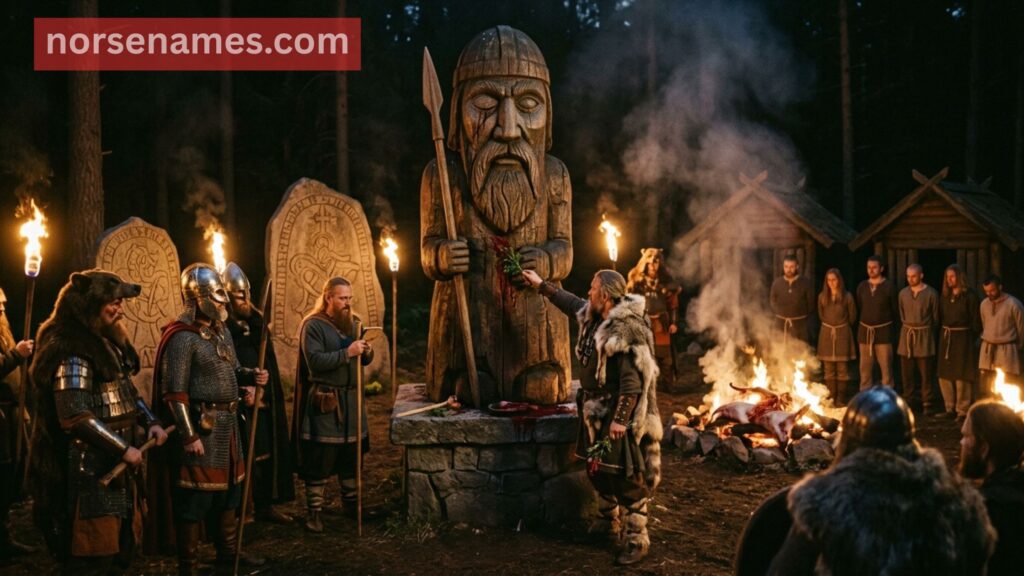
One of the most important centers of Odin worship was the temple at Uppsala in present-day Sweden. Medieval accounts describe major religious ceremonies held there every nine years, where animals—and according to some historical sources, even humans—were sacrificed to honor the gods. The number nine held special significance in Odin Norse mythology, reflecting the nine nights Odin hung upon Yggdrasil and the Nine Realms of Norse cosmology.
Odin’s influence also survives in everyday life. The English word Wednesday comes from Wōdnesdæg, meaning “Woden’s Day,” with Woden being the Anglo-Saxon name for Odin. This linguistic connection highlights how deeply Norse beliefs shaped Germanic culture.
Although Christianity eventually replaced the old Norse religion across Scandinavia, Odin Norse mythology continues to inspire modern Ásatrú practitioners, historians, and mythology enthusiasts. Today, many people study the Eddas, celebrate traditional Norse festivals, and honor Odin as part of the revival of Norse pagan traditions.
Understanding Odin’s place in religion helps explain why Odin Norse mythology is far more than a collection of legends. For the Vikings, Odin was not simply a mythical character—he was a living deity whose wisdom, sacrifice, and leadership influenced their beliefs, rituals, and view of the world.
Odin Norse Mythology Major Myths and Stories
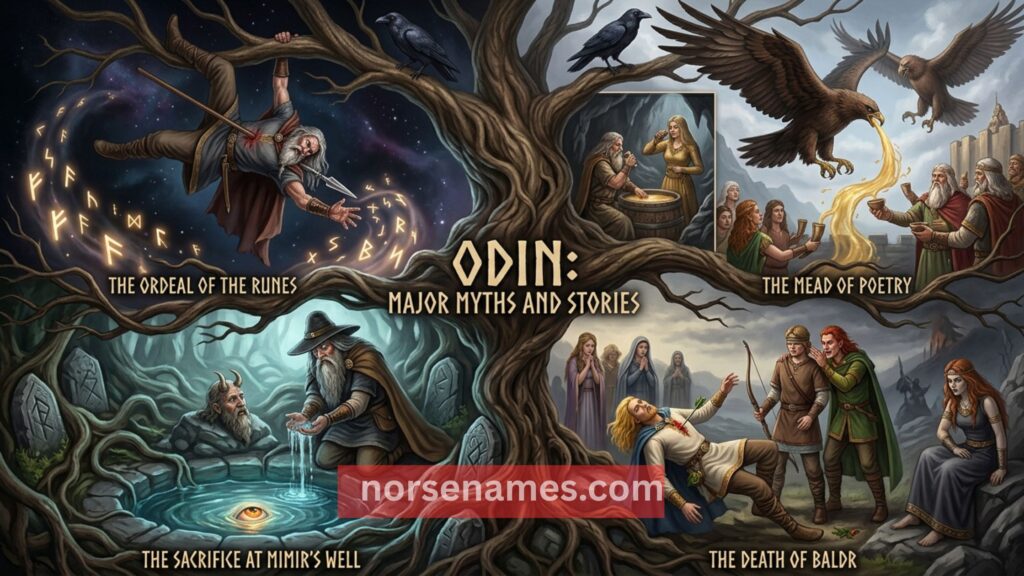
The legends of Odin Norse mythology reveal a god unlike any other. Rather than winning glory through brute strength alone, Odin earns his power through sacrifice, wisdom, cunning, and an unrelenting pursuit of knowledge. These stories explain how the Allfather gained his magical abilities, prepared for Ragnarök, and became the most influential figure in Norse legend.
The Sacrifice at Mimir’s Well
One of the most famous stories in Odin Norse mythology tells of Odin’s visit to Mimir’s Well, a sacred spring beneath one of Yggdrasil’s roots. The well contained limitless wisdom, but its guardian, Mimir, demanded a terrible price.
Without hesitation, Odin sacrificed one of his eyes in exchange for a single drink from the enchanted waters. The sacrifice granted him profound insight into the past, present, and future, making the missing eye one of the most recognizable symbols of the Allfather’s endless search for knowledge.
The Nine Nights on Yggdrasil
Determined to uncover even greater mysteries, Odin willingly sacrificed himself once again.
According to the Hávamál, he pierced himself with his own spear and hung from the branches of Yggdrasil for nine days and nine nights without food or water. At the edge of death, the secrets of the runes revealed themselves to him.
These runes were believed to hold immense magical power, allowing Odin to cast spells, heal wounds, protect warriors, and influence fate itself. This extraordinary act of self-sacrifice remains one of the defining moments in Odin Norse mythology, symbolizing that true wisdom is earned through suffering and perseverance.
The Death of Baldr
The tragic death of Baldr, Odin’s beloved son, marks one of the darkest chapters in Norse legend.
After Baldr began dreaming of his own death, Frigg secured promises from nearly every living thing never to harm him. However, she overlooked the harmless mistletoe. Loki exploited this weakness by tricking the blind god Höðr into throwing a mistletoe dart, killing Baldr instantly.
Although Odin desperately sought to bring his son back from Hel, his efforts failed. Baldr’s death became one of the key events leading to Ragnarök, reminding even the king of the gods that fate cannot be escaped.
The Mead of Poetry
Another unforgettable tale in Odin Norse mythology is the theft of the Mead of Poetry.
The magical mead was brewed from the blood of Kvasir, the wisest being in creation, and granted extraordinary poetic talent and wisdom to anyone who drank it. After discovering it hidden inside a mountain, Odin disguised himself, outwitted the giant Suttung, and spent three nights with his daughter Gunnlöð before drinking every drop of the precious mead.
Transforming into an eagle, Odin escaped back to Asgard and shared the mead with the gods and worthy poets. Because of this myth, Odin became known not only as the god of wisdom and war but also as the patron of poetry, storytelling, and artistic inspiration.
Odin and the Creation of the World
Before ruling Asgard, Odin helped create the world itself.
Together with his brothers Vili and Vé, he defeated the giant Ymir, whose enormous body became the foundation of creation. His flesh formed the earth, his blood became the seas, his bones became mountains, and his skull formed the sky. Odin later created the first humans, Ask and Embla, giving them life, intelligence, and spirit.
This creation myth established Odin as both a creator and protector of the Nine Realms.
The Wild Hunt
In later Scandinavian and Germanic folklore, Odin became the mysterious leader of the Wild Hunt—a ghostly procession that raced across the winter sky during fierce storms.
Those who claimed to witness the spectral riders believed they were seeing Odin leading the restless dead or supernatural warriors across the heavens. The legend reinforced his reputation as a god connected with war, death, and the unseen world, while adding another mysterious layer to his enduring legacy.
Together, these stories reveal why Odin Norse mythology continues to captivate readers more than a thousand years after the Viking Age. Each myth highlights a different side of the Allfather—his wisdom, sacrifice, leadership, magic, and acceptance of fate—making him one of the most complex and enduring figures in world mythology.
Odin Norse Mythology Symbols
The symbols found in Odin Norse mythology represent far more than simple objects. Each one reflects an aspect of the Allfather’s character—his wisdom, sacrifice, leadership, magic, and connection to fate. Together, these legendary symbols help explain why Odin remains one of the most recognizable figures in Norse legend.
Gungnir – Odin’s Spear
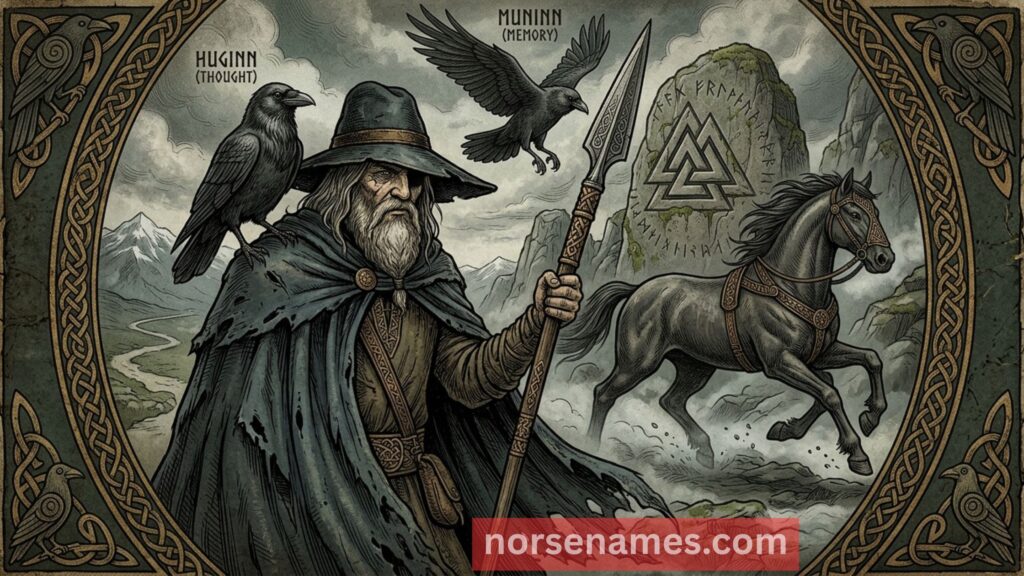
Gungnir is Odin’s legendary spear, forged by the master dwarven smiths known as the Sons of Ivaldi. It was said to never miss its target, making it a symbol of authority, justice, and divine power. Before battle, Odin would throw Gungnir over the battlefield to dedicate the coming conflict to himself.
Huginn and Muninn
The ravens Huginn (“Thought”) and Muninn (“Memory”) are among the most famous symbols in Odin Norse mythology. Every day they fly across the Nine Realms, gathering knowledge before returning to whisper everything they have seen into Odin’s ears. They symbolize wisdom, intelligence, memory, and the constant pursuit of knowledge.
Sleipnir
Sleipnir, Odin’s eight-legged horse, is considered the finest steed in Norse mythology. Born from Loki through one of mythology’s strangest stories, Sleipnir could travel effortlessly between the Nine Realms, including the world of the living and the realm of the dead. He represents speed, spiritual journeys, and Odin’s ability to move between different worlds.
The Valknut
The Valknut consists of three interlocking triangles frequently found on Viking memorial stones and burial monuments. Although its exact meaning remains debated, it is widely associated with Odin, fallen warriors, and the journey into the afterlife. Today, it is one of the best-known symbols connected to Viking culture.
The One Eye
Odin’s missing eye is one of his most powerful symbols. He willingly sacrificed it at Mimir’s Well in exchange for limitless wisdom. Rather than representing weakness, the lost eye symbolizes the belief that true knowledge often requires personal sacrifice.
Draupnir
Draupnir is Odin’s magical golden ring, crafted by the dwarves. Every ninth night, it produces eight identical rings, symbolizing prosperity, abundance, and renewal. Odin later placed Draupnir on Baldr’s funeral pyre, making it an enduring symbol of both generosity and remembrance.
The Wide-Brimmed Hat and Cloak
In many myths, Odin disguises himself as an elderly traveler wearing a broad-brimmed hat and a long cloak. This appearance reflects his role as a wanderer who seeks wisdom by traveling among gods and humans without revealing his true identity.
Together, these legendary objects explain why Odin Norse mythology continues to inspire modern literature, films, games, and fantasy worlds. Whether represented by Gungnir, the ravens, Sleipnir, the Valknut, or his missing eye, every symbol tells part of the Allfather’s story and reinforces the themes of wisdom, sacrifice, and destiny that define Odin Norse mythology.
Odin Norse Mythology Facts
Odin Norse mythology is filled with fascinating details that go far beyond the familiar image of a one-eyed god carrying a spear. From extraordinary sacrifices to magical companions, these facts reveal why the Allfather remains one of the most intriguing figures in Viking legend. Here are some of the most interesting facts about Odin Norse mythology.
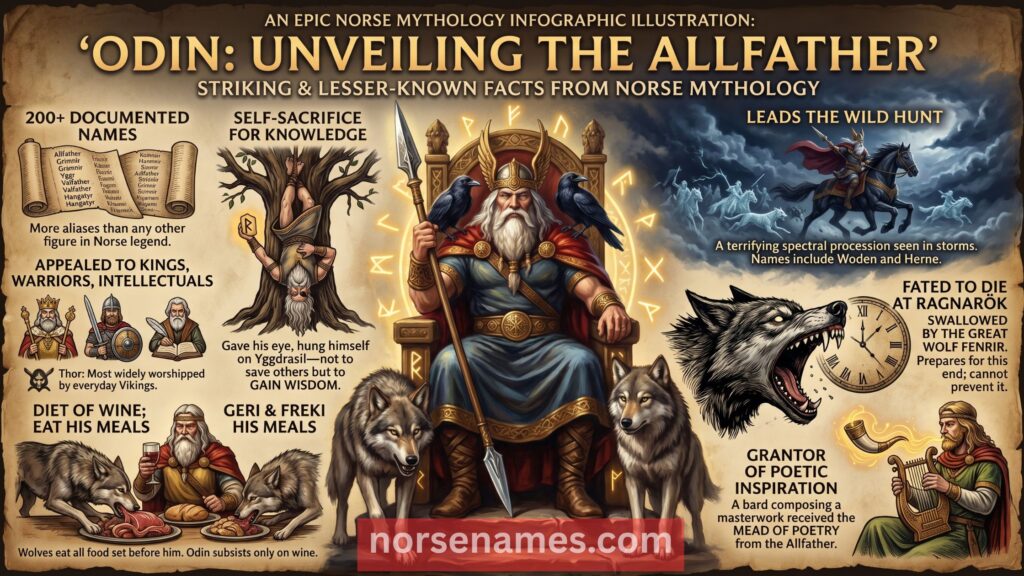
- Odin sacrificed one of his eyes at Mimir’s Well in exchange for limitless wisdom, making his missing eye a lasting symbol of knowledge earned through sacrifice.
- He hung from Yggdrasil for nine days and nine nights to discover the secrets of the runes. This self-sacrifice granted him mastery of powerful Norse magic.
- Odin was accompanied by two ravens, Huginn and Muninn, whose names mean “Thought” and “Memory.” They traveled across the Nine Realms each day, bringing him news from every corner of the world.
- His eight-legged horse, Sleipnir, could travel through the worlds of gods, humans, and the dead. Sleipnir was considered the fastest and most extraordinary horse in Odin Norse mythology.
- Odin created the first humans, Ask and Embla, together with his brothers Vili and Vé by giving them life, intelligence, and spirit.
- He ruled from the throne Hliðskjálf, which allowed him to see everything happening throughout the Nine Realms without leaving Asgard.
- Odin owned the magical ring Draupnir, which created eight identical gold rings every ninth night, symbolizing abundance, renewal, and prosperity.
- He was the god of both war and poetry. While Odin guided warriors to Valhalla, he also inspired poets and scholars after obtaining the legendary Mead of Poetry.
- Wednesday is named after Odin. The English word “Wednesday” comes from the Old English Wōdnesdæg, meaning “Woden’s Day,” using the Anglo-Saxon name for Odin.
These remarkable facts show why Odin Norse mythology continues to inspire historians, fantasy writers, game developers, and mythology enthusiasts around the world. Whether remembered for his wisdom, magic, leadership, or relentless pursuit of knowledge, Odin remains one of the most influential and enduring gods in all of Norse legend.
Odin’s Influence on Modern Culture
Although the Viking Age ended centuries ago, Odin Norse mythology continues to influence modern entertainment, literature, and even contemporary spiritual traditions. The Allfather remains one of the most recognizable figures in world mythology, inspiring millions through films, books, video games, and popular culture.
Odin in Marvel
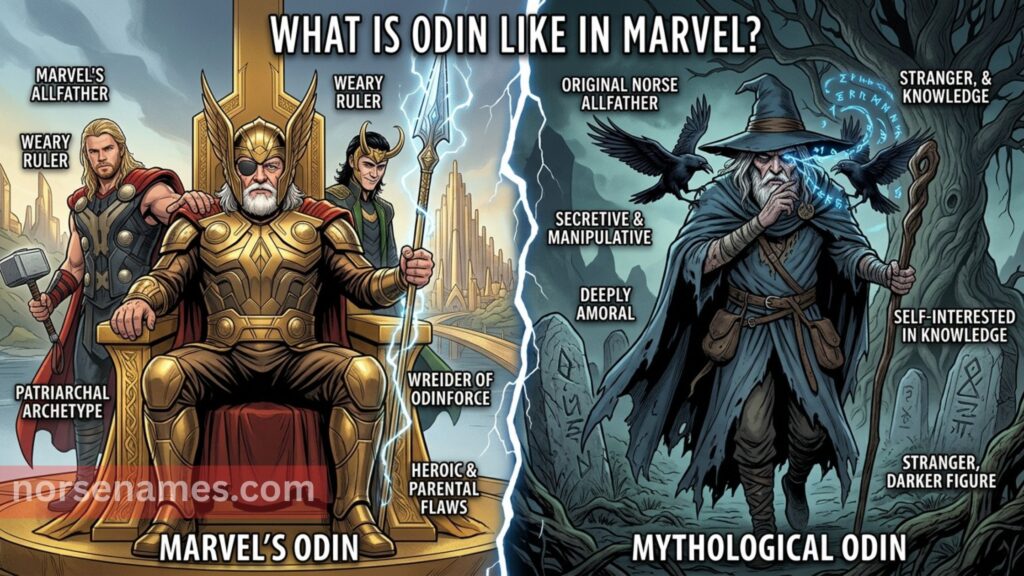
Marvel’s version of Odin introduces audiences to the wise king of Asgard and father of Thor. While inspired by Odin Norse mythology, the Marvel adaptation focuses more on his role as a ruler and father than on his sacrifices, rune magic, and relentless search for wisdom found in the original myths.
Odin in Video Games and Books
Odin appears in many popular games, including God of War Ragnarök, Assassin’s Creed Valhalla, Smite, and Valheim. He is also featured in books such as Neil Gaiman’s Norse Mythology, which retells the classic Norse legends for modern readers. These adaptations keep Odin’s stories alive while introducing new audiences to Viking mythology.
Odin in Modern Norse Paganism
Although the ancient Norse religion declined after the spread of Christianity, Odin is still honored by followers of Ásatrú and modern Heathen traditions. Many practitioners study the ancient Eddas and view Odin as a symbol of wisdom, courage, and the lifelong pursuit of knowledge.
The lasting popularity of Odin Norse mythology shows that Odin’s legacy extends far beyond the Viking Age. Whether in movies, games, literature, or modern spirituality, the Allfather continues to inspire people with his wisdom, leadership, and enduring quest for knowledge.
Odin’s Names and Titles in Norse Mythology
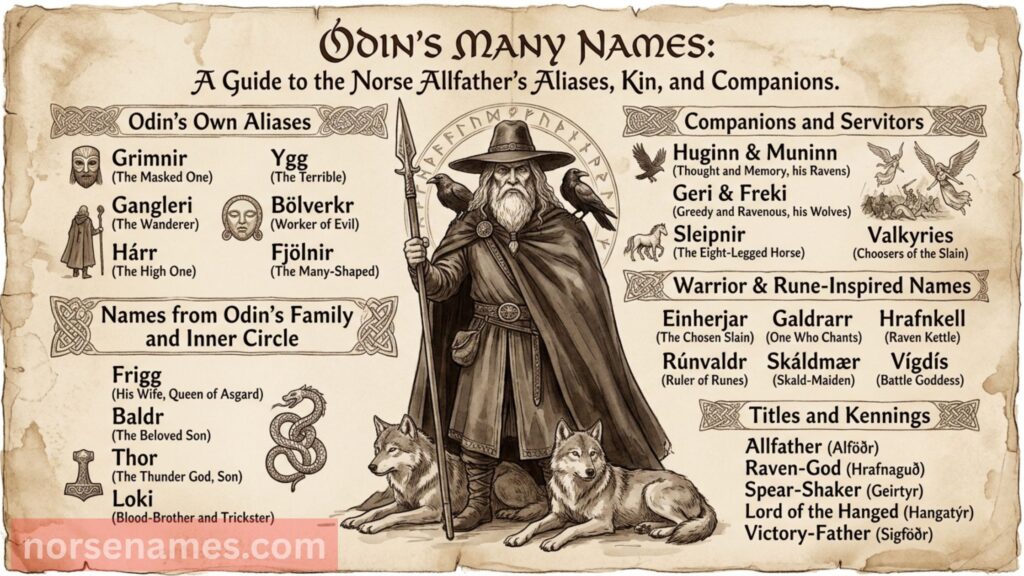
Throughout Odin Norse mythology, the Allfather is known by hundreds of different names and titles. According to the Poetic Edda and Prose Edda, these names reflect his many roles as the god of wisdom, war, magic, poetry, and kingship. Odin often traveled the Nine Realms in disguise, adopting different names to conceal his identity or represent a specific aspect of his character.
Some of Odin’s most well-known names include:
- Allfather (Alföðr) – The supreme ruler of the Aesir gods and father of many divine beings.
- Woden – The Anglo-Saxon name for Odin, from which the English word Wednesday is derived.
- Grímnir – Meaning “The Hooded One” or “The Masked One,” used when Odin wandered in disguise.
- Hár – Meaning “The High One,” emphasizing his wisdom and authority.
- Bölverkr – Meaning “Worker of Evil” or “Evil Deed,” the name Odin used while obtaining the Mead of Poetry.
- Yggr – Meaning “The Terrible One,” highlighting his fearsome power in battle.
- Valföðr – Meaning “Father of the Slain,” referring to his role as ruler of Valhalla and leader of the fallen warriors.
The many names found in Odin Norse mythology reveal that Odin was far more than a warrior king. Each title reflects a different aspect of his personality, from wise wanderer and master of magic to fearless leader and guardian of Valhalla. Together, these names help explain why Odin remains one of the most complex and respected figures in Norse legend.
Frequently Asked Questions
Who is Odin in Norse mythology?
Odin is the Allfather and the chief god of the Aesir in Odin Norse mythology. He is associated with wisdom, war, poetry, magic, and prophecy. Rather than relying on strength alone, Odin is known for sacrificing everything in his relentless pursuit of knowledge.
What is Odin the god of?
Odin is the Norse god of wisdom, war, poetry, magic, death, and kingship. He also rules Asgard, commands the Valkyries, and welcomes brave warriors to Valhalla after they fall in battle.
Why does Odin have only one eye?
According to Odin Norse mythology, Odin sacrificed one of his eyes at Mimir’s Well in exchange for limitless wisdom. His missing eye symbolizes that true knowledge often requires great personal sacrifice.
Who are Odin’s wife and children?
Odin’s wife is Frigg, the goddess of marriage and motherhood. His best-known children include Thor, Baldr, Höðr, and Váli, although different Norse sources mention additional descendants.
Is Odin stronger than Thor?
Thor is physically stronger and is the greatest warrior among the gods. However, Odin Norse mythology portrays Odin as the wiser and more powerful ruler because of his mastery of magic, prophecy, and leadership.
Is Marvel’s Odin based on Norse mythology?
Yes. Marvel’s Odin is inspired by the Allfather from Odin Norse mythology, but many myths and characteristics have been adapted to fit the Marvel Universe. The original Odin is a more mysterious and complex figure.
Is Odin still worshipped today?
Yes. Some followers of modern Ásatrú and Heathen traditions continue to honor Odin as part of the revival of Norse paganism. They study the Eddas and celebrate traditional Norse beliefs and festivals.
Conclusion
The enduring appeal of Odin Norse mythology lies in its remarkable complexity. Odin is far more than the ruler of Asgard—he is the relentless seeker of wisdom, the master of runes, the god of war and poetry, and the visionary who sacrificed everything to understand the mysteries of fate. Every major tale in Odin Norse mythology reveals a deity willing to pay any price for knowledge, even when he knows that Ragnarök and his own death cannot be avoided.
Whether you’re fascinated by Viking history, ancient religion, or legendary storytelling, Odin Norse mythology offers one of the richest and most influential characters in world mythology. His myths explore sacrifice, leadership, prophecy, magic, and the constant struggle between destiny and free will. From his faithful ravens and the mighty spear Gungnir to Valhalla, Yggdrasil, and the coming of Ragnarök, every symbol connected to Odin continues to shape modern books, films, games, and fantasy worlds.
More than a thousand years after the Viking Age, Odin Norse mythology continues to inspire readers because its themes remain timeless. The Allfather reminds us that true wisdom often demands sacrifice, that power without knowledge is incomplete, and that even the greatest leaders cannot escape fate. That is why Odin Norse mythology remains one of the most captivating, thought-provoking, and enduring traditions in all of Norse legend.