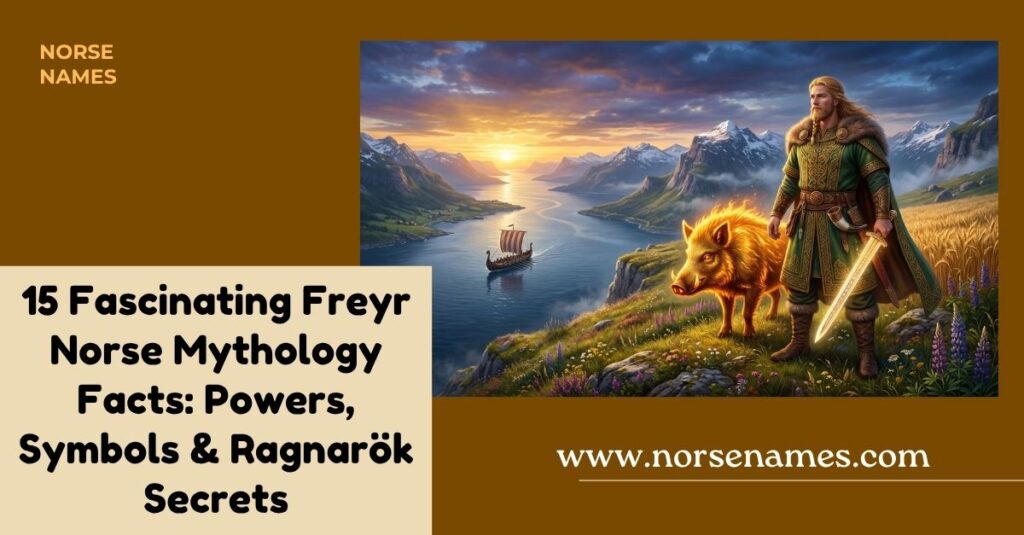

Picture a longship gliding into a Swedish fjord under a sun that refuses to set, its sail full and its hold heavy with grain. On a quiet riverbank, a farmer kneels beside a carved wooden boar, whispering for one more good harvest before winter closes in. This is the world Freyr ruled — not the thunder-cracked battlefields of Odin and Thor, but the fertile, living ground beneath every Viking’s feet. In Freyr Norse mythology, stories are not shaped by endless conquest, but by sunlight, soil, marriage vows, and the golden bristles of a boar cutting through darkness.
Of all the gods in Norse mythology, Freyr stands closest to abundance, peace, and prosperity. In Freyr Norse mythology, he is not a conqueror of realms but a sustainer of life itself. He does not dominate Midgard through war — he nourishes it through growth, harvest, and fertility. That quiet but essential role is part of why his legacy still resonates centuries after the last recorded sacrifices at Uppsala. In a mythological world often defined by violence and chaos, Freyr represents something rarer: survival through balance rather than destruction.
For fantasy writers, game designers, and worldbuilders, Freyr Norse mythology offers a refreshing departure from the standard pantheon archetypes. He is not a brooding war-king like Odin, nor a storm-bringer like Thor, nor a cunning trickster like Loki. Instead, Freyr is a god of peace who once possessed a blazing sword capable of fighting on its own — a weapon he willingly gave up for love. In Freyr Norse mythology, he is also a ruler who governs Alfheim, a deity tied deeply to fertility, sunlight, and prosperity, yet still destined to fall at Ragnarok not because of weakness, but because of sacrifice and fate. That contrast — gentle power bound to tragic destiny — is what makes his myth so enduring.
This guide explores everything essential about Freyr Norse mythology: his divine family and lineage, his powers and sacred domains, the symbols and artifacts associated with him, the rune connected to his name, and the myths that explain both his worship and his ultimate downfall at Ragnarok.
Who Is Freyr in Norse Mythology?
Freyr (Old Norse for “Lord,” sometimes anglicized as Frey) is the foremost god of the Vanir — one of the two families of gods in Norse mythology, the other being the Aesir. As the Norse god of fertility — and just as often called the harvest god in Freyr Norse mythology circles — his connection with harvests, sun and rain, virility, weddings, and his rule over wealth secured him an important position in early Scandinavian society, which depended heavily on agriculture for survival.
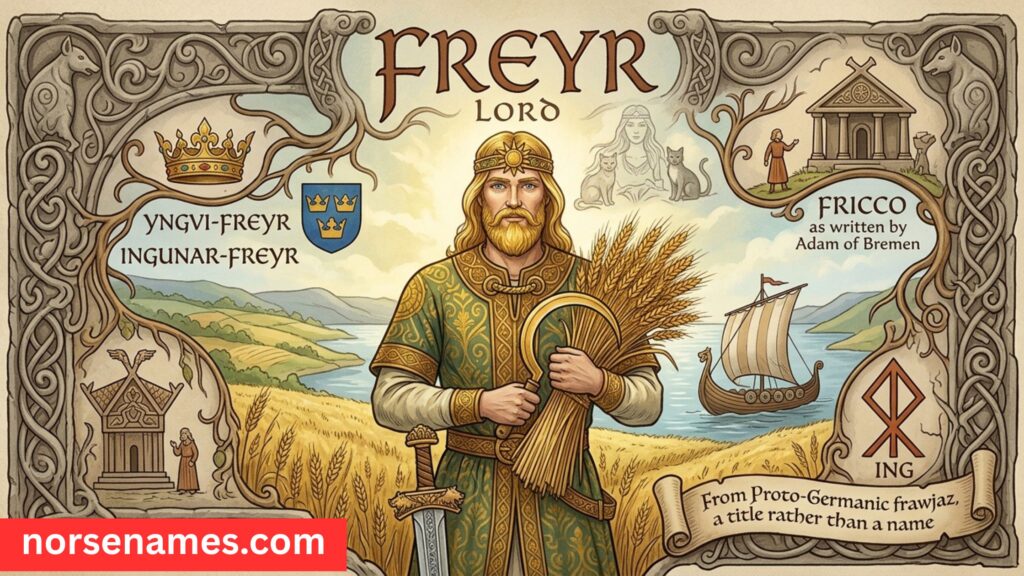
Unlike Odin’s brooding wisdom or Thor’s hammer-swinging fury, Freyr’s power was woven into everyday life. Good crops, fair weather, successful marriages, peaceful years — these were all considered his domain. Old Norse poetry even calls him “the foremost of the gods” and “hated by none,” a rare honor in a pantheon full of complicated, often dangerous figures.
Despite how beloved he was, Freyr appears in surprisingly few surviving myths. The most prominent story by far is his courtship of the giantess Gerd. What we lack in volume, though, we make up for in archaeological evidence — place names, carved idols, and historical accounts all point to Freyr being one of the most actively worshipped gods of the Viking Age, and one of the most enduring figures in Freyr Norse mythology today.
Freyr Meaning and Name Origin
The Freyr meaning is refreshingly simple for a Norse god: “Lord.” The name comes from the Proto-Germanic frawjaz, a title rather than a personal name in the strictest sense — much the way “Freyja” simply means “Lady.” This suggests that Freyr and Freyja may originally have been honorific titles attached to older, possibly forgotten deities, later solidifying into the god and goddess we know from the Eddas.
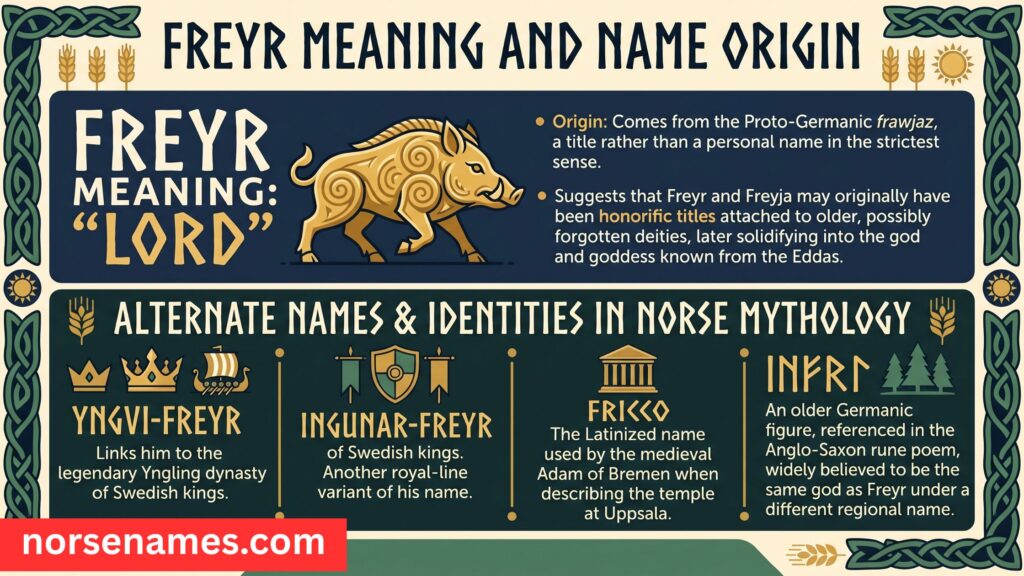
Anyone digging into Freyr Norse mythology will also run across several other names across Old Norse and wider Germanic sources, each adding a layer to his identity:
- Yngvi-Freyr — links him to the legendary Yngling dynasty of Swedish kings
- Ingunar-Freyr — another royal-line variant of his name
- Fricco — the Latinized name used by the medieval chronicler Adam of Bremen when describing the temple at Uppsala
- Ing — an older Germanic figure, referenced in the Anglo-Saxon rune poem, widely believed to be the same god as Freyr under a different regional name
This web of alternate names is one of the clearest hints we have that Freyr’s worship stretched far beyond Scandinavia, reaching into Anglo-Saxon England and continental Germanic culture under slightly different titles.
Freyr Norse Mythology Family Tree and Relationships
Freyr’s family tree reads like its own saga. He is the son of the god Njörðr and his sister-wife, and the twin brother of the goddess Freyja. Njord himself is the Vanir god of the sea, wind, and seafaring wealth, which means Freyr inherited not just fertility but a connection to prosperity in the broadest sense — land, water, and gold all under one family’s influence.
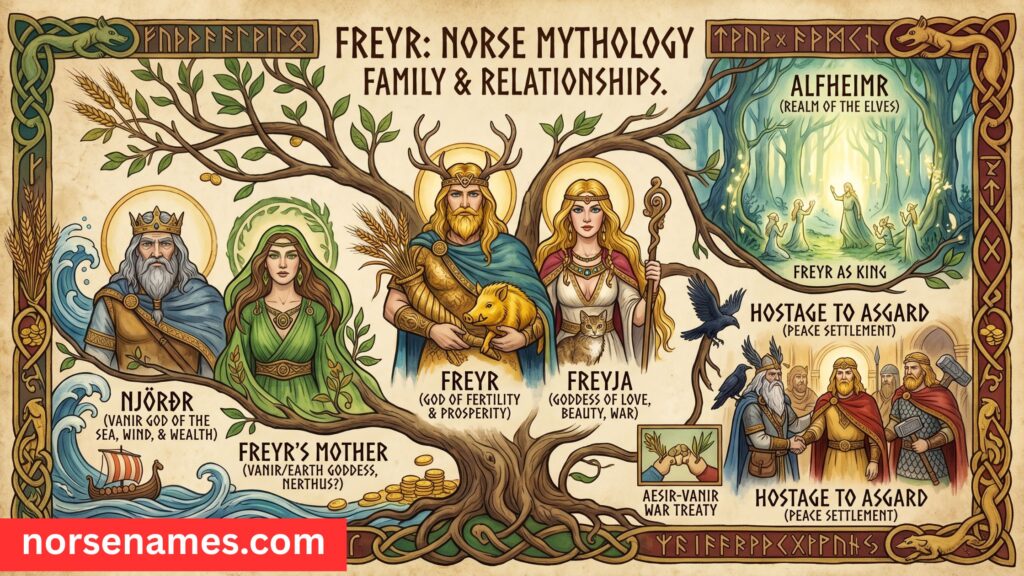
His mother’s identity is debated among scholars; some sources connect her to Nerthus, an earth goddess associated with fertility, though the Eddas themselves are vague on the matter.
That sibling closeness becomes politically important too. The Vanir and Aesir fought a war, and as part of the peace settlement, Freyr was sent to live among the Aesir as a hostage. Rather than resenting this exile, Freyr thrived in it. He earned his place in the pantheon through charm and goodwill rather than conquest, eventually becoming one of the most respected gods in Asgard despite never truly being one of the Aesir by blood — a turning point that shows up again and again in retellings of Freyr Norse mythology.
As a wedding gift — or in some tellings, a teething gift — the gods gave Freyr Alfheimr, the realm of the Elves, to rule. The fact that his home overlaps with elf-kind has led many scholars to believe the Vanir and the elves shared a deep mythological connection, both linked to fertility, nature, and the unseen forces that make crops grow. It’s also the likely root of why elves are said to favor him above other gods — he is, quite literally, their king.
Freyr and Freyja: The Divine Twins of the Vanir
Few pairings in Norse mythology are as tightly bound as Freyr and Freyja. Born of the same Vanir bloodline, the twins represent two halves of the same fertile, abundant force — Freyr governing harvest, peace, and prosperity, Freyja governing love, beauty, war, and seiðr magic.
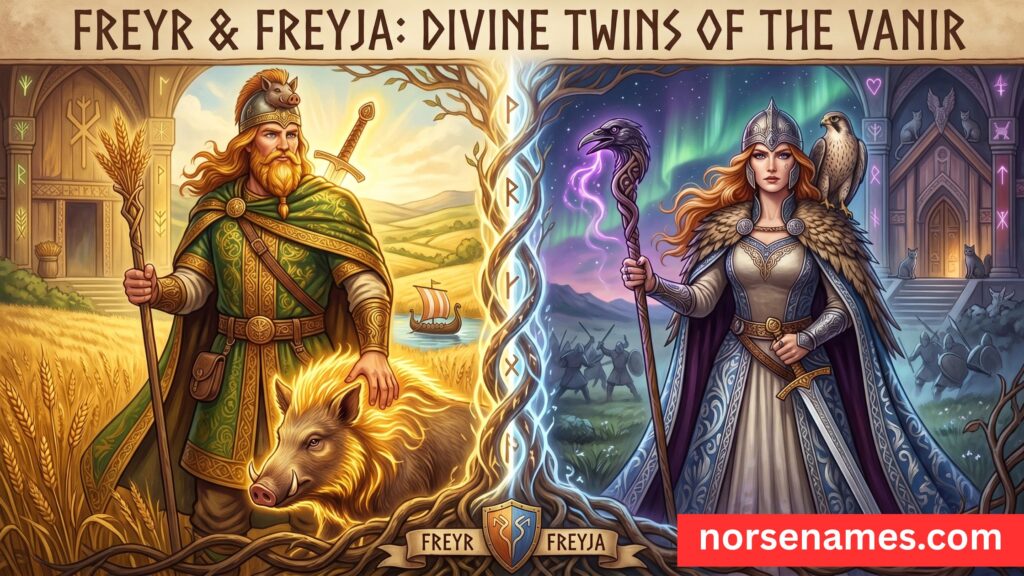
It’s worth clearing up a common point of confusion here: are Freya and Freyr the same? They are not. The similarity in name trips up a lot of newcomers to Freyr Norse mythology, but Freyr and Freyja are distinct deities — twin siblings, not two names for one god. Freyr is consistently the masculine half of the pair, tied to kingship and the land; Freyja is the feminine half, tied to love, war, and magic. The confusion is understandable, since both names essentially mean “Lord” and “Lady,” but in the sagas, they are unmistakably two separate figures with their own myths, husbands, and followings.
Both twins arrived in Asgard together as hostages after the Aesir-Vanir War, and both went on to become two of the most actively worshipped gods in the entire pantheon. Where they diverge is in temperament and myth: Freyja’s stories often involve independence, grief, and magic, while Freyr’s stories center on longing, sacrifice, and the responsibilities of kingship.
Freyr Norse Mythology Powers and Abilities
Freyr’s powers all orbit around one central idea: growth. He is the god of peace, prosperity, fertility, and weather, with influence stretching from the crops in the field to the success of a marriage to the wind that fills a ship’s sails. It’s no surprise he’s remembered just as often as a god of prosperity as he is a god of harvest in Freyr Norse mythology — in Viking Age society, the two ideas were essentially inseparable.
His specific powers include:
- Sunshine and fair weather — controlling the conditions farmers needed for a good growing season
- Rain — particularly life-giving rain rather than storms
- Fertility — both agricultural and human, tying him to weddings and childbirth blessings
- Wealth and prosperity — not gold hoarded, but wealth that flows and benefits a community
- Peace — actively preventing conflict rather than simply avoiding it
- Kingship — many royal lines, especially in Sweden, claimed direct descent from him
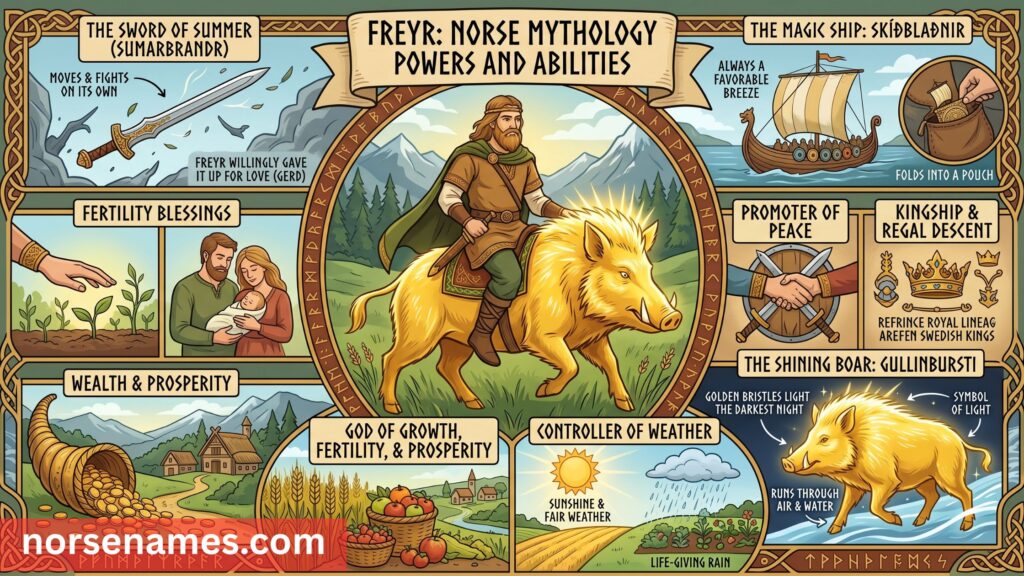
He rides the shining dwarf-made boar Gullinbursti, whose golden bristles light the way through even the darkest night. According to Snorri Sturluson, the boar could run through air and water better than any horse, and there was never so much darkness or gloom that there wasn’t sufficient light where it traveled, thanks to the glow of its mane and bristles. The boar wasn’t just transportation — it was a walking symbol of Freyr’s role as a bringer of light into the bleakest seasons.
He also possesses the ship Skíðblaðnir, which always has a favorable breeze and can be folded together and carried in a pouch when not in use — a detail that feels almost magical-realist, like something pulled straight from a fantasy novel rather than an ancient saga.
And then there’s the sword. Before his courtship of Gerd, Freyr owned a blade sometimes called the Sumarbrandr, or “sword of summer” — a weapon capable of moving and fighting on its own in the air. It’s one of the most fascinating weapons in the entire Norse canon, and Freyr willingly gave it up for love, a decision that would haunt him at the end of the world.
Freyr Norse Mythology Wife: Who Was Gerd?
Freyr’s wife is the giantess Gerd (Old Norse: Gerðr), daughter of the giant Gymir. Their union began not as a peaceful courtship but as an obsession. While sitting on Odin’s forbidden throne, Hlidskjalf — a seat that grants a view across all nine realms — Freyr spotted Gerd walking near her father’s hall and was instantly consumed by longing.
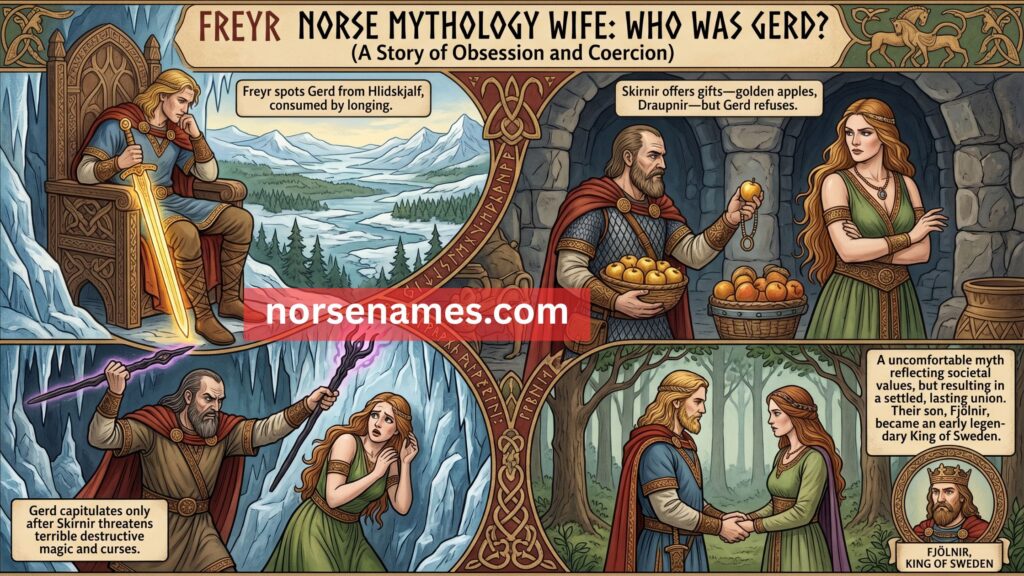
Too lovesick to act himself, Freyr sent his loyal servant Skirnir to act as a go-between, offering Freyr’s own horse and magical sword as payment for completing the courtship. Skirnir traveled to Jotunheim and tried to win Gerd over first with gifts — eleven golden apples, then even Odin’s magical ring Draupnir — but she refused. Only when Skirnir threatened her with destructive magic and a life of misery did Gerd finally agree to meet Freyr nine nights later in a quiet grove.
It’s a myth that modern readers often find uncomfortable — coercion dressed as courtship — and that discomfort is worth sitting with rather than smoothing over. Norse myths weren’t written as moral instruction manuals; they reflect the values, anxieties, and power structures of the society that told them. Despite this difficult beginning, later sources treat Freyr and Gerd’s marriage as a settled, lasting union, and some genealogies even list their son, Fjölnir, as an early legendary king of Sweden.
Freyr Norse Mythology Symbols and Sacred Objects
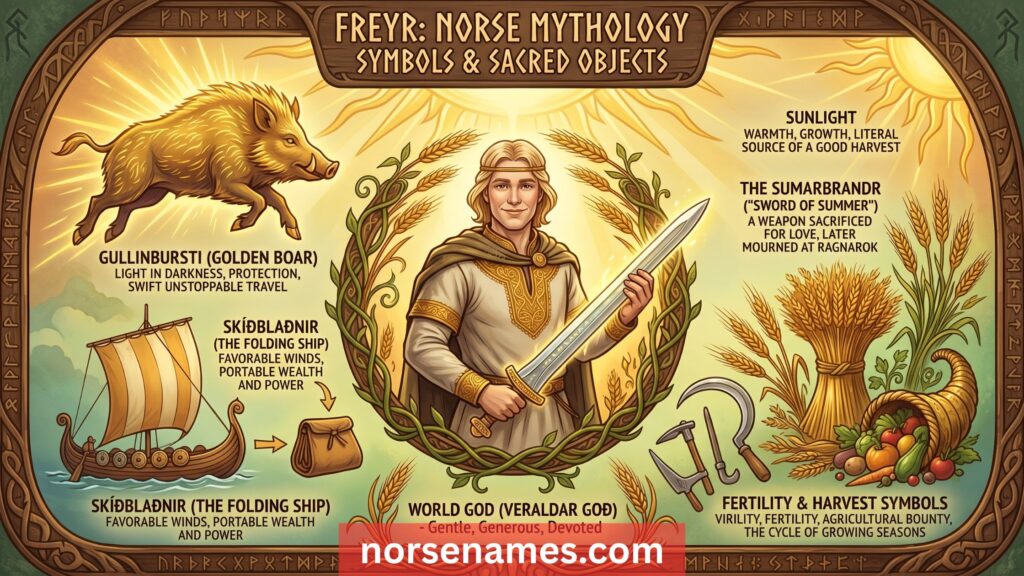
Freyr’s iconography is some of the most distinctive in the Norse pantheon, built almost entirely around fertility, light, and abundance:
| Symbol | Meaning |
|---|---|
| Gullinbursti (golden boar) | Light in darkness, protection, swift unstoppable travel |
| Skíðblaðnir (the folding ship) | Favorable winds, portable wealth and power |
| The Sumarbrandr (“sword of summer”) | A weapon sacrificed for love, later mourned at Ragnarok |
| The phallus | Virility, fertility, and the generative force of nature |
| The sickle and harvest tools | Agricultural bounty and the cycle of growing seasons |
| Sunlight | Warmth, growth, and the literal source of a good harvest |
Many surviving idols and carvings depict Freyr with an exaggerated phallus, a direct and unsubtle nod to his role as a fertility god rather than a symbol meant to embarrass him — to Viking Age worshippers, it represented life-giving power, not crudeness. Snorri Sturluson described Freyr as very handsome and fair of appearance, powerful, forgiving, and kind, calling him the “World God” (veraldar goð). Few other figures in Freyr Norse mythology earn such an unreservedly warm description in the surviving texts — Odin is wise but unsettling, Thor is brave but blunt, but Freyr is consistently painted as someone people simply liked. His personality, as far as the sagas let us see it, is gentle, generous, and devoted — a striking contrast to the more volatile gods around him.
The Freyr Rune and Its Meaning
The rune most commonly cited by scholars and modern practitioners as tied to Freyr Norse mythology is Ingwaz (ᛜ), sometimes spelled Inguz, from the Elder Futhark. The rune’s name derives from Ing, an older Germanic name widely believed to be another identity for Freyr himself — the connection is strong enough that the Anglo-Saxon Rune Poem preserves a verse about Ing traveling east “over the waves” in a wagon, a detail that echoes Freyr’s portable ship and his associations with travel and fertility.
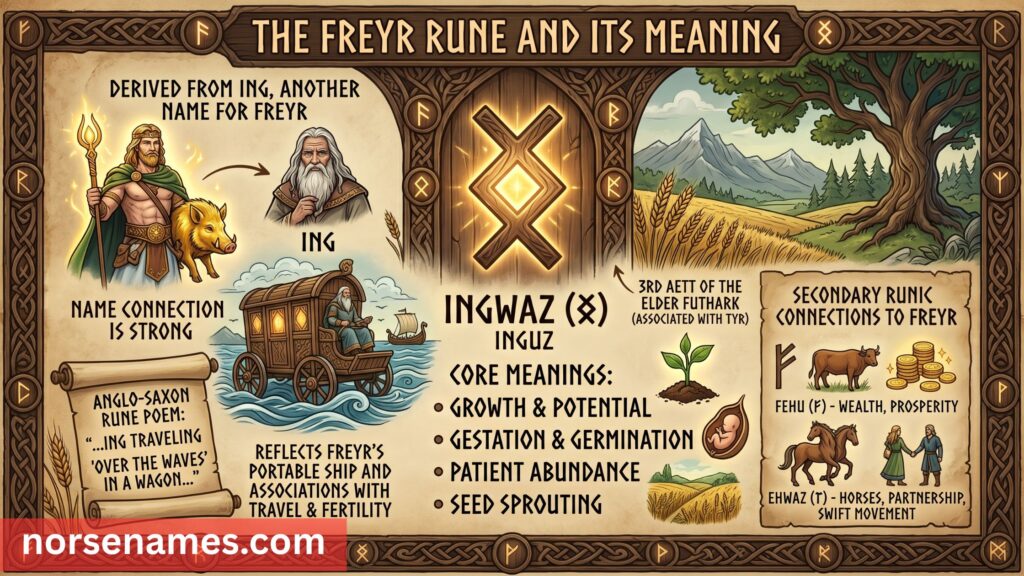
Ingwaz carries meanings of growth, potential, and gestation — much like a seed resting in the earth before it sprouts. It belongs to the third aett (group) of the Elder Futhark, which is itself associated with the god Tyr, but its individual symbolism points squarely back to Freyr’s domain of fertility and quiet, patient abundance. Some sources also connect Freyr more loosely to the runes Fehu (wealth, cattle, prosperity) and Ehwaz (horses, partnership, swift movement), both of which echo different sides of his mythology.
How Vikings Worshipped Freyr
Freyr wasn’t an abstract concept to Viking Age Scandinavians — he was a working part of daily religious life. There is ample evidence of an active cult of Freyr, with many place names bearing his mark and sacrifices recorded throughout the literature and archaeological record, especially in Sweden. Worship tied to Freyr Norse mythology wasn’t confined to temples either; it touched planting season, weddings, and the launching of ships alike, making him one of the most personally invoked gods in everyday Norse life.
At the great temple in Uppsala, one of the most important religious sites in pre-Christian Scandinavia, Freyr occupied a leading role alongside Thor and Odin, though the exact hierarchy of worship varied by region and era. The medieval chronicler Adam of Bremen described the Uppsala temple as gleaming with gold, with statues of all three gods seated inside, and noted that “Fricco” — his Latinized name for Freyr — was the god who bestowed peace and pleasure on mortals.
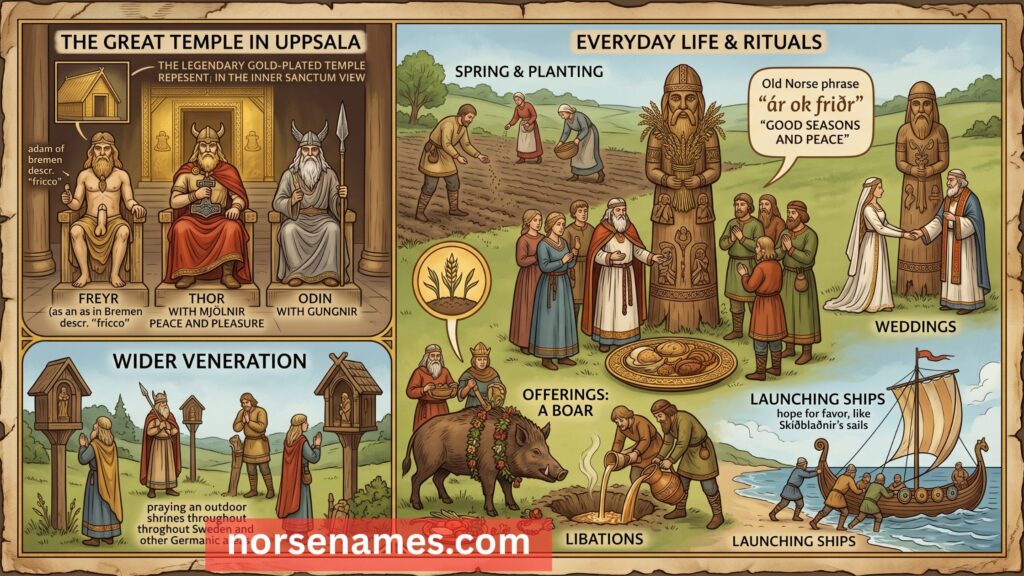
Freyr offerings typically reflected his gentle nature rather than demanding blood for its own sake. Worshippers offered libations of fresh water, ale, mead, and barley wine, alongside the ritual sacrifice of a boar — a tradition some scholars connect to the modern Yule ham still served at Scandinavian Christmas tables today. Farmers prayed to him before planting using the recurring Old Norse phrase ár ok friðr, “good seasons and peace,” a request that sums up almost everything Freyr worship was really about. Newlyweds invoked him at weddings, and sailors leaving harbor hoped his favor would fill their sails the way it filled Skíðblaðnir’s.
Freyr was one of the most widely and passionately venerated divinities among the heathen Norse and other Germanic peoples, precisely because his blessings were so directly tied to survival. A failed harvest meant a hard winter. A good one, attributed to Freyr’s favor, meant a community would live to see spring.
Major Myths and Stories in Freyr Norse Mythology
The Courtship of Gerd
Covered in detail above, the story of Freyr and Gerd remains the single most developed myth featuring Freyr as an individual character rather than a symbolic figure — and the one that sets up the tragedy waiting for him at the end of the world.
Freyr at Ragnarok
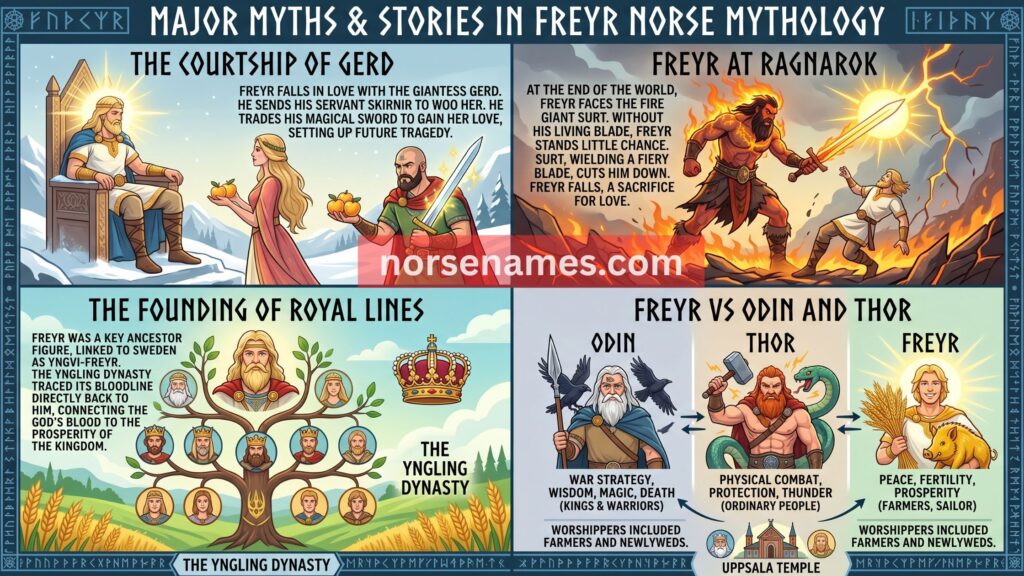
The price of giving up his sword comes due at the end of the world. According to the Völuspá, Freyr is destined to face the fire giant Surt during Ragnarok — and without his living blade, he stands little chance. So who killed Freyr in Norse mythology? It is Surt, wielding a blade that “shone like the sun of the battle-gods,” who cuts him down, splitting crags and filling the road to Hel with the dead as the sky itself splits open.
Freyr falls in this final battle, a god of peace and plenty undone by a single act of love. It’s one of the more poignant deaths in the entire mythos — not a hero failing through cowardice or weakness, but through a sacrifice made years earlier for something he believed mattered more than his own survival.
The Founding of Royal Lines
Beyond his personal myths, Freyr held enormous cultural weight as an ancestor figure. He is particularly linked with Sweden and considered an ancestor of the Swedish royal house, often appearing under the name Yngvi-Freyr in genealogies. The Yngling dynasty, one of the most important royal lines in early Scandinavian history, traced its bloodline directly back to him — a powerful piece of propaganda and faith rolled into one, suggesting the prosperity of an entire kingdom flowed from the god’s own blood.
Freyr vs Odin and Thor
It’s worth directly addressing a question that comes up often when people study Freyr Norse mythology: is Freyr a god of war? No — and that’s precisely what sets him apart from the other two dominant gods of the pantheon.
- Odin rules wisdom, death, magic, and the chaos of war strategy. He is distant, calculating, and frequently morally ambiguous.
- Thor rules thunder and physical combat, a direct, blunt-force protector of both gods and humans against giants.
- Freyr rules peace, fertility, and prosperity. He has no interest in conquest, no taste for battle for its own sake, and his single great act of war — Ragnarok — is forced on him, not chosen.
This distinction mattered enormously to Viking Age worshippers. Odin was prayed to by kings and warriors seeking victory or wisdom; Thor was invoked by ordinary people seeking protection from danger; Freyr was invoked by farmers, sailors, and newlyweds seeking abundance and peace. At the Uppsala temple, all three were honored side by side, each covering a different, essential need — proof that Norse religion wasn’t built around a single ideal of “godliness,” but around a practical division of life’s biggest concerns.
Facts About Freyr Norse Mythology
A few quick facts worth knowing:
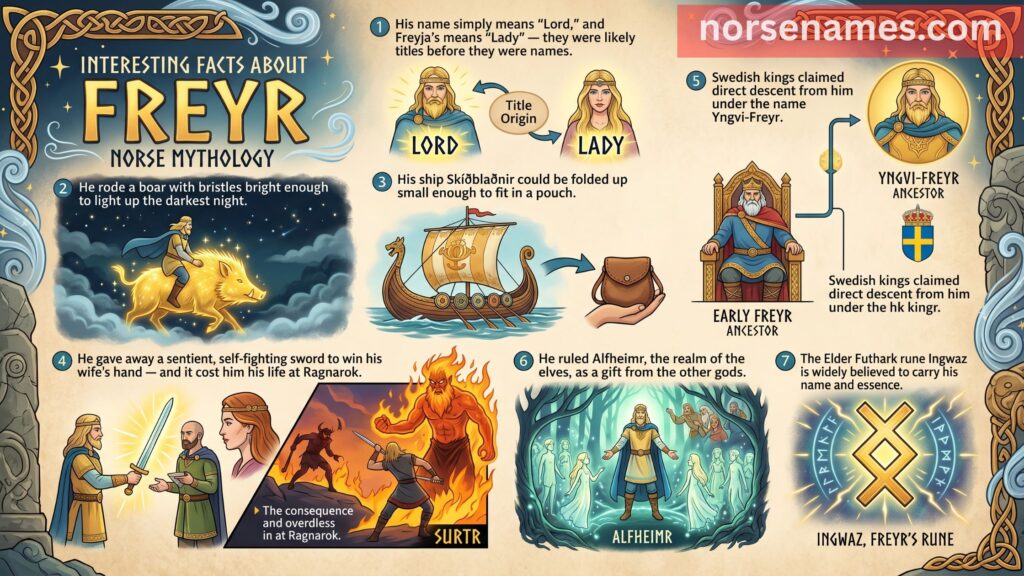
- His name simply means “Lord,” and Freyja’s means “Lady” — they were likely titles before they were names.
- He rode a boar with bristles bright enough to light up the darkest night.
- His ship Skíðblaðnir could be folded up small enough to fit in a pouch.
- He gave away a sentient, self-fighting sword to win his wife’s hand — and it cost him his life at Ragnarok.
- Swedish kings claimed direct descent from him under the name Yngvi-Freyr.
- He ruled Alfheimr, the realm of the elves, as a gift from the other gods.
- The Elder Futhark rune Ingwaz is widely believed to carry his name and essence.
Freyr Norse Mythology Names for Writers and Fans
Anyone searching Freyr Norse mythology names is usually looking for one of two things: the god’s own alternate titles, or naming inspiration drawn from his myths for fiction, gaming, or genealogy projects. Both are worth knowing.
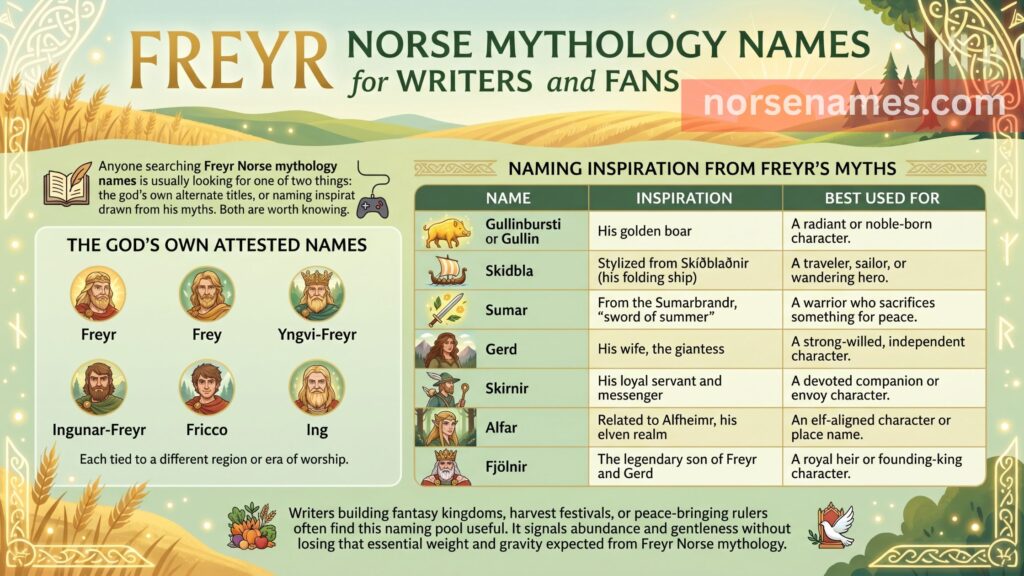
His own attested names include Freyr, Frey, Yngvi-Freyr, Ingunar-Freyr, Fricco, and Ing — each tied to a different region or era of worship. Beyond those, his myths offer a rich pool of names for fantasy characters and worldbuilding:
| Name | Inspiration | Best Used For |
|---|---|---|
| Gullinbursti or Gullin | His golden boar | A radiant or noble-born character |
| Skidbla | Stylized from Skíðblaðnir | A traveler, sailor, or wandering hero |
| Sumar | From the Sumarbrandr, “sword of summer” | A warrior who sacrifices something for peace |
| Gerd | His wife, the giantess | A strong-willed, independent character |
| Skirnir | His loyal servant and messenger | A devoted companion or envoy character |
| Alfar | Related to Alfheimr, his elven realm | An elf-aligned character or place name |
| Fjölnir | The legendary son of Freyr and Gerd | A royal heir or founding-king character |
Writers building fantasy kingdoms, harvest festivals, or peace-bringing rulers often find this naming pool more useful than the more commonly mined Odin or Thor references — it offers a way to signal abundance and gentleness without losing that essential weight and gravity readers expect from Freyr Norse mythology.
Freyr in Modern Culture and Media
Although he doesn’t enjoy the same level of pop-culture fame as Odin, Thor, or Loki, Freyr has quietly experienced a revival in modern fantasy, gaming, and contemporary pagan traditions. The themes at the heart of Freyr Norse mythology — fertility, peace, sacrifice, and prosperity — continue to resonate with writers and creators looking for a different kind of heroic figure.
In fantasy literature and tabletop role-playing games, Freyr often serves as inspiration for benevolent kings, harvest deities, and rulers whose power comes from nurturing their people rather than conquering enemies. His connection to sunlight, fertile land, and the elven realm of Alfheim makes him particularly attractive to worldbuilders creating nature-based religions and peaceful kingdoms.
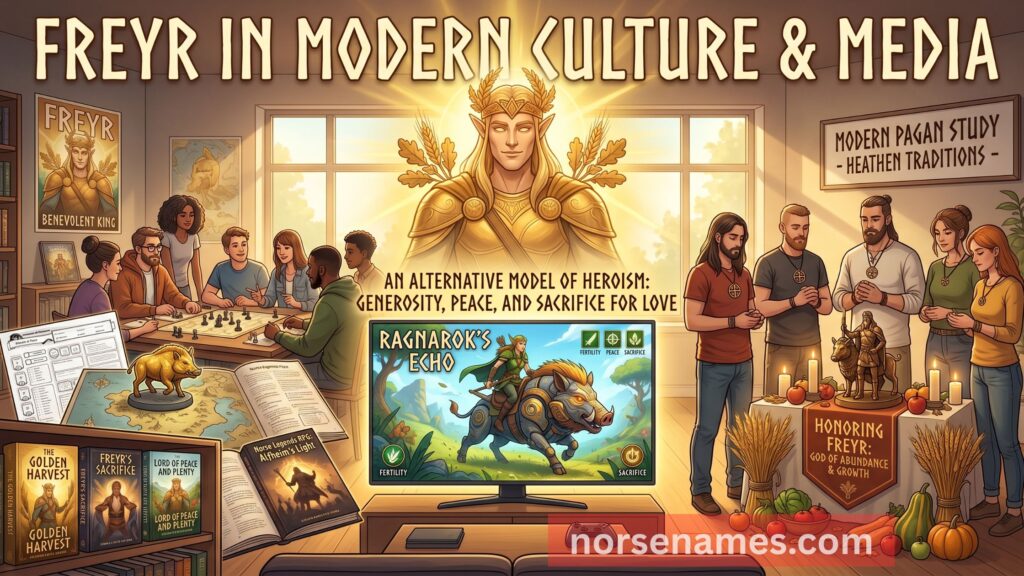
Video games have also helped introduce new audiences to Freyr. Several games inspired by Norse mythology reference him directly or borrow elements of his legends, including his association with fertility, his magical boar Gullinbursti, and his tragic fate at Ragnarok. Even when he does not appear as a central character, aspects of Freyr’s mythology frequently influence the design of peaceful deities, druidic figures, and nature-aligned rulers in fantasy settings.
Freyr has also gained renewed attention through the modern revival of Norse paganism and Heathen traditions. Many contemporary practitioners honor him as a god of abundance, good harvests, peace, and personal growth. Seasonal celebrations, fertility rites, and prayers for prosperity often invoke his name, demonstrating that his role as a life-giving deity still carries meaning more than a thousand years after the Viking Age.
Perhaps the most enduring aspect of Freyr’s modern appeal is that he offers an alternative model of heroism. In an age filled with stories about warriors and conquerors, Freyr stands out as a god whose greatest strengths are generosity, peace, and the willingness to sacrifice for love. That combination of gentleness and tragedy ensures that Freyr Norse mythology continues to inspire novels, games, art, and spiritual traditions around the world.
Conclusion
Freyr Norse mythology endures not because he’s the loudest god in the pantheon, but because he represents something most myth cycles eventually circle back to: the idea that survival, love, peace, and prosperity matter just as much as glory in battle. He gave up his magical sword for a giantess who initially wanted nothing to do with him, ruled the elven realm of Álfheimr as a divine gift, rode the golden boar Gullinbursti through the darkest nights, and still walked willingly toward a battle he knew he could not win.
For anyone exploring Freyr Norse mythology, Viking culture, or the deeper meanings hidden within Norse legends, this god offers a different kind of hero — one defined by fertility, abundance, sunlight, and peace rather than conquest and war. The enduring appeal of Freyr Norse mythology lies in this contrast: a deity of harvests and prosperity whose greatest act was a sacrifice made for love.
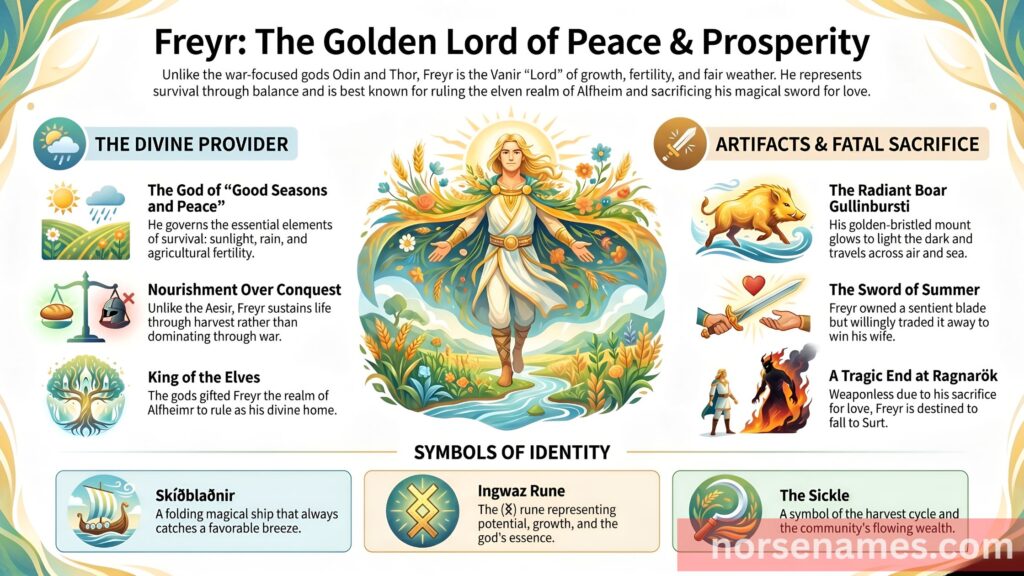
Whether you’re researching the Nine Realms, studying ancient Scandinavian beliefs, or searching for the meanings behind Freyr Norse mythology symbols, runes, and myths, Freyr’s story proves that not every legend needs a battlefield to be unforgettable. In the end, Freyr Norse mythology reminds us that the gods who nurture life can leave behind legends just as powerful as those who seek glory through war.
Frequently Asked Questions
What is Freyr the god of?
Freyr is the Norse god of fertility, peace, prosperity, sunshine, and fair weather. He governs harvests, weddings, and the general wellbeing of agricultural communities.
Is Freyr one of the Aesir or the Vanir?
Freyr belongs to the Vanir, a group of gods associated with fertility, prosperity, and nature. After the Aesir-Vanir War, he lived among the Aesir as part of a peace agreement.
This could rank well because many readers get confused about his divine family.
Who killed Freyr in Norse mythology?
The fire giant Surt kills Freyr during Ragnarok. Freyr is left without his magical sword — having given it away years earlier to win Gerd — making him unable to defend himself in the final battle.
What rune is associated with Freyr?
The Ingwaz rune from the Elder Futhark is most closely associated with Freyr, derived from Ing, an older Germanic name believed to refer to the same god.
Was Freyr worshipped by Vikings?
Yes, extensively. Freyr was one of the most actively worshipped gods of the Viking Age, with a major cult center at the temple in Uppsala, Sweden, alongside Odin and Thor.
Are Freya and Freyr the same?
No. Freya and Freyr are separate deities in Norse mythology. They are twin siblings from the Vanir family, with Freyr associated with fertility and prosperity and Freya associated with love, beauty, war, and magic.
Were Freya and Freyr lovers?
No. In surviving Norse myths, Freya and Freyr are never portrayed as lovers. They are consistently described as twin siblings. Some modern misconceptions arise because their names are similar and because sibling marriages existed among certain divine beings in Norse mythology, but no source describes a romantic relationship between Freya and Freyr.