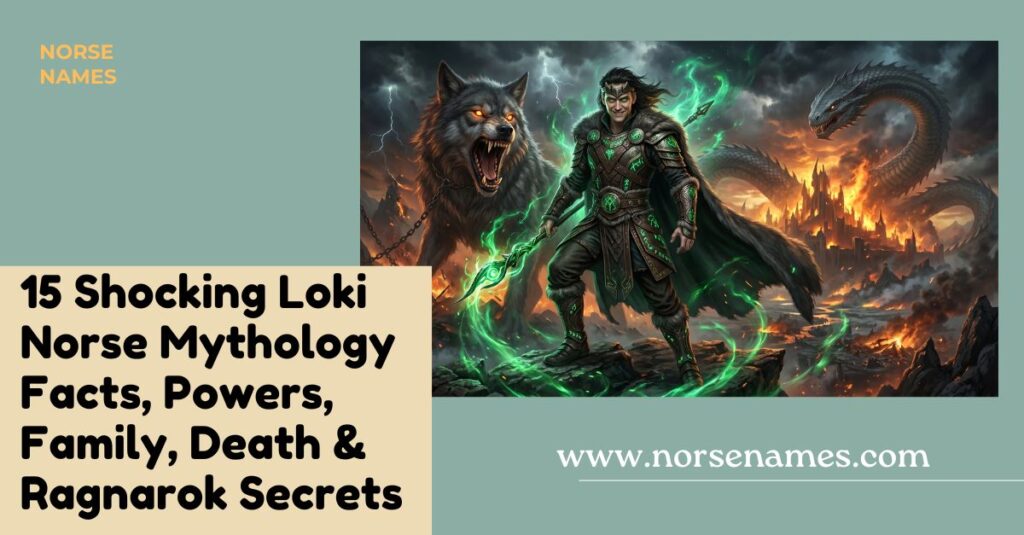

Few figures in Norse mythology are as complex and unpredictable as Loki. Known as the ultimate trickster of the Norse pantheon, Loki Norse mythology stories reveal a being who moves between loyalty and betrayal, creation and destruction, order and chaos. He is a shapeshifter, a schemer, and one of the key forces behind the events of Ragnarök.
Unlike traditional gods who represent a single domain, Loki represents change itself. His actions shape the destiny of gods like Odin, Thor, and Baldr, making him one of the most important figures in Norse legends. From his strange family tree to his powerful magic and final role in the end of the world, Loki’s story remains one of the most fascinating parts of Scandinavian mythology.
This guide explores Loki Norse mythology in detail, including his powers, family, major myths, death in Ragnarök, and his lasting influence in modern storytelling.
Facts About Loki Norse Mythology
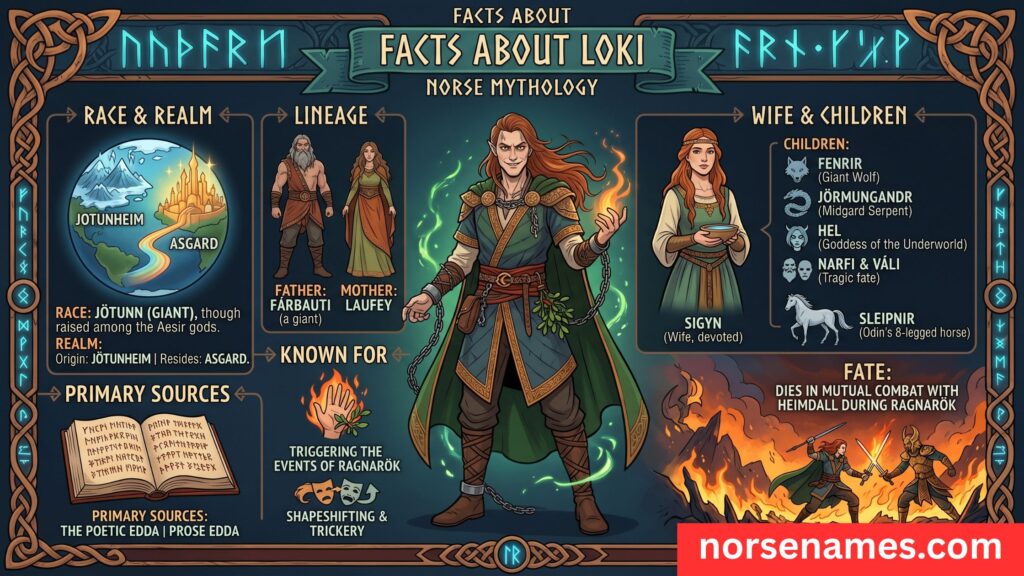
Here’s a quick-reference rundown of essential Loki Norse mythology facts before we go deeper:
- Race: Jötunn (giant), though raised among the Aesir gods
- Realm of origin: Jötunheim, though he resides primarily in Asgard
- Father: Fárbauti, a giant
- Mother: Laufey
- Wife: Sigyn
- Children: Fenrir, Jörmungandr, Hel, Narfi, Váli, and Sleipnir
- Primary sources: The Poetic Edda and the Prose Edda
- Known for: Shapeshifting, trickery, and triggering the events of Ragnarök
- Fate: Dies in mutual combat with Heimdall during Ragnarök
With those basics established, let’s look closer at who he really is.
Who Is Loki in Norse Mythology?
So who is Loki in Norse mythology, exactly? He’s a trickster god — a being whose primary domain isn’t war, wisdom, or fertility, but mischief, transformation, and chaos itself. Old Norse sources call him by several names and titles, including Loptr (possibly meaning “the airy one”) and Hveðrungr. He’s quick-witted, silver-tongued, and almost pathologically clever, able to talk his way out of situations that would doom anyone else.\
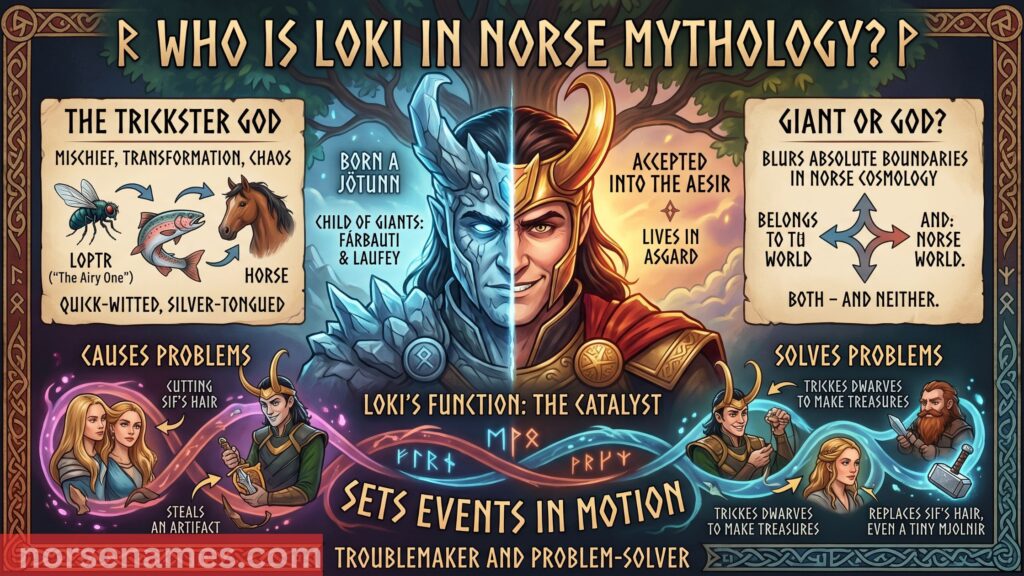
Loki: Giant or God? This is one of the most debated questions in all of Norse legends. The question of Loki giant or god doesn’t have a clean answer, since he belongs to both worlds at once. Biologically, he’s a jötunn, born to giant parents. Yet he’s fully accepted into the Aesir gods, the tribe that rules Asgard, blurring a boundary that Norse cosmology usually treats as absolute. Whether you call him a giant or a god, the truth is he’s both — and neither.
What makes Loki essential to Loki Norse mythology isn’t just his personality — it’s his function. He’s a catalyst. Again and again, it’s Loki who sets events in motion, for better or worse. He solves problems the other gods can’t solve, often because he caused them himself. This push-and-pull between troublemaker and problem-solver defines nearly every story he appears in.
Loki Norse Mythology Family Tree
The Loki Norse mythology children include Fenrir, Jörmungandr, Hel, Narfi, Váli, and Sleipnir. Loki’s family tree is one of the most tangled and consequential threads in Loki Norse mythology, blending gods, giants, and monsters into a single bloodline that shapes the fate of Midgard and beyond. Here’s the family tree at a glance:
- Father: Fárbauti, a giant
- Mother: Laufey (Loki is sometimes called Loki Laufeyjarson, taking his mother’s name rather than his father’s — an unusual detail that hints at his outsider status even within his own family)
- Blood-brother: Odin, bound to Loki through a sacred oath of loyalty
- Wife: Sigyn
- Sons with Sigyn: Narfi and Váli
- Lover: the giantess Angrboða
- Children with Angrboða: Fenrir, Jörmungandr, and Hel
- Offspring through shapeshifting: Sleipnir, born after Loki transformed into a mare
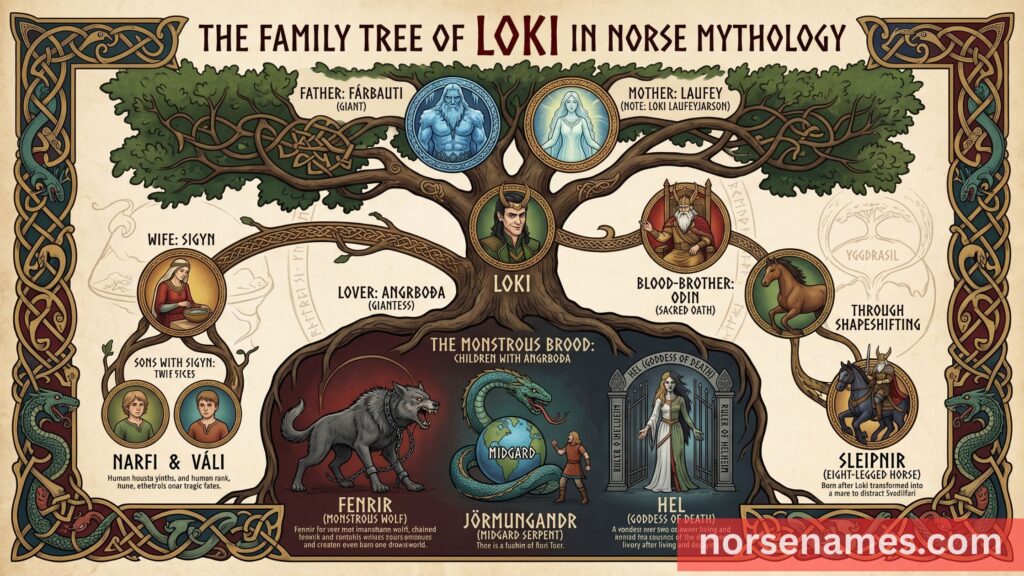
The children Loki has with Angrboða are arguably his most consequential legacy. Fenrir is a monstrous wolf destined to kill Odin during Ragnarök, and the gods’ fear of that fate leads them to bind the wolf long before the final battle arrives. Jörmungandr grows so massive he encircles all of Midgard and is destined to battle Thor at the end of the world. Hel completes the trio, becoming ruler of the underworld realm that bears her name, governing those who do not die in glorious battle.
Then there’s Sleipnir — born not from Angrboða, but from Loki’s own body. After shapeshifting into a mare to distract the stallion Svaðilfari, Loki gives birth to an eight-legged horse, who becomes Odin’s personal steed. This single myth captures almost everything that defines Loki Norse mythology: shapeshifting power, a willingness to use his own body as a tool, and an uncanny ability to turn chaos into something useful for the very gods he so often torments.
Loki Norse Mythology Wife
Sigyn rarely gets the spotlight in Norse legends, but her role is one of the most quietly devastating in the entire mythological cycle.
She is Loki’s loyal wife, the mother of their sons Narfi and Váli, and — unlike almost everyone else in the Nine Realms — she never abandons him, even after his crimes turn the gods against him permanently.
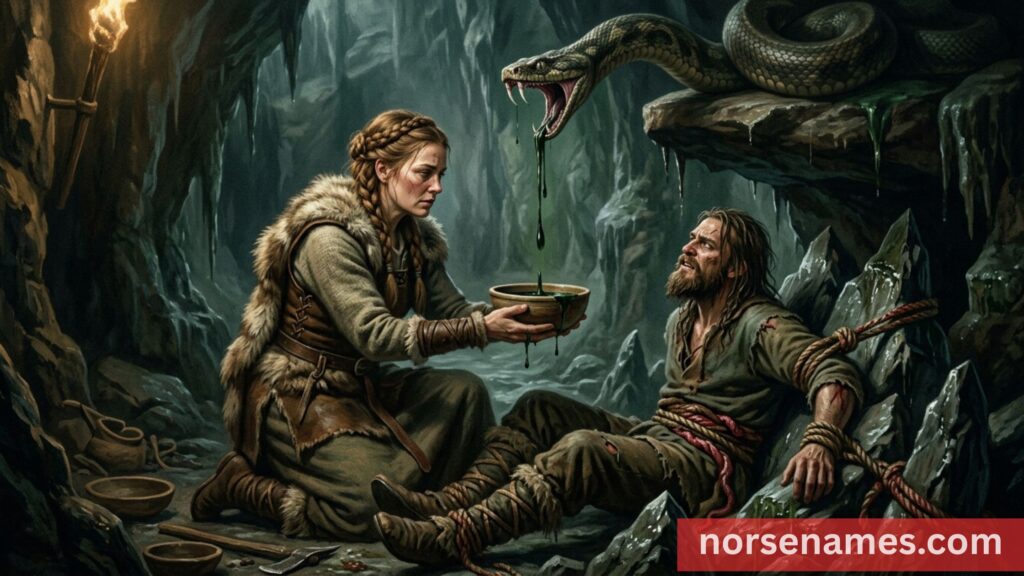
When Loki is bound in punishment for orchestrating Baldr’s death, a serpent is placed above him to drip venom onto his face as torment. Sigyn stays by his side, holding a bowl to catch the venom before it can reach him. She must periodically leave to empty the bowl, and in those brief moments, the venom falls and Loki convulses in agony — said by some sources to be the mythological origin of earthquakes.
Sigyn’s loyalty stands in sharp contrast to nearly every other relationship in Loki’s life, which brings us to his complicated bonds with the other Aesir gods.
Loki and the Aesir: His Bonds with Odin and Thor
Loki’s standing among the gods of Asgard is built on relationships as contradictory as he is.
Loki and Odin. The two are described as blood-brothers, a sacred Viking-era oath of loyalty that made them, for a time, inseparable. Odin tolerates — even relies on — Loki’s cunning more than any other god does, often turning to him to solve problems that arise from his own schemes. But this bond is also the one that breaks most completely. By the time of the Lokasenna and the death of Baldr, the brotherhood between Loki and Odin has curdled into bitter enmity, setting the stage for their roles as enemies at Ragnarök.
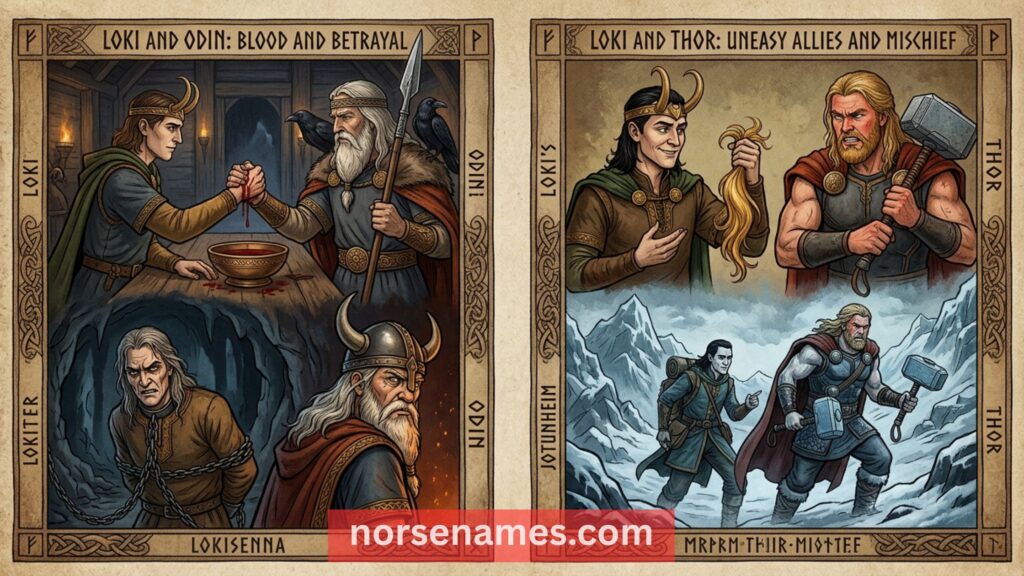
Loki and Thor. The relationship between Loki and Thor is less about brotherhood and more about uneasy partnership. Thor frequently finds himself dragged along on Loki’s schemes, serving as both victim of his pranks — as when Loki cuts off Sif’s hair — and reluctant ally, as in their joint journey to retrieve Thor’s hammer from the giant Thrym. Loki needles Thor relentlessly, but the two also work together when Asgard’s survival is at stake.
Loki Norse Mythology Powers and Abilities
The most notable powers within Loki Norse mythology include shapeshifting, trickery, deception, and magical transformation — together forming a skill set unlike any other figure in the Norse pantheon, built less around brute strength and more around intelligence and manipulation.
Shapeshifting is his signature ability. Loki’s shapeshifting abilities let him transform into a salmon, a fly, an old woman, a mare, and a falcon across various myths, using each form for a specific purpose — escape, disguise, seduction, or sabotage. No other figure in Norse mythology shifts shape with such frequency or creative purpose.
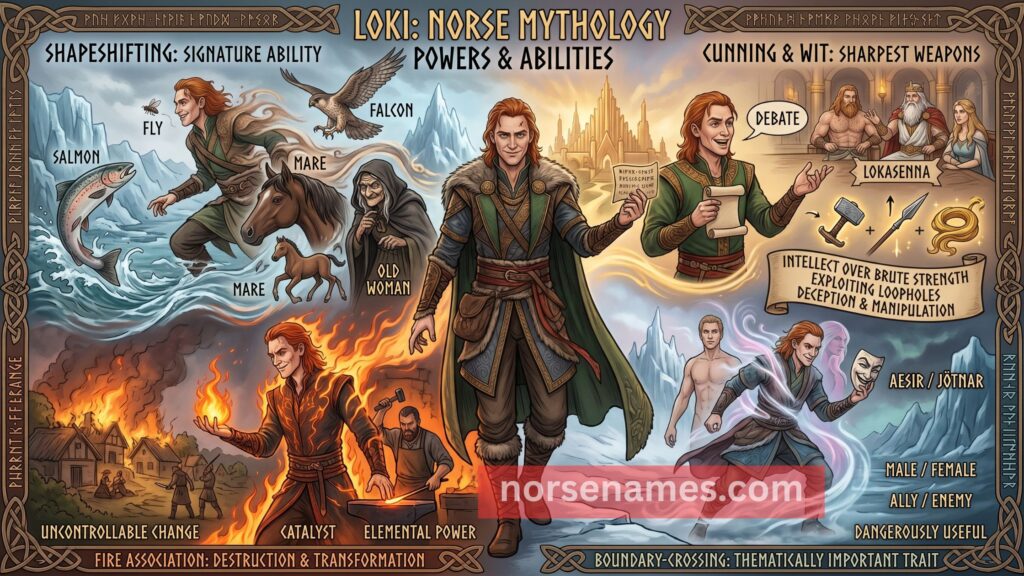
Cunning and wit are arguably his sharpest weapons. Loki talks his way past guardians, manipulates dwarves into crafting treasures, and verbally dismantles an entire hall of gods during the flyting contest known as the Lokasenna. His intelligence is less about wisdom — that’s Odin’s domain — and more about exploiting loopholes, technicalities, and divine weakness.
Fire association runs through much of his symbolism, linking him to destruction, transformation, and uncontrollable change.
Boundary-crossing might be his most thematically important trait. Loki moves between Aesir and jötnar, male and female forms, ally and enemy, mortal cunning and divine power. He exists in the spaces between categories, which is precisely why he’s so dangerous and so useful to the other gods at the same time.
Loki Norse Mythology Myths Explained
Loki’s myths form some of the richest storytelling in Loki Norse mythology, drawn primarily from the Poetic Edda and the Prose Edda, and they reveal a character who evolves from clever troublemaker into something far darker.
The Wall of Asgard. A builder offers to construct a fortification around Asgard in exchange for the goddess Freya, the sun, and the moon — provided he finishes within one winter, aided only by his stallion Svaðilfari. When it becomes clear the builder will succeed, the gods blame Loki for agreeing to the terms. Loki transforms into a mare to lure the stallion away, the deadline is missed, and nine months later, Loki gives birth to Sleipnir.
The Theft of Sif’s Hair. In a fit of mischief, Loki cuts off the golden hair of Thor’s wife, Sif. To avoid Thor’s wrath, he commissions dwarven smiths to craft her new hair spun from gold, which inadvertently leads to a wager between dwarf brothers that produces several of the gods’ greatest treasures — including Thor’s hammer, Mjölnir, and Odin’s spear, Gungnir.
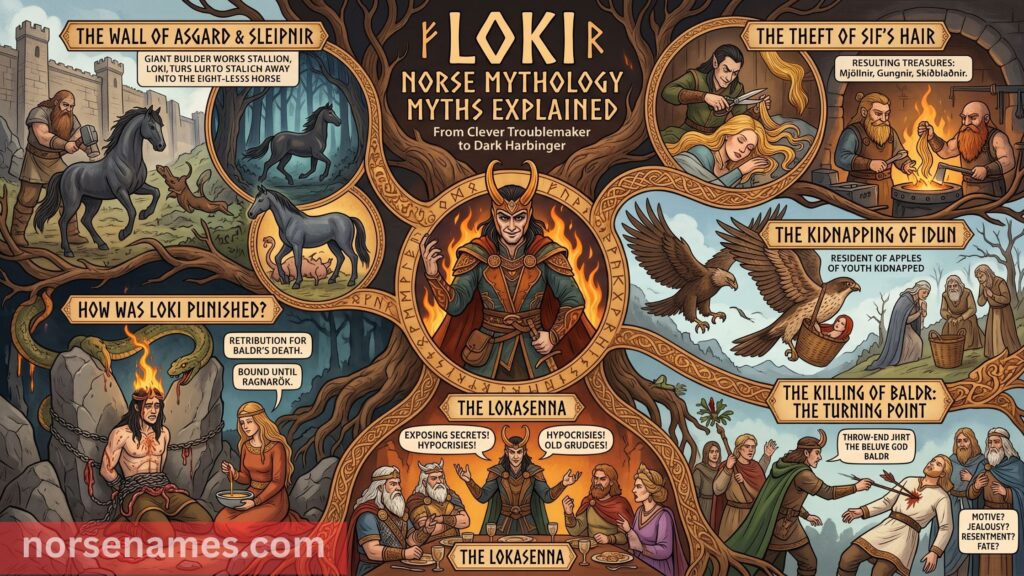
The Kidnapping of Idun. Loki is coerced into delivering the goddess Idun, keeper of the apples of youth, into the hands of a giant. Without her apples, the gods begin to age and wither. Loki is forced to rescue her, transforming into a falcon to retrieve Idun and fly her back to Asgard just ahead of pursuit.
Why did Loki kill Baldr? This is the turning point in his story. After learning that the beloved god Baldr is invulnerable to all things except mistletoe, Loki crafts a dart or arrow from the plant and tricks the blind god Höðr into throwing it, killing Baldr instantly. The exact motive is debated — some sources suggest jealousy or resentment, others point to fate itself working through Loki as its instrument. Whatever the cause, this act cannot be undone, and it marks his permanent fall from the gods’ favor.
The Lokasenna. In this poem from the Poetic Edda, Loki crashes a feast among the gods and delivers a scathing, insult-laden tirade against nearly everyone present, exposing secrets, hypocrisies, and old grudges.
How was Loki punished? As retribution for Baldr’s death, the gods capture Loki and bind him to three stones using the entrails of his own son, which transform into unbreakable chains. A serpent is placed above him, dripping venom onto his face, and only Sigyn’s loyal vigil with a bowl eases his suffering. He remains bound until Ragnarök.
Loki Ragnarök and Death
The story of Loki Ragnarök represents the final chapter in the trickster god’s journey. When the end of the world finally arrives, Loki breaks free from the bonds that have held him since Baldr’s death and joins the forces of chaos against the gods, sailing alongside giants and monsters aboard the ship Naglfar.
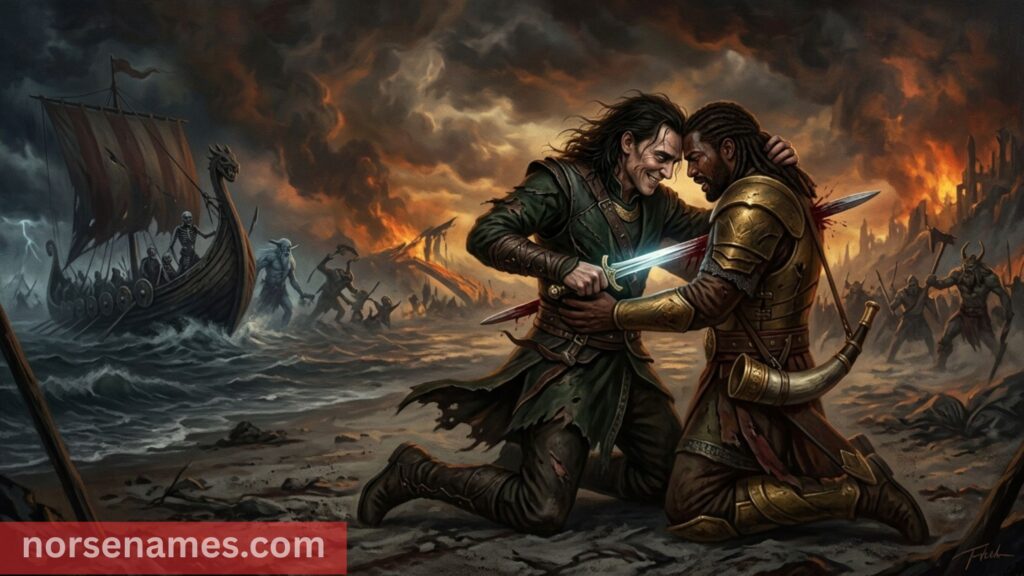
His part in Loki Ragnarök climaxes in a final confrontation with Heimdall, the ever-watchful guardian of Asgard and keeper of the Bifrost. Loki vs. Heimdall is one of the most fitting duels in the entire saga — the trickster who slips through every boundary against the sentinel whose entire purpose is to guard one.
Loki Death in Ragnarök. The Loki death in Ragnarök myth ends with a mutual killing between Loki and Heimdall: the two meet on the battlefield and kill each other, closing their long, fraught relationship in simultaneous destruction. It’s a fittingly symmetrical ending for a god whose entire existence had been defined by crossing the very lines Heimdall was sworn to protect. The Loki Norse mythology death story ends during Ragnarök when Loki and Heimdall kill each other in battle.
Loki Norse Mythology Symbol and Meanings
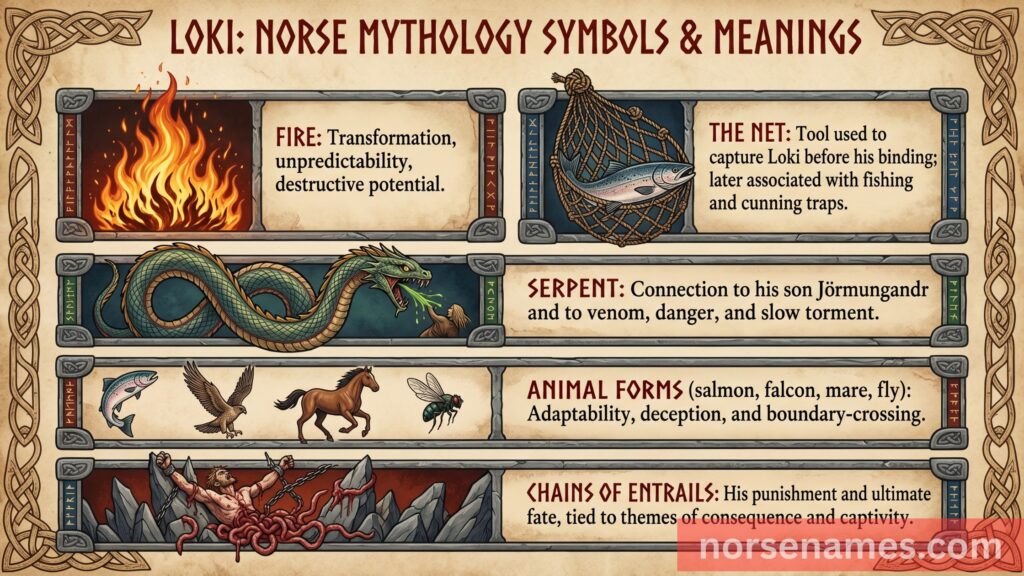
Loki isn’t typically associated with a single iconic weapon the way Thor has Mjölnir, but several symbols recur throughout his stories. Among the most recognizable Loki symbols are fire, serpents, nets, and animal transformations, each tied to a different facet of his character.
| Symbol | Meaning |
|---|---|
| Fire | Transformation, unpredictability, destructive potential |
| The net | Tool used to capture Loki before his binding; later associated with fishing and cunning traps |
| Serpent | Connection to his son Jörmungandr and to venom, danger, and slow torment |
| Animal forms (salmon, falcon, mare, fly) | Adaptability, deception, and boundary-crossing |
| Chains of entrails | His punishment and ultimate fate, tied to themes of consequence and captivity |
Unlike gods tied to specific weapons or sacred sites, Loki’s symbolism is defined by transformation itself. He is less a figure represented by objects and more a figure represented by change.
Influence on Norse Culture
Within Viking culture, Loki occupied a complicated space. He doesn’t appear to have been widely worshipped the way Odin, Thor, or Freya were — there’s little archaeological evidence of temples or cult practices dedicated to him. Instead, his presence in Viking mythology was primarily literary and oral, preserved through skaldic poetry, the Poetic Edda, and Snorri Sturluson’s Prose Edda.
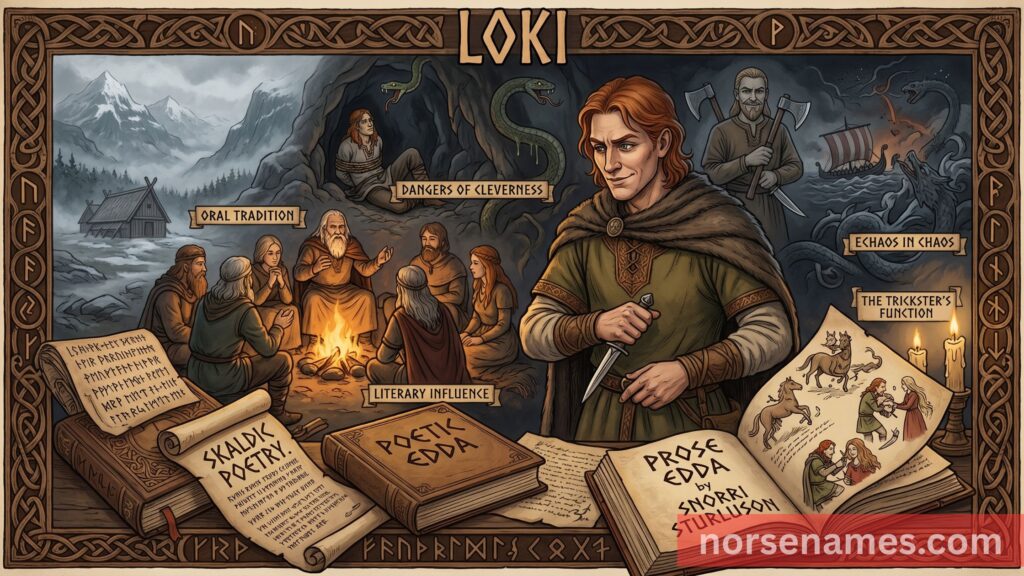
That said, Loki’s presence in Norse legends served an important cultural function. He gave Viking-era storytellers a vehicle for exploring themes that more straightforwardly heroic gods couldn’t carry: the dangers of cleverness without conscience, the thin line between loyalty and betrayal, and the unsettling idea that chaos is woven into the cosmos rather than something that can simply be defeated.
Some scholars studying broader Scandinavian mythology have also connected Loki to wider Germanic and Indo-European trickster traditions, suggesting his role as cosmic disruptor reflects ideas about change, fate, and the inevitability of endings.
Modern Interpretations
Loki’s leap into modern pop culture is one of the most dramatic examples of Norse mythology reshaping contemporary fantasy and gaming. Marvel’s cinematic portrayal — charismatic, tragic, endlessly scheming — introduced millions of people to the character, though it diverges significantly from the source material, particularly in softening or reframing his more monstrous mythological role.
Video games have embraced him with similar enthusiasm. Titles set in Norse-inspired worlds frequently feature Loki as a major character, quest-giver, or antagonist, drawing on his reputation as the Nine Realms’ most unpredictable figure. Tabletop RPGs and fantasy fiction borrow heavily from his archetype too: the charming rogue, the morally gray ally, the god who might save you or doom you depending on his mood.
What modern interpretations consistently get right is the emotional core of the character — someone caught between worlds, never fully trusted, never fully accepted, brilliant enough to outmaneuver gods but never quite powerful enough to belong among them.
Loki Norse Mythology Names
For writers and worldbuilders drawing on Loki Norse mythology for character inspiration, there’s a rich vein of names worth exploring. Several Loki Norse mythology names appear throughout Old Norse texts, including Loptr and Hveðrungr, alongside fantasy-inspired variations that echo his fire, cunning, and shapeshifting nature.
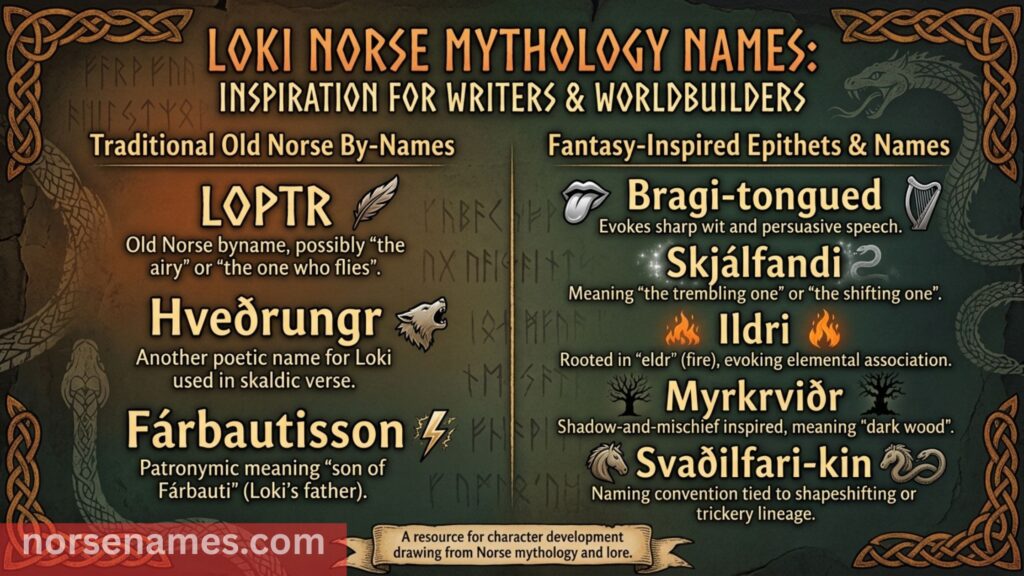
- Loptr — an Old Norse byname for Loki, possibly meaning “the airy” or “the one who flies”
- Hveðrungr — another of Loki’s poetic names, used in skaldic verse
- Bragi-tongued — fantasy-style epithet evoking sharp wit and persuasive speech
- Fárbautisson — patronymic-style name meaning “son of Fárbauti,” Loki’s father
- Skjálfandi — invented fantasy name suggesting “the trembling one” or “the shifting one”
- Ildri — fantasy name rooted in “eldr” (fire), evoking Loki’s elemental association
- Myrkrviðr — a shadow-and-mischief inspired fantasy name meaning roughly “dark wood”
- Svaðilfari-kin — naming convention for characters tied to shapeshifting or trickery lineage
These work well as direct names, surnames, or epithets for tricksters, shapeshifters, and morally ambiguous characters in fantasy fiction, tabletop campaigns, or original Norse-inspired worldbuilding projects.
FAQ’s About Loki Norse Mythology
Who is Loki in Norse mythology? Loki is a trickster figure associated with mischief, shapeshifting, and chaos. Born a giant but raised among the Aesir gods, he’s both an ally and an eventual enemy of Asgard, playing a pivotal role in events leading up to Ragnarök.
Is Loki a god or a giant? Both, in a sense. He’s biologically a jötunn, born to giant parents, but he’s accepted into the ranks of the Aesir and treated as one of their own — at least until his actions during the death of Baldr permanently break that trust.
Why did Loki kill Baldr? Sources disagree on the exact motive, but Loki engineers Baldr’s death using a mistletoe dart, tricking the blind god Höðr into throwing it. Some accounts suggest jealousy or resentment; others frame it as fate working through him.
How was Loki punished? The gods bind him to three stones with the entrails of his own son, which turn into unbreakable chains, and place a venom-dripping serpent above his head as torment until Ragnarök.
What are Loki’s powers? Shapeshifting, trickery, deception, sharp intelligence, and the ability to talk his way into — and out of — almost any situation in the Nine Realms.
Who are Loki’s children? Fenrir, Jörmungandr, Hel, Narfi, Váli, and Sleipnir — though Sleipnir is unique in that Loki gave birth to him after shapeshifting into a mare.
Who is Loki’s wife? Sigyn. She remains loyal to him even after his binding, famously catching the venom dripped onto his face by a serpent as part of his punishment.
How does Loki die? During Ragnarök, Loki and Heimdall kill each other in single combat, bringing their long-running opposition to a simultaneous end.
Conclusion
Loki Norse mythology offers something rare: a god who refuses to be simplified. He’s a father of monsters and a maker of treasures, a blood-brother and a betrayer, a clown at the feast and the harbinger of the world’s end. That refusal to sit still — morally, physically, or narratively — is exactly why he remains one of the most studied and most borrowed figures in Loki Norse mythology and the broader canon of Norse legends today.
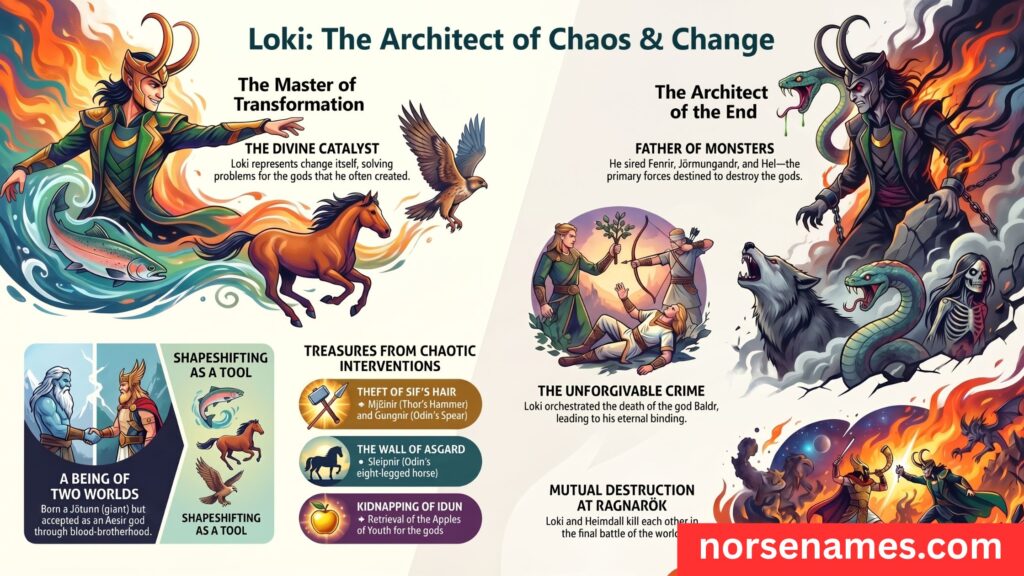
For fantasy writers, game designers, and mythology enthusiasts alike, Loki proves that the most compelling characters aren’t the ones who choose a side, but the ones who make you question whether sides ever really mattered at all.